
Astilbe
In this, the second in the series of posts on Carole's garden near Uxbridge Ontario, we will take a closer look at the pond and shade gardens.

When Carole and her husband Frank first bought their home, there was nothing more than a natural stream and a low lying, boggy area in the space where the pond is currently located.

Here is a similar view of the pond area as it looks in now. Quite the change!


Carole's husband is not a gardener, but Carole tells me that one of the many ways in which Frank helps out is to pull her around in a dingy, so she can do some pond gardening.

Along the perimeter of the pond there are moisture loving plants like this pink Astilbe and
this purple Japanese Iris (below).

A Japanese Iris with blue Veronica in behind and a repeat flowering daylily in the foreground.
Japanese Irises: Japanese Irises need at least 6 hours of sunlight to bloom properly. They also require ample moisture especially up until bloom time. They will also be much healthier plants if the soil is moist throughout the summer. (A heavy mulch of 2-3 inches can help to conserve moisture.) They like a slightly acidic soil that is a rich in organic matter.

This is a "Before" photograph of what was to become the shade garden. Carole tells me:
"I put a shade garden here because there was a grouping of fairly large birch trees, however when we added the top soil to prepare the bed and raise the grade we killed all but one tree. We knew that this would probably happen, but we needed to get the low lying area to drain properly. Luckily our neighbour had a number of young birch saplings which they gave to us. We replanted the birch grove and it has grown up nicely."

Here is a similar view of the shade garden in present day. Again an amazing transformation!

On the perimeter of the birch trees is this part-shade bed where there are Heuchera, Hosta, Astrantia, Astilbe, Solomon's Seal, Lady's Mantle and Sedge grass.


In the shade garden proper, you will see that Carole has done a really nice job of mixing
leaf shape, size, color and texure.


The shade garden is not without flowers. Carole relates that:
" I like to use etherial plants and bulbs under my hostas so I get an early bloom before the leaves come on the trees and the hostas cover them up. I use dwarf Daffodils, Scilla, Virginia Blue Bells, Sanguinaria canadiensis or Bloodroot (both the native and double varieties). I also mix in Primulas, Pulmonarias, Brunnera and Disporum or Fairy bells. I like to let these naturalize through the garden."

Single and Double Bloodroot or Sanguinaria canadiensis and Sanguinaria canadiensis 'multiplex' respectively: The single form of Bloodroot has 8-16 petals with a golden centre. The double form resembles a waterlily flower. Both have large, round leaves with deep lobes. Bloodroot gets its name from its rhizomes which contain a red juice. They like shade to part-shade and moist soil that is rich in organic matter. In April or early May flower buds appear wrapped protectively inside the leaf, which open as the flower emerges.

In addition, Carole says that:
" I grow all kinds of Hosta, Ligularias, Mudenkia, Percicaria, Astilbe, Snakeroot and daylilies on the fringes of the shade garden."

Throughout the shade garden Carole has added large bottles and oversized glass vases.

As I am sure you can imagine maintaining a garden as large as Carole's must take a lot of work. I asked her if she has any strategies to make the workload easier. Carole replied that in fall:
"I cut all my plants back in fall to 3-4" and clear out any weeds that may have escaped me through the season. This is also when I put down any manure mulch the garden needs.
I also do any rearranging or dividing in fall. It is nice and cool and there are no bugs!
I like to blow the leaves off my shade garden in fall, shred them and put them back around the around the plants. I know that this is extra work, but the leaves break down faster. The shredding also prevents smaller bulbs from being "drowned out", there is less chance of mould developing and it looks nicer."

In spring, Carole advises that:
"I start in the garden as soon as I can. I use a hand trowel, scissors and a long handled claw. I hand dig any perennial weeds (dandelions, grass etc.) that may have come up. Any annual weeds I just claw over. If you do this once a week or at least every two weeks for 4-6 weeks, you will find you have eliminated most of your weeds. You have to be relentless or the weeds can take over.
After that you spend your time deadheading. I do not let my plants go to seed as it makes for a very messy garden and it is harder to keep your plants separated."

I asked Carole for one final bit of advice for those gardeners who still struggle with the reality of gardening in shade. She replied:
"My best advice is to experiment with different plants as not all "shade" is the same and the garden is ever changing."
I have saved the best for last. In the final post in the series, we will visit what I think is Carole's masterpiece: the backyard garden.
Have a wonderful weekend!


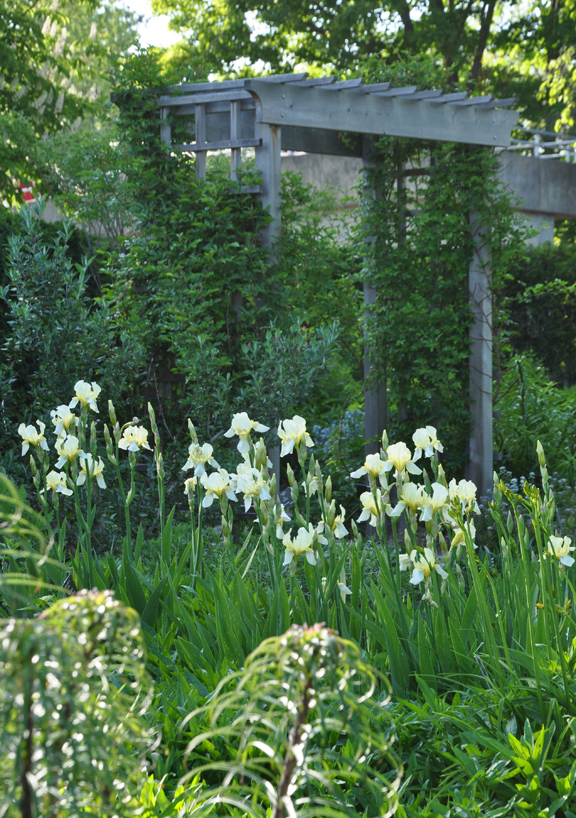


 Royal Botanical Gardens in Hamilton.

 Pink and red peonies + purple and mauve irises. Royal Botanical Gardens in Hamilton.
 Siberian Iris, Geranium sangaineum 'John Elsley' in left foreground and in behind them are magenta- colored Centaurea hypoleuca 'John Coutts'.