Showing posts with label Royal Botanical Gardens. Show all posts

Friday, March 8, 2013

I is for Iris


There was a fresh dusting of snow this morning that just barely covered the dirt-spattered layer of snow beneath it. I don't know about you, but I am sick of winter whites, browns and greys. 

It's time for some color! 

Last summer, I started a garden alphabet that got as far as the letter 'h'. Today, I am going to pick up where I left off. In this post, the letter 'i' represents one of the most beautiful flowers a garden can possibly offer: the iris.


The iris came by its name through Greek mythology. According to legend Iride or Iris, the messenger of the Gods, scattered fields full of irises, with all the colors of the rainbow, as she passed between heaven and earth.

Iris in my back garden.

In early spring of last year, I dug up all the bearded irises in the front garden and moved them to a new and less crowded spot in the back garden. Though I knew I would pay for this upheaval by enjoying few if any flowers, it was a chore that just had to be done. 

Root rot had taken its toll on the crowded and neglected rhizomes in the front garden. It is hard to imagine anything more putrid smelling than mushy rhizomes infected with this fungal disease. I cut away all the infected parts of the plants and kept only the best rhizomes. (I have read that you can also disinfect the wounds with a solution of 1 part bleach to 9 parts water.)

In previous years, I have also had problems with Iris Borer. Borers begin their lives as eggs laid on garden debris in fall. They hatch into one inch sized larvae that that chew into the leaves and then eat their way down to the rhizomes. Borer damage is often seen as notched wounds or slimy, wet-looking areas on the leaves. To deal with this pest, I have learned to try to keep the rhizomes clear of any debris. I also try to catch the larvae in the spear-shaped foliage by removing any slimy leaves.


As well the bearded irises, I also have a few varieties of Siberian Irises. 

In the backyard, Siberian irises form good sized clumps of grassy foliage and put on a fine display of butterfly-like flowers in June. They get morning and early afternoon sun.


A few of my Siberean irses have become overgrown and this spring I will have to look forward to 
the Herculean task of lifting the heavy clumps and dividing them.

I am sure some of you must be asking if irises are worth all the trouble. Absolutely!


If I had to choose between growing a Siberian Iris and a Japanese Iris, I would choose a Japanese Iris. I think the flowers are bigger and more impressive.

Japanese Irises like a fair bit of moisture until they finish flowering. My garden is fairly dry, so I have compensated for this by giving my white irises a spot in the garden with dappled afternoon sunlight.


Here are some ideas for planting irises that I picked up from my visits to the Royal Botanical Gardens last spring:
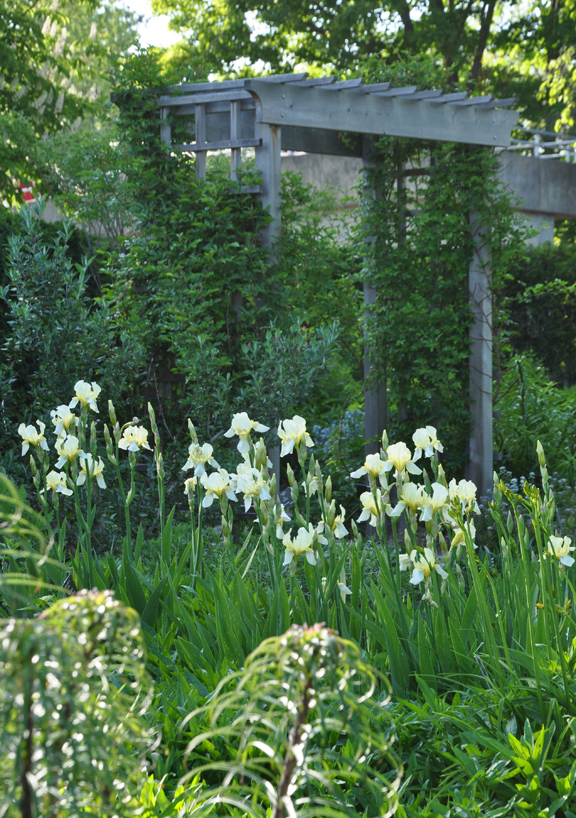

Plant irises in drifts for maximum effect. 


A single plant just doesn't cut it!

(Generally bearded irises flower for 3 or 4 weeks. You can extend the flowering season however, 
by selecting early and late flowering varieties.)


Try mixing a two colors together...


or two different shades of the same color....

Royal Botanical Gardens in Hamilton.

or max-out on one color.

Royal Botanical Gardens in Hamilton.

Consider mixing cool blues and mauves with yellow irises.


Think about mixing a few different varieties of irises of the same color together.

Royal Botanical Gardens in Hamilton.

You also might want to think about using irises in combination with other flowers. 
Here we have a pale yellow iris + blue Baptisia. 

Pink and red peonies + purple and mauve irises. Royal Botanical Gardens in Hamilton.

Siberian Iris, Geranium sangaineum 'John Elsley' in left foreground and in behind them are magenta- colored Centaurea hypoleuca 'John Coutts'. Royal Botanical Gardens in Hamilton.


Have a great weekend everyone!

Wednesday, May 30, 2012

Peonies to Die For!

Herbaceous Peony, Paeonia 'Ambience'

Even before most roses dazzle us with their flowers, there are peonies. With their big, showy blossoms, and if your lucky, a soft hint of fragrance, peonies have a definite stage presence in early summer.

If only they lasted longer! My peonies last a week, maybe a week and a half. Then, they are green into late fall. 

Here in Ontario, peonies are just starting to come in flower and it is time to get out there and admire these scene stealers while you still can.

With that in mind, I popped into the Royal Botanical Gardens on Saturday to take in the show. 

And it did not disappoint. Let's take a look together:

Herbaceous Peony, Paeonia 'Mr. Thim'

If you are going to go with ruffled and frilly blooms, you might as well consider choosing pink! There were lots of pretty pink peonies to choose from.

Herbaceous Peony, Paeonia 'Cora Stubbs'

Herbaceous Peony, Paeonia 'Coral Tide'


Looking one way.


And another.

I wanted to show you a few overall shots. Massed pink, white and red flowers were statement making. Note that in the first image, the blue and purple irises make a nice backdrop.

Also interesting to note that none of these peonies were staked. I am not sure what the field of flowers would look like after a rain storm, but in the bright light of a sunny day, the flowers were holding their own.


I hope you will forgive me for digressing for just a moment. One of my latest amusements is to photograph other photographers.

I thought that this couple were charming.


Ladies don't we all secretly wish we all could bring a man to his knees in such rapt admiration! 

Too often, we think of the early days of a romance, when we think of love. 

This is not a young couple, yet he obviously adores her. I find that truly romantic.

I have another reason for showing this shot here. While I find the limited mix of peony colors above pleasing, I find this unedited mix of iris colors unattractive. There are just too many colors here and not all of them work together. 

What do you think?

Herbaceous Peony, Paeonia 'Ambience'

Herbaceous Peony, Paeonia 'Coral Supreme'

These shots came out a bit pinker than they should be. Perhaps it was the blazing sun on this particular afternoon. Coral describes them perfectly! 'Coral Supreme' are definitely going on my wish list!

Herbaceous Peony, Paeonia 'Coral Supreme' up close

Herbaceous Peony, Paeonia 'Do Tell'

Herbaceous Peony, Paeonia 'Honey Gold'


Red is so tough to photograph and is well beyond my skill set, but know that there were some beautiful reds to be seen at the Royal Botanical Gardens.

Herbaceous Peony, Paeonia 'Red Imp' 

Herbaceous Peony, Paeonia 'Red Imp' up close

Unidentified Tree Peony

Tree Peony, Paeonia suffruticosa 'Hakuoo'

I took a number of shots of tree peonies, but for whatever reason the plants were not as carefully identified as the other peonies at the RBG. I hate to tempt you too many pictures that are unidentified! Tree peonies are larger and taller than standard herbaceous peonies. These plants were definitely staked.

My favourite was this white Tree Peony called 'Hakuoo'. Gorgeous! The flower petals make me think of ocean waves.

Tuesday, November 15, 2011

Texture in the Garden


Donna of Garden Walk, Garden Talk has started a regular Word for Wednesday linking party, which is an "exploration of words through pictures, where a word relates to the story in photos." This week Donna has suggested a pairing of two words: "texture and pattern."

I found this week's theme challenging, not because it was a difficult pair of words to define in pictures, but rather because it was way too easy. I simply had too many images! In the end, I decided to divide Donna's theme over two posts. Today, I will focus in on texture.

Texture can be defined as the tactile quality of a surface. 

Textures can vary widely. They can be soft, like the fuzz of a ripe summer peach.


They can be slippery and smooth, like the surface of an icicle in winter.


And they can also be sharp and foreboding, like these frost "thorns" on a branch in the winter.

The garden of Heather Bradley, Mississauga Ontario

In the garden, texture appeals as much to our eyes, as to our sense of touch.


Garden textures have many close friends. Repetition is one of them. A repeated planting is textural.

The green surface of a pond at Lost Horizon Nursery, Acton Ontario

Private garden, Burlington, Ontario

Shape and pattern are also texture's best friends. Here, the repeated shape of these lily pads and their random pattern on the surface of the water is textural.

The soft petals of this spring Ranunculus has the delicate texture of a taffeta party dress. 

Soft textures invite us to touch them. Fine, delicate and smooth are a few of the adjectives we most commonly use to describe soft textures.


The delicate beauty of Annual Fountain Grass in a Brampton Public Park

Perennial Fountain Grass, Brampton Public Park

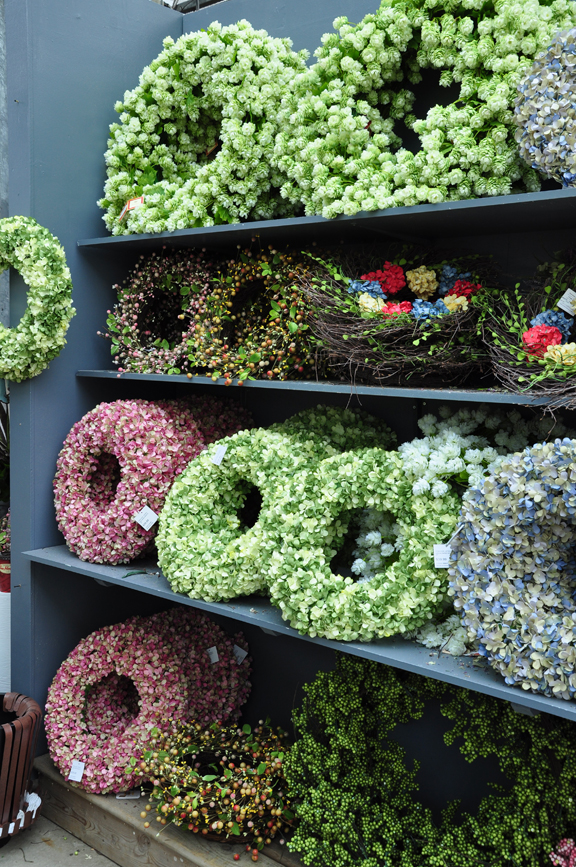
Soft textured wreaths in a local nursery.


Soft pink astilbe in the Spargette's private garden in Brampton, Ontario. (I wish my Astilbe looked this good! Astible likes to be kept fairly moist. It also prefers morning sun and afternoon shade. Mine gets too much shade and not enough water.) 

The texture of fall grasses can be both soft and feathery. Colin Gosden's garden, Mississauga, Ontario.


Bed and Breakfast Inn in Niagara-on-the-Lake, Ontario

In a garden setting, stone textures can be ever bit as aesthetically pleasing as soft textured surfaces.


Coarse textures like stone and weathered wood may be rough and unyielding, but still have uses in the garden.

Soft petalled blooms look even more delicate when contrasted with the rugged, weather-beaten surface of stone.


Cupid's Dart in amongst stones and pebbles in Colin Gosden's garden, Mississauga, Ontario.

Finally, leaves can have textural surfaces all of their own.

New to my garden this summer is Calamintha, Calamintha grandiflora variegata.

Heuchera in the Spargette's private garden in Brampton, Ontario

Heuchera ' Midas Touch', Humber Nursery, Toronto, Ontario. 

Fall hosta in my own garden.

Niagara Botanical Gardens, Niagara Ontario.

In the garden, texture works so closely with its best friends, color, shape, pattern and repetition that it almost becomes indistinguishable. 


But trust me, texture is right in there, quietly performing its magic.

If you are brave enough to endure another picture marathon, I'll put my take on "Pattern" up on Friday.