Showing posts with label Astilbe. Show all posts

Friday, January 15, 2016

A Bird-Friendly Shade Garden


One of the biggest changes that mark the shift from winter into spring is the emergence of green leaves. Foliage never looks so fresh and vibrant as it does in the spring! Today I want to share a bird-friendly garden where foliage is the star.

May

Overall, the palette of this garden is quiet and restrained. What stands out for me is not the layout: it's basically a green lawn with perimeter flowerbeds. This approach to design is so commonly employed, it is almost standard issue.

What is worthy of note is the planting.

June
Green is the pervasive color here.

At first consideration, this may seem like a simplistic use of color, but there is a subtle sophistication at work here that makes the appearance of fresh green leaves seem all the more dramatic each spring.


June

The different shades of the green play off one another, and even though the flowerbed is largely a single color, the planting as a whole, reads as quietly "colorful".


In this little corner, you can see a great example of the blend of different greens. 

1 The bright green in the top left corner is fresh growth on a Yew. 2 In the center is a blue-green Actaea pachypoda 'Misty Blue'. In the lower right-hand corner is the ferny foliage of an Astilbe. 4 Dogwood tree 5Japanese Forrest Grass, Hakonechloa 6. Solomon Seal, Polygonatum


Actaea pachypoda 'Misty Blue' has blue-green foliage and white flowers in spring. In summer the flowers become white berries on contrasting red stems. This plant prefers sandy or clay soil with average to moist growing conditions. Height:60-90 cm (23-35 inches) , Spread: 60-90 cm (23-35 inches). USDA Zones: 3-9.

Japanese Forest Grass, Hakonechloa and Solomon Seal, Polygonatum

June

The combination of plants is quite exquisite here.

The creamy-white variegation of the hostas, the grey-green leaves of the Japanese Maple, and the sharp chartreuse of the Pagoda Dogwood all work together to lift and lighten this area of the garden. 


 1. Yew 2. Golden Shadows Pagoda Dogwood 3. May Apple, Podophyllum peltatum which is a native plant. 4. Solomon Seal, Polygonatum 5. 'Butterfly' Japanese Maple 6. Astilbe 7. Astilbe 8. Astilbe


Golden Shadows Pagoda Dogwood 

May

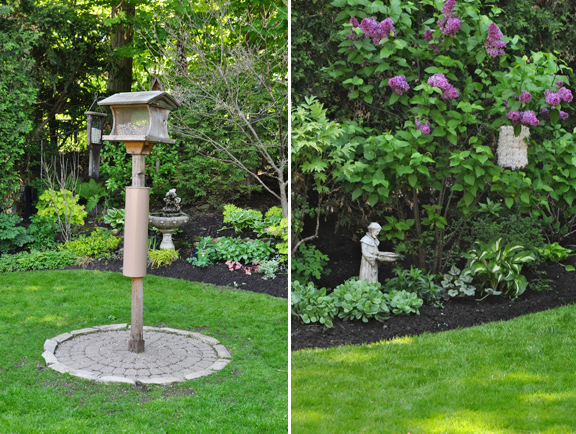
This is a bird-friendly garden. In clear view of the backyard patio is a squirrel-proof bird feeder. 

The homeowners have added a circle of bricks at the base of the feeder that is both decorative and practical. Not only does it mean that fallen seed is less likely to sprout in the lawn, but it also makes cleaning up any stray birdseed easy to do with a broom.

A bird feeder like this may just turn out to be one of my first spring projects!


Birds are also given easy access to nesting materials, which hang in a number of locations.


1. Magnolia tree 2. Astilbe 3. Hosta 4. Lungwort, Pulmonaria with spotted grey-green foliage. 5. Big Root Geranium, 'Geranium macrorrhizum'

Bigroot Geranium, 'Geranium macrorrhizum'

June

What makes this section stand out is the careful consideration of each plant's attributes. The Astilbe in the foreground is quite glossy and shiny, while the larger leaves of the hostas are more matt.


Also adding complexity to the design is the combination of leaf shapes and sizes. In this little plant grouping, there are two Hostas and two Astilbes. The Astilbe in the upper left corner is fern-like, while the one in the lower half of the picture is so dense, it is almost moss-like.

June


May


Bleeding Heart, Dicentra spectabilis 'Gold Heart' has amazing chartreuse foliage and pink heart-shaped flowers in spring. Normal, sandy or clay soils all work for this plant. It likes average to moist growing conditions. The foliage will start to fade and go dormant in late summer. Part to full shade. Height: 60-90 cm (23-35 inches), Spread: 60-90 cm (23-35 inches). USDA Zones: 2-9.


As any experienced gardener will tell you, flowers come and go. A garden where foliage is given a starring role is always going to look terrific.

Bookmark this post with a PIN.

Saturday, September 13, 2014

A Secret Garden: Part 2, The Shade Garden and Pond

 
Astilbe

In this, the second in the series of posts on Carole's garden near Uxbridge Ontario, we will take a closer look at the pond and shade gardens.


When Carole and her husband Frank first bought their home, there was nothing more than a natural stream and a low lying, boggy area in the space where the pond is currently located.


Here is a similar view of the pond area as it looks in now. Quite the change!


Carole's husband is not a gardener, but Carole tells me that one of the many ways in which Frank  helps out is to pull her around in a dingy, so she can do some pond gardening.


Along the perimeter of the pond there are moisture loving plants like this pink Astilbe and 
this purple Japanese Iris (below).

A Japanese Iris with blue Veronica in behind and a repeat flowering daylily in the foreground.

Japanese Irises: Japanese Irises need at least 6 hours of sunlight to bloom properly. They also require ample moisture especially up until bloom time. They will also be much healthier plants if the soil is moist throughout the summer. (A heavy mulch of 2-3 inches can help to conserve moisture.) They like a slightly acidic soil that is a rich in organic matter.


This is a "Before" photograph of what was to become the shade garden. Carole tells me:

"I put a shade garden here because there was a grouping of fairly large birch trees, however when we added the top soil to prepare the bed and raise the grade we killed all but one tree. We knew that this would probably happen, but we needed to get the low lying area to drain properly. Luckily our neighbour had a number of young birch saplings which they gave to us. We replanted the birch grove and it has grown up nicely."


Here is a similar view of the shade garden in present day. Again an amazing transformation!


On the perimeter of the birch trees is this part-shade bed where there are Heuchera, Hosta, Astrantia, Astilbe, Solomon's Seal, Lady's Mantle and Sedge grass.


In the shade garden proper, you will see that Carole has done a really nice job of mixing 
leaf shape, size, color and texure.


The shade garden is not without flowers. Carole relates that:

" I like to use etherial plants and bulbs under my hostas so I get an early bloom before the leaves come on the trees and the hostas cover them up. I use dwarf Daffodils, Scilla, Virginia Blue Bells, Sanguinaria canadiensis or Bloodroot (both the native and double varieties). I also mix in Primulas, Pulmonarias, Brunnera and Disporum or Fairy bells. I like to let these naturalize through the garden."


Single and Double Bloodroot or Sanguinaria canadiensis and Sanguinaria canadiensis 'multiplex' respectively: The single form of Bloodroot has 8-16 petals with a golden centre. The double form resembles a waterlily flower. Both have large, round leaves with deep lobes. Bloodroot gets its name from its rhizomes which contain a red juice. They like shade to part-shade and moist soil that is rich in organic matter. In April or early May flower buds appear wrapped protectively inside the leaf, which open as the flower emerges.


In addition, Carole says that:

" I grow all kinds of Hosta, Ligularias, Mudenkia, Percicaria, Astilbe, Snakeroot and daylilies on the fringes of the shade garden."


Throughout the shade garden Carole has added large bottles and oversized glass vases.


As I am sure you can imagine maintaining a garden as large as Carole's must take a lot of work. I asked her if she has any strategies to make the workload easier. Carole replied that in fall:

"I cut all my plants back in fall to 3-4" and clear out any weeds that may have escaped me through the season. This is also when I put down any manure mulch the garden needs.

I also do any rearranging or dividing in fall. It is nice and cool and there are no bugs!

I like to blow the leaves off my shade garden in fall, shred them and put them back around the around the plants. I know that this is extra work, but the leaves break down faster. The shredding also prevents smaller bulbs from being "drowned out", there is less chance of mould developing and it looks nicer."


In spring, Carole advises that:

"I start in the garden as soon as I can. I use a hand trowel, scissors and a long handled claw. I hand dig any perennial weeds (dandelions, grass etc.) that may have come up. Any annual weeds I just claw over. If you do this once a week or at least every two weeks for 4-6 weeks, you will find you have eliminated most of your weeds. You have to be relentless or the weeds can take over.

After that you spend your time deadheading. I do not let my plants go to seed as it makes for a very messy garden and it is harder to keep your plants separated."


I asked Carole for one final bit of advice for those gardeners who still struggle with the reality of gardening in shade. She replied:

"My best advice is to experiment with different plants as not all "shade" is the same and the garden is ever changing."

I have saved the best for last. In the final post in the series, we will visit what I think is Carole's masterpiece: the backyard garden.

Have a wonderful weekend!

Monday, March 18, 2013

A Garden in the Shade (Part 2)


In my last post, we finished off at the entrance to the one sunny pocket in the backyard garden. 

Let's head under the arbor and look around.


Before we move away to explore the rest of the garden, I wanted to show you this 
pretty, little Japanese birdbath.

I also want to point out the interesting way the gardener has managed to combine rock of different scales both in this bright, sunny corner and in other areas of the garden. 

On the left, she has created a dry stream bed using river rock with a flagstone edging. 

On the right, she has mixed flagstone with pea gravel to create a path. Pea gravel has a nice crunch under foot, but flagstone is easier to walk on. Assorted groundcovers soften and blend the edges of the path into the rest of the plantings.


And speaking of groundcovers...I like Creeping Jenny, but I always stress over its aggressive spread. This gardener obviously does not share my worry, because as you will notice, she has it planted throughout the garden. 

It does make an interesting textural matt under this Japanese Maple doesn't it?


She had this Black Bamboo, Phyllostachys nigra planted in a partially buried pot (initially slow to spread, but be warned, it can also be invasive)

I love the skirt of ornamental grass that hides the pot.


Hakonechloa macra 'Aureola'


Moving to the left, we enter an area of half-shade with dappled sunlight.


Among the flowering plants and shrubs are pink Astilbe and a number of hydrangeas. 

As you can imagine, she waters both frequently!


 In terms of foliage plants, the homeowner has planted a variety of hosta, heuchera and variegated Jacob's Ladder (see lower right corner two photos back). 

There are also Ostrich Ferns toward the back of this flowerbed.

In the far corner of the garden, there are a number of mature trees and full shade conditions. Added to the combination of hosta and heuchera, there is a Japanese Painted Fern, Athyrium niponicum var. pictum on the left. 

I am going to make a wild guess that the perennial on the right is a Heuchera,'Southern Comfort'.


Always pretty for shade: Siberian Bugloss, Brunnera macrophylla, 'Jack Frost'


I thought this was a fun idea. Hanging from the tree branches are several birdcages 
with plant pots inside.


No room for a full-sized pond? Check this out! This pond was no bigger than a bucket. 

I messed up this shot a little and missed the last word expressed in the sentiment on the 
little pebbles in the foreground. 

The rocks say, "Hello, have a nice day!" I pass that sentiment on to you.