
There was a fresh dusting of snow this morning that just barely covered the dirt-spattered layer of snow beneath it. I don't know about you, but I am sick of winter whites, browns and greys.
It's time for some color!
Last summer, I started a garden alphabet that got as far as the letter 'h'. Today, I am going to pick up where I left off. In this post, the letter 'i' represents one of the most beautiful flowers a garden can possibly offer: the iris.

The iris came by its name through Greek mythology. According to legend Iride or Iris, the messenger of the Gods, scattered fields full of irises, with all the colors of the rainbow, as she passed between heaven and earth.

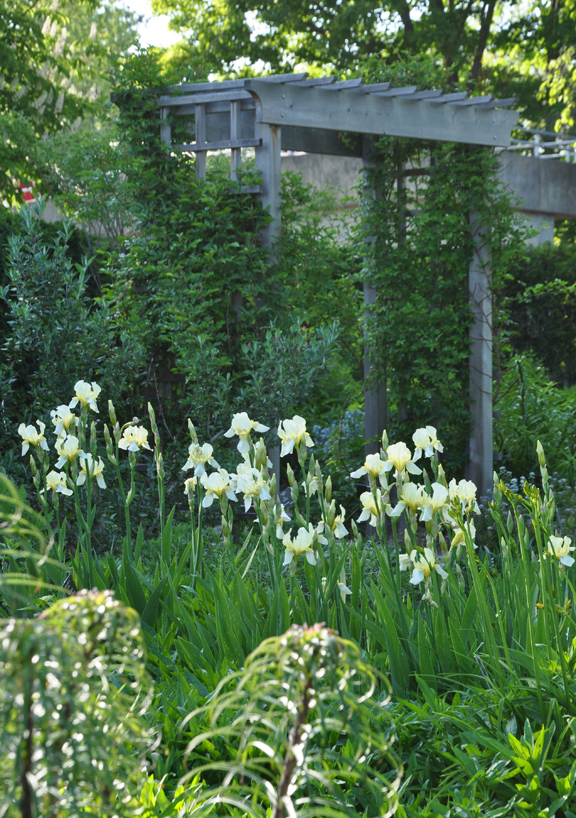
Iris in my back garden.
In early spring of last year, I dug up all the bearded irises in the front garden and moved them to a new and less crowded spot in the back garden. Though I knew I would pay for this upheaval by enjoying few if any flowers, it was a chore that just had to be done.
Root rot had taken its toll on the crowded and neglected rhizomes in the front garden. It is hard to imagine anything more putrid smelling than mushy rhizomes infected with this fungal disease. I cut away all the infected parts of the plants and kept only the best rhizomes. (I have read that you can also disinfect the wounds with a solution of 1 part bleach to 9 parts water.)
In previous years, I have also had problems with Iris Borer. Borers begin their lives as eggs laid on garden debris in fall. They hatch into one inch sized larvae that that chew into the leaves and then eat their way down to the rhizomes. Borer damage is often seen as notched wounds or slimy, wet-looking areas on the leaves. To deal with this pest, I have learned to try to keep the rhizomes clear of any debris. I also try to catch the larvae in the spear-shaped foliage by removing any slimy leaves.

As well the bearded irises, I also have a few varieties of Siberian Irises.
In the backyard, Siberian irises form good sized clumps of grassy foliage and put on a fine display of butterfly-like flowers in June. They get morning and early afternoon sun.

A few of my Siberean irses have become overgrown and this spring I will have to look forward to
the Herculean task of lifting the heavy clumps and dividing them.
I am sure some of you must be asking if irises are worth all the trouble. Absolutely!


If I had to choose between growing a Siberian Iris and a Japanese Iris, I would choose a Japanese Iris. I think the flowers are bigger and more impressive.
Japanese Irises like a fair bit of moisture until they finish flowering. My garden is fairly dry, so I have compensated for this by giving my white irises a spot in the garden with dappled afternoon sunlight.

Here are some ideas for planting irises that I picked up from my visits to the Royal Botanical Gardens last spring:
Plant irises in drifts for maximum effect.

A single plant just doesn't cut it!
(Generally bearded irises flower for 3 or 4 weeks. You can extend the flowering season however,
by selecting early and late flowering varieties.)
by selecting early and late flowering varieties.)

Try mixing a two colors together...

or two different shades of the same color....

Royal Botanical Gardens in Hamilton.
or max-out on one color.
 Royal Botanical Gardens in Hamilton.
Consider mixing cool blues and mauves with yellow irises.

Think about mixing a few different varieties of irises of the same color together.

Royal Botanical Gardens in Hamilton.
You also might want to think about using irises in combination with other flowers.
Here we have a pale yellow iris + blue Baptisia.
 Pink and red peonies + purple and mauve irises. Royal Botanical Gardens in Hamilton.
 Siberian Iris, Geranium sangaineum 'John Elsley' in left foreground and in behind them are magenta- colored Centaurea hypoleuca 'John Coutts'. Royal Botanical Gardens in Hamilton.
Have a great weekend everyone!
My garden alphabet so far: 'A' is for Astilbe, 'B' is for Butterfly, Three 'C's, 'D' is for Delphinium, The Letters 'E' and 'F' , 'G' is for Geranium , 'H' is for Hollyhocks and now 'I' is for Iris


