Showing posts with label Solomon Seal. Show all posts

Thursday, January 28, 2016

Made for the Shade: Solomon's Seal


Nothing causes a novice gardener anxiety like this simple five-letter-word: SHADE. In the coming months, I hope to highlight a few plants that thrive in shade. The first plant I'd like to feature is Solomon's Seal, Polygonatum.


Solomon's Seal is an ugly duckling that quickly transforms into a swan each spring. It emerges from the warming soil with a tight, serpent-like envelope of blue-green foliage.


In the gentle heat of the spring sun, Solomon's Seal thrusts forward out of the ground gradually releasing its secret stash of leaves.

Jamie DeWolf's woodland garden in Mississauga, ON

When fully open, Solomon's Seal's has left its slightly sinister serpentine appearance far behind. 

Solomon's Seal in my friend Donna's garden.


Bright green foliage alternate along the length of elegant stems that curve gently. The lance-shaped leaves remain attractive all summer long and then turn golden in fall. 

Spring raindrops bead on the surface of the leaves and sparkle like diamonds.


White bells tipped with green are a wonderful spring bonus. These flowers don't require any deadheading. They drop to the ground naturally. 

Solomon's Seal likes part-shade to full shade. It also likes organic-rich soil.

Solomon's Seal form a backdrop for hosta in this private Ontario garden.


Jamie DeWolf's garden

I find Solomon's Seal is slow to mature and requires a bit of patience. My garden is perhaps drier than it would like, so my Solomon's Seal hasn't taken off as well as it would have if conditions were more ideal. (It also doesn't help that the dogs flatten it on a regular basis!)

Eventually, Solomon's Seal will grow into a sizeable vase-shaped clump that is perfect for naturalizing in a woodland setting like the one you see above. The good news is that once established clumps of Solomon's Seal are long-lived and are relatively low-maintenance.

Private Garden, Mississauga Ontario

I wanted to show you this front garden because I think the slightly elevated placement of the clump of Solomon's Seal shows it off to perfection. (The Solomon's Seal is up near the corner of the garage in front of an Ornamental grass.)

A closeup of the previous garden

The tiny white flowers of this plant are somewhat understated and so the raised elevation makes it possible to enjoy a better view of them.


When sunlight hits the tiny flowers, they glow like a string of tiny twinkle-lights. Here are three basic varieties:

Polygonatum Biflorum is true Solomon's Seal

Polygonatum odoratum 'Variegatum' is a variegated form that has arching reddish colored stems and foliage that is edged with creamy-white. The fragrance of the flowers is lily-like. Height: 50-60 cm (20-23 inches) Spread: 30-45 cm (12-18 inches)

Giant Solomon's Seal, Polygonatum biflorum var. commutatum is one of the tallest varieties. Blue-black berries follow the flowers. Height: 90-120 cm (35-47 inches) Spread: 60-90 cm (23-35 inches).


Foamflower, Tiarella

Companion plants could include Brunnera, Heuchera, Hosta, Ferns, Hellebores and Foamflowers, and Bleeding Hearts.

Plant type: Perennial

Plant size: Depending on the cultivar this shade lover can range from 60-120 cm (23 -47 inches) and can spread to 60-90 cm (23-35 inches)

Shape: Vase-shaped

Flower: white bell-like flowers tipped with green

Bloom period: Early spring

Leaf color: Deer resistant bright green foliage

Light: Part-shade to shade

Growing Conditions: Moist, rich organic soil

Companion Plants: Hosta, Heuchera, Brunnera, Bleeding Heart, Ferns, Hellebores and Foamflower.

Divide: In early spring or early fall

USDA Zones: 3-9


Solomon's Seal is generally started by transplanting the plant's rhizomes rather than by seed. It may take several years before you would be able to make a plant division for propagation purposes. It's best to divide Solomon's Seal in early spring or early fall. 

All things considered, it's a great plant for a shady garden.

Bookmark this post with a PIN.

Friday, January 15, 2016

A Bird-Friendly Shade Garden


One of the biggest changes that mark the shift from winter into spring is the emergence of green leaves. Foliage never looks so fresh and vibrant as it does in the spring! Today I want to share a bird-friendly garden where foliage is the star.

May

Overall, the palette of this garden is quiet and restrained. What stands out for me is not the layout: it's basically a green lawn with perimeter flowerbeds. This approach to design is so commonly employed, it is almost standard issue.

What is worthy of note is the planting.

June
Green is the pervasive color here.

At first consideration, this may seem like a simplistic use of color, but there is a subtle sophistication at work here that makes the appearance of fresh green leaves seem all the more dramatic each spring.


June

The different shades of the green play off one another, and even though the flowerbed is largely a single color, the planting as a whole, reads as quietly "colorful".


In this little corner, you can see a great example of the blend of different greens. 

1 The bright green in the top left corner is fresh growth on a Yew. 2 In the center is a blue-green Actaea pachypoda 'Misty Blue'. In the lower right-hand corner is the ferny foliage of an Astilbe. 4 Dogwood tree 5Japanese Forrest Grass, Hakonechloa 6. Solomon Seal, Polygonatum


Actaea pachypoda 'Misty Blue' has blue-green foliage and white flowers in spring. In summer the flowers become white berries on contrasting red stems. This plant prefers sandy or clay soil with average to moist growing conditions. Height:60-90 cm (23-35 inches) , Spread: 60-90 cm (23-35 inches). USDA Zones: 3-9.

Japanese Forest Grass, Hakonechloa and Solomon Seal, Polygonatum

June

The combination of plants is quite exquisite here.

The creamy-white variegation of the hostas, the grey-green leaves of the Japanese Maple, and the sharp chartreuse of the Pagoda Dogwood all work together to lift and lighten this area of the garden. 


 1. Yew 2. Golden Shadows Pagoda Dogwood 3. May Apple, Podophyllum peltatum which is a native plant. 4. Solomon Seal, Polygonatum 5. 'Butterfly' Japanese Maple 6. Astilbe 7. Astilbe 8. Astilbe


Golden Shadows Pagoda Dogwood 

May

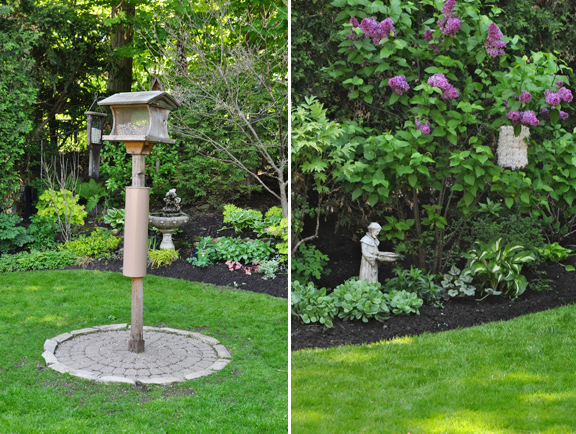
This is a bird-friendly garden. In clear view of the backyard patio is a squirrel-proof bird feeder. 

The homeowners have added a circle of bricks at the base of the feeder that is both decorative and practical. Not only does it mean that fallen seed is less likely to sprout in the lawn, but it also makes cleaning up any stray birdseed easy to do with a broom.

A bird feeder like this may just turn out to be one of my first spring projects!


Birds are also given easy access to nesting materials, which hang in a number of locations.


1. Magnolia tree 2. Astilbe 3. Hosta 4. Lungwort, Pulmonaria with spotted grey-green foliage. 5. Big Root Geranium, 'Geranium macrorrhizum'

Bigroot Geranium, 'Geranium macrorrhizum'

June

What makes this section stand out is the careful consideration of each plant's attributes. The Astilbe in the foreground is quite glossy and shiny, while the larger leaves of the hostas are more matt.


Also adding complexity to the design is the combination of leaf shapes and sizes. In this little plant grouping, there are two Hostas and two Astilbes. The Astilbe in the upper left corner is fern-like, while the one in the lower half of the picture is so dense, it is almost moss-like.

June


May


Bleeding Heart, Dicentra spectabilis 'Gold Heart' has amazing chartreuse foliage and pink heart-shaped flowers in spring. Normal, sandy or clay soils all work for this plant. It likes average to moist growing conditions. The foliage will start to fade and go dormant in late summer. Part to full shade. Height: 60-90 cm (23-35 inches), Spread: 60-90 cm (23-35 inches). USDA Zones: 2-9.


As any experienced gardener will tell you, flowers come and go. A garden where foliage is given a starring role is always going to look terrific.

Bookmark this post with a PIN.