Friday, January 15, 2016

A Bird-Friendly Shade Garden


One of the biggest changes that mark the shift from winter into spring is the emergence of green leaves. Foliage never looks so fresh and vibrant as it does in the spring! Today I want to share a bird-friendly garden where foliage is the star.

May

Overall, the palette of this garden is quiet and restrained. What stands out for me is not the layout: it's basically a green lawn with perimeter flowerbeds. This approach to design is so commonly employed, it is almost standard issue.

What is worthy of note is the planting.

June
Green is the pervasive color here.

At first consideration, this may seem like a simplistic use of color, but there is a subtle sophistication at work here that makes the appearance of fresh green leaves seem all the more dramatic each spring.


June

The different shades of the green play off one another, and even though the flowerbed is largely a single color, the planting as a whole, reads as quietly "colorful".


In this little corner, you can see a great example of the blend of different greens. 

1 The bright green in the top left corner is fresh growth on a Yew. 2 In the center is a blue-green Actaea pachypoda 'Misty Blue'. In the lower right-hand corner is the ferny foliage of an Astilbe. 4 Dogwood tree 5Japanese Forrest Grass, Hakonechloa 6. Solomon Seal, Polygonatum


Actaea pachypoda 'Misty Blue' has blue-green foliage and white flowers in spring. In summer the flowers become white berries on contrasting red stems. This plant prefers sandy or clay soil with average to moist growing conditions. Height:60-90 cm (23-35 inches) , Spread: 60-90 cm (23-35 inches). USDA Zones: 3-9.

Japanese Forest Grass, Hakonechloa and Solomon Seal, Polygonatum

June

The combination of plants is quite exquisite here.

The creamy-white variegation of the hostas, the grey-green leaves of the Japanese Maple, and the sharp chartreuse of the Pagoda Dogwood all work together to lift and lighten this area of the garden. 


 1. Yew 2. Golden Shadows Pagoda Dogwood 3. May Apple, Podophyllum peltatum which is a native plant. 4. Solomon Seal, Polygonatum 5. 'Butterfly' Japanese Maple 6. Astilbe 7. Astilbe 8. Astilbe


Golden Shadows Pagoda Dogwood 

May

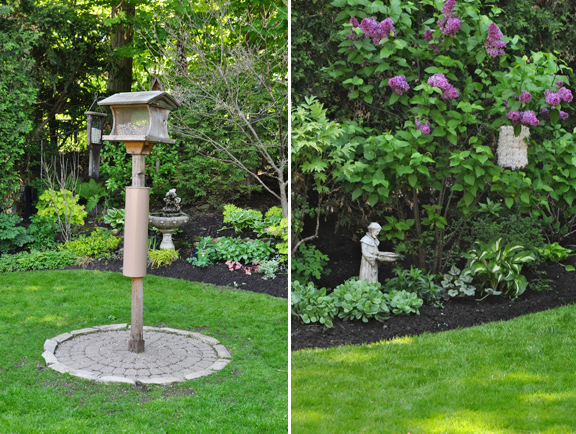
This is a bird-friendly garden. In clear view of the backyard patio is a squirrel-proof bird feeder. 

The homeowners have added a circle of bricks at the base of the feeder that is both decorative and practical. Not only does it mean that fallen seed is less likely to sprout in the lawn, but it also makes cleaning up any stray birdseed easy to do with a broom.

A bird feeder like this may just turn out to be one of my first spring projects!


Birds are also given easy access to nesting materials, which hang in a number of locations.


1. Magnolia tree 2. Astilbe 3. Hosta 4. Lungwort, Pulmonaria with spotted grey-green foliage. 5. Big Root Geranium, 'Geranium macrorrhizum'

Bigroot Geranium, 'Geranium macrorrhizum'

June

What makes this section stand out is the careful consideration of each plant's attributes. The Astilbe in the foreground is quite glossy and shiny, while the larger leaves of the hostas are more matt.


Also adding complexity to the design is the combination of leaf shapes and sizes. In this little plant grouping, there are two Hostas and two Astilbes. The Astilbe in the upper left corner is fern-like, while the one in the lower half of the picture is so dense, it is almost moss-like.

June


May


Bleeding Heart, Dicentra spectabilis 'Gold Heart' has amazing chartreuse foliage and pink heart-shaped flowers in spring. Normal, sandy or clay soils all work for this plant. It likes average to moist growing conditions. The foliage will start to fade and go dormant in late summer. Part to full shade. Height: 60-90 cm (23-35 inches), Spread: 60-90 cm (23-35 inches). USDA Zones: 2-9.


As any experienced gardener will tell you, flowers come and go. A garden where foliage is given a starring role is always going to look terrific.

Bookmark this post with a PIN.

Saturday, January 9, 2016

A Garden filled with Lavender & Heather


Above the sky is a clear cerulean blue. In the near distance the sea shimmers in the August sun like a mirage. In between the two, set on the crest of the rolling Nova Scotian hillside, sits a navy-blue house.

It's the simple, salt-box design of the dark blue house with its crisp white trim that first catches your eye and the garden in front of the house that holds it there. Soft billowy clouds of lavender and heather together–what a striking combination!


Everything is balanced with perfect symmetry: the chimneys, the windows and even clusters of white lilies on either side of the white front door.


The edge of the old windy highway along the Annapolis Basin is narrow, but I can't help but pull the car side of the road and get out for a closer look at the garden. 

Working along the stone wall that borders the driveway is an old man with a wheelbarrow. Used to tourists, he calls out, "Are you lost?"

Lost? No, not lost. 

I tell him it's the garden that has made me stop the car. One of my sisters, who is travelling with me, joins us and the three of us get to chatting.

Amazingly in a matter of minutes, we shift from being complete strangers to three people with something in common. It turns out the grey-haired man was a professor at St Mary's University before he retired. He knows my sister-in-law and her mother, who taught English in the same department. He even knows of my late father-in-law, who taught business and marketing in another of the university's departments.

Sometimes you can travel a very long way only to discover it is a very small world!

The retired English professor tells us that it's his wife who is responsible for the garden. Sadly she is out on a shopping errand and is unable to hear our compliments, but he invites us to wander around and have a look on our own.


A few notes on different Types of Lavender: 

English lavender is Lavandula Angustifolia is considered to be the hardiest of lavenders. Lavender species ( Munstead, Hidcote, Royal Velvet, and Vera) have the most medicinal properties. 

French Lavender or Lavandula Intermedia (Grosso, Provence, Giant Hidcote) are bigger plants whose flowers have a higher camphor content, making them best for perfumes. Unfortunately, they tend to be less hardy. 

Lavendula Stoechas or Spanish or spike lavender must be grown as an annual in northern garden zones such as Ontario.


In the centre of the front garden is a stylized fiddlehead, the handiwork of a local stone carver. Perched on top of the fiddlehead fern is a naive carving of a little bird. In a busier setting the simple, unpretentious carving might be lost, but in this understated garden, it is the perfect focal point.

UPDATE: Donna, a good friend who lives in Nova Scotia, has identified this sculpture as the work of Heather Lawson. You can watch a terrific video about stone carver Heather Lawson here. Here is a link to Heather's website.


A few Tips for Growing Lavender:

Lavender forms rounded mounds of grey-green foliage with white, pink, mauve or blue flowers. Depending on the cultivar you choose, they may range from 30 cm to 60 cm. Planted in a row, compact varieties can form a low hedge, which can be attractive in a formal or knot garden.

Good drainage is absolutely essential when growing lavender. The cold won't do them in, but wet, soggy soil in the winter months will cause them to perish. If you have clay soil, amend it with sand and small pebbles to increase the drainage. Another enemy of lavender is the wind. Plant lavender in a sheltered, sunny spot, where they are protected from harsh winter winds.

Lavenders are quite happy growing in poor soil. In fact, you should avoid overfeeding them with high nitrogen fertilizers or manure.

Once lavender is established, it doesn't need regular watering. Lavender prefers dry conditions and is very drought tolerant.

If you don't prune lavender it can become leggy and will produce fewer flowers. Pruning should be done at least once a year. After your lavender shows signs of new growth in spring, prune it to about 2" above the old wood. Never prune away all of the new growth. Also, if you prune too deeply into the old wood, you run the risk of the plant never coming back.


A link to a supplemental blog post: How to make a Lavender Sachet


I am curious to see the back garden, so we follow the gravel driveway that curves past the side of the house. As we walk, we pass a more informal perennial flowerbed where everything is growing marvellously out-of-control.


The rusty metal obelisks are made by local artist Alexa Jaffurs. I love the whimsy of their slightly wonky shapes.

Alexa replied to the email I sent her, "...we too, have three dogs coexisting with a big garden. I've made a number of small moveable things that help redirect doggish energy. We also have had to move plants, bow-wowing to the inevitable."

Here is a link to Alex's website.

Coneflowers, Echinacea

Globe Thistles, Echinops ritro

Globe Thistles, Echinops ritro is a great mid-to-late summer flower. Don't be put off by the fact that its a thistle. I have them in my own garden and they are a well-behaved perennial. The foliage is grey-green. Bees love the blue flowers. Globe Thistles aren't fussy and will grow in normal, sandy or clay soils. They like full sun and average to moist growing conditions. Height: 90-120 cm (35-47 inches), Spread: 60-75 cm ( 23-29 inches). USDA Zones: 2-9.


This is an evergreen that you don't see too often. I believe it is a Tamarack (please correct me if I am wrong). I have only ever seen one in here in Southern Ontario, probably because it isn't particularly hardy here.

It has soft evergreen foliage and tiny magenta flowers. I couldn't find any references for growing conditions online, so if you are familiar with this evergreen tree, please share.

UPDATE: Thank you to a couple of readers for helping me to properly identify this plant. It is Tamarix. One reader has recommended Tamarix ramosissima 'Pink Cascade' (Tamarisk). Tamarix is apparently considered to be somewhat invasive in the western US, but not in the eastern part of the country where cold winters keep it in check. I found a source online: Rare Find Nursery.)


At the end of the driveway was a small outbuilding with heather growing in and around it.


Brief notes on Growing Heather:

Common Heather (Calluna vulgaris) is a compact low-growing evergreen shrub that has bell-shaped flowers from late summer into fall. It is native to the moors and bogs of Europe and can be a challenge to grow. Sadly for me here in Southern Ontario, it is hardy only in USDA zones 4-9. Heather is fussy about soil and water requirements. They require moist soil that is acidic, well-drained and rich in organic matter.


The character of the garden at the back of the house changes once more. In this a gravel garden, perennials mix with evergreen and deciduous trees and shrubs. The style is restrained and yet informal. Foliage texture and color are key elements. 


The colorful foliage of a Heuchera is seen on the left, and in the foreground on the right, there is the maroon foliage of a Barberry bush.

In the photograph on the right, you can see the deep blue waters of the Annapolis Basin peeking through the trees. The English professor told us that he and his wife have always had the good fortune to live in a house near the sea.


It is a testament to their remarkable garden that I did not take a single picture of the splendid view of the Annapolis Basin.

Monday, January 4, 2016

Annual Salvia: Recent Introductions to watch for this Spring


This summer I had the opportunity to visit the trial gardens at Landscape Ontario for the first time. 

The Landscape Ontario trial beds are located in a windswept open field. A bedding plant grown there is likely to face summer's most extreme conditions. That a plant flourishes in such an unforgiving place is an excellent indication that it will do well in any home garden.

I took lots of pictures and made many notes on just about everything in the trial garden flowerbeds. Today I am going to share my observations on recent Salvia (annuals) introductions.

Salvia Black & Bloom

But before we get to the photographs and notes, I want to briefly touch on what annual Salvias have to offer the home gardener: 

• Annual Salvias have long-lasting flowers and an extended bloom time.
• They come in a range of colors including hard-to-come-by blue. 
• They are useful as bedding plants and some varieties are great in containers.
• Butterflies, hummingbirds and other pollinators love them.

Generally Salvias like sun, but they prefer morning sun with a little afternoon shade in more southern garden zones. They can be planted in average garden soil, but like so many plants, they like really good drainage. Salvias benefit from a regular watering, especially if there is no rain. An application of a balanced granular or water soluble fertilizer at least once a month will encourage good plant growth and lots of flowers.


The first series I want to show you is Summer Jewel.

Salvia 'Summer Jewel Red' is a 2011 AAS Bedding Plant Award Winner. It sprints from sown seed to flower in just 50 days and then blooms continuously from mid-spring into autumn. 

I thought the nice branching and neat, compact shape of this plant was particularly appealing. Full sun and light, well-drained soil. Height: 10-24 inches, Spread: 16-18 inches.


Salvia 'Summer Jewel White' is another in this series. 

Like 'Summer Jewel Red', this plant has a compact shape and blooms earlier than many other Salvias when grown from seed. Full sun and light, well-drained soil. Height: 10-24 inches, Spread: 16-18 inches.


Here is a step-back look at the first two Salvias in the series. This photo was taken at the end of August. 

As you can see, the plants have a pleasing vase-shape and tons of blooms.


One last Salvia in the series. This time the flowers are peachy-pink. 

Salvia 'Summer Jewel Pink' is the latest addition ot the Summer Jewel series. It has the same compact form and same extended bloom time.

Growing Summer Jewel Series from Seed:

You can sow the Salvias in this series from February to April, depending on your gardening zone. Sow them onto the surface of moist seed compost and place them in a warm location until they germinate (68-77F).
When the seedlings are big enough to handle, you can sow them in three inch pots and grow them on in somewhat cooler conditions. Plant the seedlings outdoors after all danger of frost has passed.


My picture is a little blurry, but it shows you what is particularly nice about Salvia "Black & Bloom': dark stems and bright, indigo-colored flowers.

Salvia Black & Bloom can handle heat, drought and humidity with grace. Full Sun. Height: 91-122 cm (36-48 inches), Spread:91-122 cm (36-48 inches).


Salvia 'Playin' the Blues' is a recent introduction from Proven Winners that should be available in garden centres this spring.

It is hardy in frost free zones (USDA Zones 7-10) and an annual in more northerly climates. 'Playin' the Blues' is sterile (it doesn't produce seeds), so it is a good bloomer that does not need deadheading. Full sun. Height: 24-48 inches Spread: 18-30 inches.

Salvia 'Playin' the Blues'

Salvia 'Playin' the Blues seems to waves its heavy flower spikes rather wildly. Either you find that appealing or you think it makes the plant look a bit messy.

On the other hand, the Salvia 'Black & Bloom' looks a bit neater, but the flowers are much more dainty, and are perhaps, a little less showy.

Salvia farinacea Victoria Blue

The plants in a new Cathedral series of Salvias are more compact than the very familiar indigo flowers of Salvia farinacea Victoria Blue.

Of all the Salvias I saw in the trial garden at Landscape Ontario, Salvia 'Cathedral Sky Blue' was the one that really caught my eye.

I particularly liked the contrast of the pale mauve-blue flowers with the plant's grey-green foliage. As you can see from my pictures, the plants in the trail garden were bushy, pest-free and covered with flowers at the end of August.


The Cathedral Series of Salvias are available in 'Deep Blue', 'Sky Blue', 'Lavender' and 'White'. 

The plants in this series are vegetatively propagated (not grown from seed). In gardening zones 8 and warmer they can be grown as perennials, but for the rest of us, they are an annual. 


There will be more notes on new and recent plant introductions in upcoming posts!