Wednesday, November 23, 2011

The Garden in November

Spirea 'Little Princess'

I seem reluctant to leave gardening aside this year. I find excuses to go outside to putter around, rake some leaves and put things in order.


The weather has been unusually warm.


A few roses ignored my prediction that they were finished for the season. In the last couple of weeks, the temperatures have dipped a few times and they are now freckled and battle scared. Finally, at the end of November they are ready to be cut back and put to bed for the winter. 


This Pokeweed was one of the last plants to put on a fall display of berries. I forgot to show it earlier and thought that I would do so now. Two weeks ago the leaves turned brown, but the berries are still shiny and black.


Despite the mild temperatures, we had repeated hard frosts.


I continue to watch the skeletonization of this hydrangea with wrap fascination.


I have also been collecting seeds of all kinds.

These Amsonias or Blue stars have long, pendulous seed pods.

Rudbeckia seed heads

Dictamnus fraxinella,Gas plant

The trees are all bare now. It has been interesting to observe which shrubs and perennials have hung onto their leaves despite the frosts.

The freckled leaves of a Ninebark.

Ninebark

The odd leaf still clings to my Ninebarks.

Spirea 'Little Princess'

Spirea 'Goldflame'

It seems that a few of the Spirea are refusing to give into winter without a fight.

Viburnum leaf

Until last week there were still a few leaves left on this Viburnum.

Common White Lilac

I noticed this Lilac early this morning. I think it is downright confused by all this mild temperatures. 
There are fresh green leaves budding!


Thyme and Parsley in a glass bell.

The warm weather has also meant that my vegetable garden is still going. There are spring onions, carrots, thyme, sage and parsley.

More mild temperatures are forecast for the weekend. I plan to take full advantage and plant just a few more spring bulbs. Yes, I am still planting bulbs in November. Shameless, I know!

To all my American friends, have a very happy Thanksgiving!

Friday, November 18, 2011

Pattern


It is a good thing that Mother Nature can't hire herself a fancy lawyer and sue mankind for copyright infringement, because we wouldn't have a leg to stand on in court. We have shamelessly appropriated all her best motifs to use in our decorative patterns.


Any such lawsuit would surely end badly for us. There is evidence of our thievery everywhere.


Perhaps our only defence would be that our intent in not malicious.

We revel in the beauty of Nature's creations.


Through time nature has always been a designer's muse.  What is that old expression, "Imitation is the sincerest form of flattery."


Man made patterns are simply repeated decorative designs. 


The size of these man made patterns are generally limited by the method of manufacture. They have a "repeat" where the pattern stops and then restarts. The pattern in this wallpaper that I designed (years ago now) was limited by the 21" metal cylinders that were used to manufacture it and the length of the paper rolls it was printed on. A pattern "match" makes it possible for the wallpaper pattern to appear to be unending.

Zebra Grass

Nature has no such limitations.


She is endlessly creative in her patterning. 


She adorns her creatures with patterned markings to camouflage and protect them. 


Foxglove, Private garden in Mississauga, Ontario.

And she uses patterned markings to attract pollinators to come on in.

Canna Lily in a Brampton, Ontario Park. 

For gardeners, the patterning on leaves can be a great way to add visual interest into an 
otherwise sea of green foliage.

Fallopia Variegata on the left and Fleece Fower, Persicariafiliformis Tovara on the right. Both in a private garden in Brampton, Ontario.

Coleus, Edwards Gardens, Toronto.

 Heuchera 'Berry marmalade'

Heuchera 'Ginger peach'

Spragette, Garden, Brampton, Ontario.

Mixing patterns in a garden can be beautiful. Here the striped pattern of the Japanese Hakone Grass contrasts beautifully with the dainty flowers of Lady's Mantel and a rounded leaf shape of Siebold Sedum.

A mix of hosta with different patterned markings in the garden of Joe and Kathy Covello in Brampton, Ontario. 

Orangey-red Coleus, Geraniums, Variegated Ivy and deep burgundy Oxalis

Add color to a mix of leaf patterns and the effect can be quite stunning.

This post is the second part of my answer to Donna's Word for Wednesday theme: "Texture and Pattern". To see other interesting interpretations of this week's W4W, please click the link: Garden Walk, Garden Talk.

Tuesday, November 15, 2011

Texture in the Garden


Donna of Garden Walk, Garden Talk has started a regular Word for Wednesday linking party, which is an "exploration of words through pictures, where a word relates to the story in photos." This week Donna has suggested a pairing of two words: "texture and pattern."

I found this week's theme challenging, not because it was a difficult pair of words to define in pictures, but rather because it was way too easy. I simply had too many images! In the end, I decided to divide Donna's theme over two posts. Today, I will focus in on texture.

Texture can be defined as the tactile quality of a surface. 

Textures can vary widely. They can be soft, like the fuzz of a ripe summer peach.


They can be slippery and smooth, like the surface of an icicle in winter.


And they can also be sharp and foreboding, like these frost "thorns" on a branch in the winter.

The garden of Heather Bradley, Mississauga Ontario

In the garden, texture appeals as much to our eyes, as to our sense of touch.


Garden textures have many close friends. Repetition is one of them. A repeated planting is textural.

The green surface of a pond at Lost Horizon Nursery, Acton Ontario

Private garden, Burlington, Ontario

Shape and pattern are also texture's best friends. Here, the repeated shape of these lily pads and their random pattern on the surface of the water is textural.

The soft petals of this spring Ranunculus has the delicate texture of a taffeta party dress. 

Soft textures invite us to touch them. Fine, delicate and smooth are a few of the adjectives we most commonly use to describe soft textures.


The delicate beauty of Annual Fountain Grass in a Brampton Public Park

Perennial Fountain Grass, Brampton Public Park

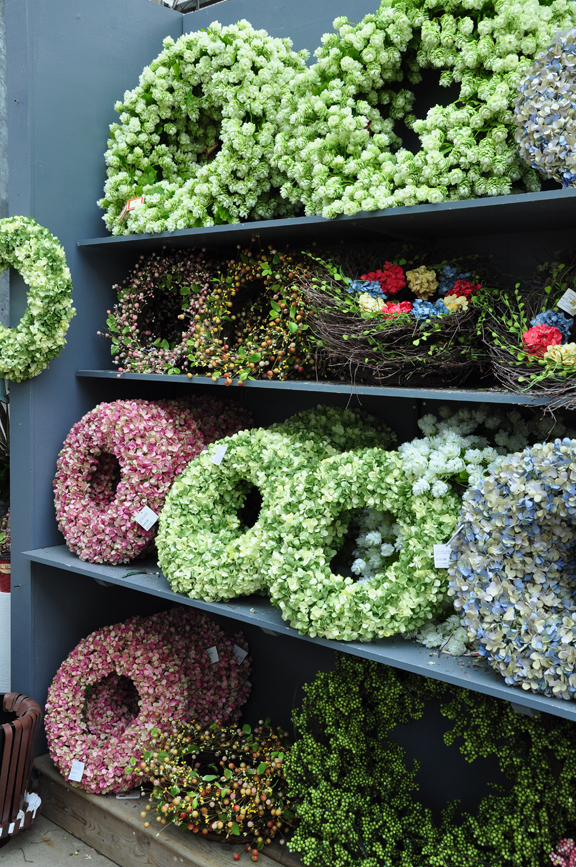
Soft textured wreaths in a local nursery.


Soft pink astilbe in the Spargette's private garden in Brampton, Ontario. (I wish my Astilbe looked this good! Astible likes to be kept fairly moist. It also prefers morning sun and afternoon shade. Mine gets too much shade and not enough water.) 

The texture of fall grasses can be both soft and feathery. Colin Gosden's garden, Mississauga, Ontario.


Bed and Breakfast Inn in Niagara-on-the-Lake, Ontario

In a garden setting, stone textures can be ever bit as aesthetically pleasing as soft textured surfaces.


Coarse textures like stone and weathered wood may be rough and unyielding, but still have uses in the garden.

Soft petalled blooms look even more delicate when contrasted with the rugged, weather-beaten surface of stone.


Cupid's Dart in amongst stones and pebbles in Colin Gosden's garden, Mississauga, Ontario.

Finally, leaves can have textural surfaces all of their own.

New to my garden this summer is Calamintha, Calamintha grandiflora variegata.

Heuchera in the Spargette's private garden in Brampton, Ontario

Heuchera ' Midas Touch', Humber Nursery, Toronto, Ontario. 

Fall hosta in my own garden.

Niagara Botanical Gardens, Niagara Ontario.

In the garden, texture works so closely with its best friends, color, shape, pattern and repetition that it almost becomes indistinguishable. 


But trust me, texture is right in there, quietly performing its magic.

If you are brave enough to endure another picture marathon, I'll put my take on "Pattern" up on Friday.