Showing posts with label cicadas. Show all posts

Thursday, April 19, 2018

Myths, Misconceptions and Insect Lore


by Jean Godawa


In the early years of my career, when I visited nature and gardening groups or was invited to a classroom of eager six-year-olds, I was curious to hear the stories and background knowledge that people had about insects. Sometimes the stories were stated with such conviction that I had to go home and check through my textbooks to make sure I wasn't missing some obscure fact.

I did not enjoy telling a sweet child that the number of spots on a ladybug doesn't indicate its age or that earwigs don't crawl into your ear and nibble on your brain. When it comes to insects, I feel that knowing the straight-up facts makes people less afraid of them.

Myths and misconceptions about insects abound. Insect lore has a long historical tradition that is usually based on the predictive abilities, dangerous potential or valuable qualities of these fascinating creatures.


A common legend says that if a woolly bear caterpillar (Pyrrharctia isabella) with wide black bands crosses your path in the fall, it will be a long, harsh winter, especially if it is crawling in a southerly direction, trying to escape the northern cold. Narrower black bands, apparently, predict a mild winter.


As tempting as it would be to believe a simple caterpillar over complicated meteorological tools, sadly, the black bands on a woolly bear caterpillar have nothing to do with the upcoming winter. This caterpillar moults several times before it pupates and becomes the adult Isabella tiger moth. With each of the caterpillar's moults, the black bands get shorter.


There is, however, an insect that truly does have a bit of weather expertise. It may not be able to predict upcoming weather but it can tell you the temperature. If you count the number of chirps of the snowy tree cricket (Oecanthus fultoni) in a 13 second period, then add 40, you will get the approximate temperature in degrees Fahrenheit.

Long before we were measuring the outside temperature with cricket chirps, people looked to insects for other inspirations.


The ancient Egyptians had a particular affinity for a creature whose behaviour many of us would find repulsive. The scarab beetle rolls up balls of dung to bury and lay its eggs inside. Rather than seeing this as something disgusting, the Egyptians saw it as a symbol of the sun rolling across the sky. Since the young hatched from the dung ball, they interpreted it as a young sun god being reborn every morning. This god, Khepri, was often depicted as a man with a scarab beetle for a head.

Cricket cage of coconut shell and ivory from the Qing dynasty (Smithsonian Institution)

They may not be soft and cuddly like puppies or kittens but some insects are treasured pets. Valued by some Asian cultures for their melodious and calming chirp, crickets have been collected in cages for hundreds of years. Elaborately carved bone or wood cages have been found dating back as early as 960 A.D.

Another insect, cicadas, were also revered in Chinese culture as a symbol of rebirth and immortality. While too loud to keep indoors, they were sometimes kept in cages that hung from the eaves of the house or in tree branches nearby.


This attraction to insects is very much alive today. Bug markets in Shanghai and Beijing have become popular tourist stops where thousands of crickets along with some very decorative cages are sold. Many of these insects are used for sport rather than their soothing sounds, as cricket fighting has continued to be a popular pastime.


Thanks to a lazy grasshopper, I learned early that it was important to prepare for tomorrow. Many of us remember Aesop's story of the grasshopper who spent the summer singing and dancing while he watched the ants collecting food for the winter. When winter came, the grasshopper, near death, begged the ants for help, which they refused to give. Aesop was harsh!


Whether founded in observation or superstition, stories and beliefs about insects are just as common today as they were in antiquity.

I have been told many times that having a ladybug land on you is considered to be good luck. While not one for superstitions, I have to agree. Ladybugs eat plant pests which is definitely good luck for gardeners.

Post written by Jean Godawa


Jean is a science teacher and writer. She has been writing science-related articles for print and online publications for more than ten years. Jean holds a degree in biology and environmental science with a focus on entomology from the University of Toronto. She has also conducted field research in the tropical rainforests of Asia and South America.

Many thanks to Ken Sproule and Joseph Berger for allowing us to use their photographs in this post.


Bookmark this post with a Pin.

Sunday, September 11, 2016

The Sounds of Summer

In her latest post, Jean Godawa writes about cicadas, whose mating call is one of the sounds we  so closely associate with summer.


Labour Day has passed, signalling, for many, the end of summer. But the cicadas in the maple tree outside my window clearly don't follow the same calendar that I do. These insects that are usually associated with the dog days of summer, are still loudly buzzing away.


Cicadas are large, wide-bodied members of the true bug order Hemiptera, growing up to 5 cms (2 inches) long. The most common species in my area, the dog day cicadas (Neotibicen canicularis), certainly live up to their name, being active during the sultry days of July and August.

Despite their size, you are more likely to hear these large creatures than to see them; they spend  most of their short adult lives high in the trees.

Using abdominal muscles and drum-like membranes called tymbals, male cicadas make noise to attract females for mating. The sound can be heard more than a kilometer away and can reach up to 120 decibels; that's louder than the sound produced by a motorcycle or power saw.


After mating, female cicadas lay eggs in small branches that die off and fall to the ground. The immature cicadas (nymphs) burrow into the ground and feed on plant roots for at least 2 to 5 years. We hear these loud insects every summer but the documented broods (numbered I through XIV) have predictable, staggered cycles, some as long as 17 years depending on the species.


Periodical cicadas (Magicicada spp.) have life spans of either 13 or 17 years. They are easily distinguished from other cicada species by their red eyes and reddish wing veins. Brood V emerged this year in the northeastern U.S. and the offspring of this brood won't be seen or heard until 2033. Brood VI will emerge next year in Georgia and the Carolinas. No data is available for the presence of periodical cicadas in Canada, while dog day cicadas, with much shorter life spans, are quite common in Ontario and Quebec.

Carolina locust (Dissosteira carolina)

Periodical cicadas have mistakenly been called 17 year locusts but are completely different from actual locusts, also known as grasshoppers (Orthoptera).

Large groups of cicada nymphs can cause serious damage to young tree roots and in an emerging year, thousands, if not millions of adults laying eggs can damage tree branches. In general though, cicadas are not considered an economically important pest, nor are they dangerous to humans.


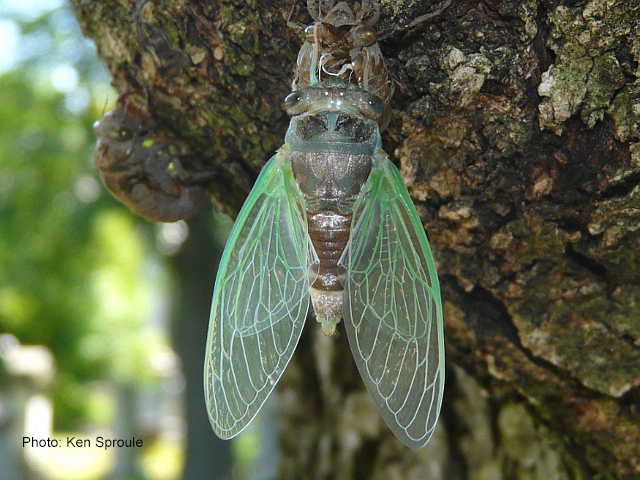
When mature, cicada nymphs crawl out of the ground and onto tree trunks where they latch on and molt their exoskeleton to become winged adults.


You can often find these abandoned "shells", or exuviae, in early or mid-July on the ground or at the base of trees. You can see from these, the large, strong front legs that nymphs use to dig through the soil.


Adult cicadas use a straw shaped mouth to siphon sap from trees but they don't eat much and only live for a few weeks as adults, dying off with the summer.


While cicadas may munch on tree roots in our yards, some people advocate using large groups of cicadas to our advantage. They are, according to some scientists, a logical food choice for humans, since they belong to the same group of animals (Arthropods) as shrimp and lobsters. I admit that, in the interest of scientific curiosity, I have eaten insects. Most had kind of a nutty flavour. But I would much rather listen to the cicada song than have one for a snack. As long as I can hear them buzzing, I can be assured that summer is definitely not over yet.


About Jean GodawaJean is a science teacher and writer. She has been writing science-related articles for print and online publications for more than ten years. Jean holds a degree in biology and environmental science with a focus on entomology from the University of Toronto. She had conducted field research in the tropical rainforests of Asia and South America.

Many thanks again to photographer Ken Sproule and the wonderful people at bugwood.org for curating such an extensive catalogue of insect photographs.

Bookmark this post with a PIN.