Showing posts with label Insects in the garden. Show all posts

Sunday, September 11, 2016

The Sounds of Summer

In her latest post, Jean Godawa writes about cicadas, whose mating call is one of the sounds we  so closely associate with summer.


Labour Day has passed, signalling, for many, the end of summer. But the cicadas in the maple tree outside my window clearly don't follow the same calendar that I do. These insects that are usually associated with the dog days of summer, are still loudly buzzing away.
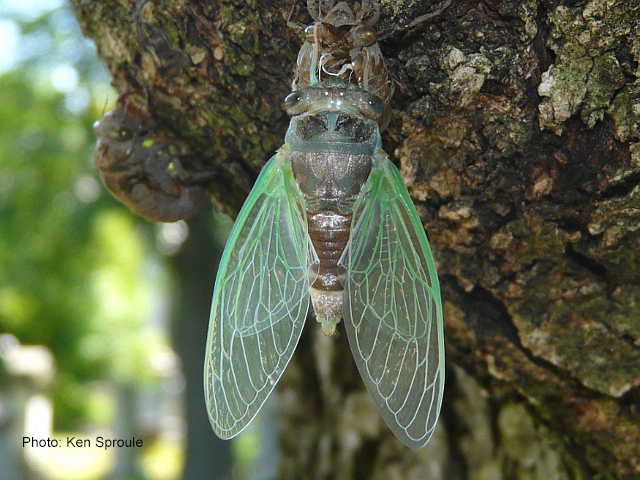

Cicadas are large, wide-bodied members of the true bug order Hemiptera, growing up to 5 cms (2 inches) long. The most common species in my area, the dog day cicadas (Neotibicen canicularis), certainly live up to their name, being active during the sultry days of July and August.

Despite their size, you are more likely to hear these large creatures than to see them; they spend  most of their short adult lives high in the trees.

Using abdominal muscles and drum-like membranes called tymbals, male cicadas make noise to attract females for mating. The sound can be heard more than a kilometer away and can reach up to 120 decibels; that's louder than the sound produced by a motorcycle or power saw.


After mating, female cicadas lay eggs in small branches that die off and fall to the ground. The immature cicadas (nymphs) burrow into the ground and feed on plant roots for at least 2 to 5 years. We hear these loud insects every summer but the documented broods (numbered I through XIV) have predictable, staggered cycles, some as long as 17 years depending on the species.


Periodical cicadas (Magicicada spp.) have life spans of either 13 or 17 years. They are easily distinguished from other cicada species by their red eyes and reddish wing veins. Brood V emerged this year in the northeastern U.S. and the offspring of this brood won't be seen or heard until 2033. Brood VI will emerge next year in Georgia and the Carolinas. No data is available for the presence of periodical cicadas in Canada, while dog day cicadas, with much shorter life spans, are quite common in Ontario and Quebec.

Carolina locust (Dissosteira carolina)

Periodical cicadas have mistakenly been called 17 year locusts but are completely different from actual locusts, also known as grasshoppers (Orthoptera).

Large groups of cicada nymphs can cause serious damage to young tree roots and in an emerging year, thousands, if not millions of adults laying eggs can damage tree branches. In general though, cicadas are not considered an economically important pest, nor are they dangerous to humans.


When mature, cicada nymphs crawl out of the ground and onto tree trunks where they latch on and molt their exoskeleton to become winged adults.


You can often find these abandoned "shells", or exuviae, in early or mid-July on the ground or at the base of trees. You can see from these, the large, strong front legs that nymphs use to dig through the soil.


Adult cicadas use a straw shaped mouth to siphon sap from trees but they don't eat much and only live for a few weeks as adults, dying off with the summer.


While cicadas may munch on tree roots in our yards, some people advocate using large groups of cicadas to our advantage. They are, according to some scientists, a logical food choice for humans, since they belong to the same group of animals (Arthropods) as shrimp and lobsters. I admit that, in the interest of scientific curiosity, I have eaten insects. Most had kind of a nutty flavour. But I would much rather listen to the cicada song than have one for a snack. As long as I can hear them buzzing, I can be assured that summer is definitely not over yet.


About Jean GodawaJean is a science teacher and writer. She has been writing science-related articles for print and online publications for more than ten years. Jean holds a degree in biology and environmental science with a focus on entomology from the University of Toronto. She had conducted field research in the tropical rainforests of Asia and South America.

Many thanks again to photographer Ken Sproule and the wonderful people at bugwood.org for curating such an extensive catalogue of insect photographs.

Bookmark this post with a PIN.

Saturday, August 20, 2016

Shade, Shells and Slime

In her latest post Jean Godawa writes about slugs and snails. 

I'm lucky to live in a part of the city with many large mature trees. The fall colours on my street rival those of any picturesque country lane. So much so, that visitors and passers-by often stop to take pictures. As grateful as I am for the autumn beauty and summer shade that this canopy provides, I envy gardens filled with blooms of all textures, shapes and colours that only a sunny or partially sunny area can sustain. Thankfully, the previous owner of our home had a talent for creating visual interest with several varieties of hostas which thrive today.

With all those hostas in my Jurassic-looking garden however, comes an open invitation for snails and slugs (Gastropoda). The wide, sturdy leaves and low positioning of hostas make them perfect hosts for these slow moving, shade loving members of the mollusc phylum.


The brown-lipped, or grove snail (Cepaea nemoralis) is an introduced species found in the north eastern U.S. and southern Ontario. It varies in colour and number of stripes with the opening lip of the shell typically dark brown in colour.

The white-lipped snail (Cepaea hortensis) has a light coloured band around the shell opening.

Snails and slugs have two pairs of antennae-like appendages - one small pair is used for smelling while the larger, upper pair holds the eyes.


Gastropods require a moist environment to survive. The common amber snail (Succinea putris) lives near water sources and feeds on strong aquatic reeds and grasses.

You may rarely see these nocturnal creatures but you will know they are around. They feed at night to avoid both predators and the harsh, drying effects of the sun. They spend the day sheltered under the shade of plants, decaying plant matter, mulch or garden structures. A slime trail, along with holes or jagged edges on leaves indicates a snail or slug problem.


Slugs vary in size with some species growing up to 25 cms (10 inches) in length. They can range in colour from light yellow to dark brown or grey. Their feeding behaviour and habitat preference is similar to snails. The obvious difference between the two is the slug's lack of shell.

Most snails and slugs that you encounter in the garden are hermaphrodites, with both male and female reproductive organs. Despite this, they do not self-fertilize - they must mate to reproduce. Eggs are laid in a sticky secretion in a damp protected area of the garden. After about a month, the immature creatures hatch and begin feeding. Warm humid conditions speed up their development.


Being fascinated, as I am, with all kinds of crawly and slimy things, I have a hard time getting rid of creatures that are just doing what is natural. If plants are hardy and growing well, they can usually tolerate a bit of damage from a snail or slug. When pest numbers increase and I start to feel the crunch of shells under my feet as I walk in the yard, then I know it's time to act.

Cleaning up debris around affected plants and trimming off any leaves that touch the ground helps protect plants from snail and slug damage. Remove overturned pots, fallen branches and if you're not squeamish, handpick the creatures off the plant and drop them in a bucket of soapy water. Go out after dark with a flashlight or early in the morning to find and remove the pests.

Barriers, such as copper strips or diatomaceous earth, and traps, with or without bait, can also eliminate snails and slugs. Be sure to check and clean traps frequently at first for the best results.

For every plant we bring into the garden, there will be some creature that needs it for food, shelter or reproduction. Whether it's an owl living in a tree, a deer eating tall lilies or slugs munching on hostas, if we accept that we share our space with many other creatures and we arm ourselves with knowledge about those creatures, then it's easy to maintain healthy, vibrant gardens.


About Jean GodawaJean is a science teacher and writer. She has been writing science-related articles for print and online publications for more than ten years. Jean holds a degree in biology and environmental science with a focus on entomology from the University of Toronto. She had conducted field research in the tropical rainforests of Asia and South America.

Many thanks to Ken Sproule for providing the images for this post.

Bookmark this post with a Pin.