Showing posts with label Sedum. Show all posts

Saturday, March 7, 2020

New Perennials for 2020 from Terra Nova Nurseries, Inc. + Some Old Favourites


It's a gorgeous day here–sunny and warm enough for the snow to be melting. Though it feels like spring has arrived, I remind myself that it is only the first of March and winter may not be done with us just yet.

 You can see the tangled growth at the base of the lilac in this shot from June 2019.

Even though it is just a common lilac, the flowers are pretty and very fragrant.

Despite the pockets of snow, the dogs and I spent a good part of yesterday afternoon out in the garden. The temperature was mild enough for me to ditch my winter jacket and get to work pruning a neglected lilac. While this is not the proper time of year to prune a lilac (you could cut off all this year's flower buds if you aren't confident in what you're doing) I find it helpful to get a headstart on simple tasks like removing spindly suckers before I get overwhelmed with a long list of other pressing spring chores. That and it's nice to be puttering around outside in the sunshine!

Like me, I am sure you are beginning to draw up a spring wishlist. What interests me these days are plants with unique foliage and flowers. With that in mind, I've put together a list of new introductions from Terra Nova Nurseries that have captured my imagination. And as I promised earlier in the year, I'm also going to highlight some older introductions I think are worth seeking out.

A word about Terra Nova® Nurseries. They use tissue culture to propagate and grow both annuals and perennials.  Based in Canby Oregon, they have introduced over a thousand new plants to market.

As a wholesale propagation nursery, Terra Nova does not sell directly to the public. On their website, they have a handy page that will help you locate a retailer in your state or province that sells their plants (Sadly for Canadians on the East Coast and in Saskatchewan, Terra Nova is underrepresented).

Some of the New Plants for 2020


Geum Tempo™ Rose from Terra Nova® Nurseries


Geum Tempo™ Rose has dark rose-pink flowers on short, dark stems. Moist, loamy soil is prefered. Long bloom time. Full sun. Height: 8-21 inches, Spread: 12 inches. USDA zones: 5-9.


Sedum Peach Pearls has burgundy leaves and rose-gold flowers. Even in its first year, this sedum produces multiple flower crowns. 'Peach Pearls' likes soil with good drainage. Drought tolerant and attractive to pollinators. Full sun. Height: 14-20 inches, Spread: 24 inches. USDA zones: 4-9.


Veronica Vespers™ Blue has blueish-purple flowers. A long period of bloom begins in late spring and runs into mid-summer.  It prefers moist soil with lots of organic material and good drainage. Full sun. Height: 9-13 inches, Spread: 11 inches. USDA zones: 4-8.


Heuchera Northern Exposure™ Sienna has green foliage when it first emerges in the spring. In summer, it becomes a mix of sienna and orange with greenish margins. Fall sees it revert back again to green. Rust resistant. Moderately well-drained soil and average moisture conditions. Full sun to part shade. Height: 13-22 inches, Spread: 21 inches. USDA zones: 4-9.

Other Perennials that Caught my Eye:


Of all the perennials on my list, I would love to get my hands on this one the most! I find Thalictrum to be a terrific option for part-shade. This type of Meadow Rue has lovely ferny foliage, dark stems and star-like flowers. I have the mauve flowering variety but would like to add a white flowering version:

Thalictrum Nimbus™ White has clouds of white flowers and fern-like foliage. The flowers age to lavender-pink seed heads. This perennial prefers moist, humus-rich soil but adapts well to average soil with good drainage. Part-shade. Height: 28 inches, Spread: 16 inches. USDA zones: 5-9.


I have a quite number of Bleeding Hearts, but I don't have this cultivar with its combination of golden leaves and white flowers.

I can just imagine Dicentra 'White Gold' mixed in with tulips and daffodils. Beautiful! Again, it's a great option for the shady area of your garden (although, based on experience with similar 'Gold Heart', I would recommend part-shade for the best leaf color).

Dicentra 'White Gold' has heart-shaped white flowers and golden leaves on a vigorous plant. This perennial prefers moist, loamy soil. Part to full shade. Height: 24-30 inches, Spread: 36 inches. USDA zones: 4-8.


When you're a plant collector, it's hard to resist adding more of your favourites:

Geum Petticoats™ Peach has semi-double peach flowers on a compact plant with green foliage. Moist, loamy soil is prefered. Reblooms. Full sun. Height: 10-12 inches, Spread: 20 inches. USDA zones: 5-9.

Every year I try to invest in at least one new hosta with interesting features. Here are two with very attractive reddish-purple accents:


Hosta 'Purple Heart' has glossy lime-green foliage with red-purple at the base of each heart-shaped leaf. 'Purple Heart' has a neat, uniform growth habit and good slug resistance. Full shade. Height: 15-24 inches, Spread: 30 inches. USDA zones: 4-9.


Hosta 'Raspberry Sundae' is a compact hosta with creamy-white variegation through the centre of the leaf. It has deep burgundy petioles, leaf bases and flower stalks. Its flowers are deep lavender-purple. Part-shade to full shade. Height: 9-23 inches, Spread: 21 inches. USDA zones: 4-9.


Yet another personal favourite is Penstemon (I already have Penstemon 'Husker Red' and 'Dark Towers'). Many of the newer introductions aren't hardy here, but I was very excited to see two that are reputed to be tough, hardy perennials:

Penstemon Dakota™ Verde has violet flowers on dark stems. Seed heads are a lovely dark burgundy color and the foliage takes on a purple tinge in the fall. Average, well-drained soil is fine for this perennial. Full sun. Height: 12-24 inches, Spread: 18 inches. USDA zones: 3-8.


Penstemon Dakota™ Burgundy has violet flowers. This penstemon is shorter and more compact than popular 'Dark Towers'. Average well-drained soil and moisture conditions are fine for this plant. Full sun. Height: 12-24 inches, Spread: 18 inches. USDA zones: 3-8.


I thought I would also throw in a few annuals that caught my attention. Some people struggle with Rex Begonias, but I seem to have good luck with them. I keep them as houseplants year-round in an east-facing window. Each spring, I divide them and move the divisions outdoors to fill part-shade containers.

I often take cuttings in the fall and keep Coleus over the winter as houseplants. Last fall I didn't have a chance to take the usual cuttings, so this spring I am definitely in the market for some new plants. Here are a couple I am going to watch for:


I hope this post has inspired you to add a few plants to your own wishlist for 2020. 
Have a wonderful weekend!

Photos in this post are courtesy of Terra Nova Nurseries. www.terranovanurseries.com

Bookmark this post with a PIN.

Tuesday, July 12, 2016

You Love Joe's Garden!


The problem with garden profiles, that you often see in magazines or on garden blogs like this one, is that they capture a garden at single point in time. But gardens are not static things. They change constantly. So in a series of posts that I'll show you over the course of the summer, I have gone back and revisited some of the gardens I photographed previously in the late spring. The hope is to give you a better sense of a garden's evolution over the course of a growing season.

Of all the gardens I have ever featured on this blog, Joe's garden is by far one of the most popular. Based on page views and pins, you love Joe's garden! 

'John Davis' Explorer Rose in June
Early July

In June, Joe's garden is filled with roses. (To get a more complete picture, you can see Joe's June garden here. You can see the garden in early July here.)

In July, the roses begin to rest through the hot, dry days of mid-summer and a wide assortment of perennials take over where the roses have left off. Here is a island flowerbed from the front of the house in late July:


1. Phlox paniculata 'Pink Flame and 'Peppermint Twist' 2. Heuchera  3. Brunnera 'Jack Frost'  4. Pulmonaria  5. Sedum  6. Variegated Phlox  7. Annual Candytuft  8. Hosta

Early July
Echinacea in Late July.
Late July

As well as the flowers, foliage is key factor in the success of any of Joe's plantings. In the background of this picture, the spiky foliage of a bearded iris looks spectacular long after the flowers have finished. 

The combination of blue-green and cream has an echo in the foliage of the hosta in the foreground.


As sunny as a yellow flower might be, the golden foliage of this hosta looks perfect paired with the silver leaves of a (1.) Brunnera 'Jack Frost' and (2.) the tiny purple flowers of perennial Campanula and (3.) annual Canndytuft.


Annual Candytuft, Iberis Umbellata: Height 30-40 cm. Full sun. Flowers range from white to pink and mauve. Annual Candytuft flowers within a couple of months from seed.  It is taller and less compact than its perennial cousin.

Nestled in next to the Candytuft is another great foliage plant Jacob's Ladder 'Stairway to Heaven'. Here is what it might have looked like blooming in spring:


Jacob's Ladder, Polemonium reptans 'Stairway to Heaven' has variegated foliage that is blushed with pink in the cooler days of early spring. The flowers are pale mauve-blue. Afternoon shade and moist conditions suit this plant best. Height: 25-40 cm ( 10-16 inches), Spread: 40-45 cm (16-18 inches). USDA zones: 3-9.

Early July
Phlox paniculata 'Bright Eyes' in late July.

In the backyard, Phlox continue to be a important perennial in Joe's July and August garden. 

Phlox paniculata 'Peppermint Twist': Height: 35-45 cm, Spread: 30-40 cm. Full sun. Does equally well in moist or dry soil. Normal, sandy or clay soils are fine. Attractive to butterflies. USDA Zones 4-9.

Phlox paniculata 'Pink Flame' has fragrant medium pink flowers with a dark rose eye. Height : 30-50 cm ( inches), Spread: 30-40 cm. USDA Zones 4-9.


Echinacea 'Southern Belle': has magenta pompom flowers. Does equally well in moist or dry soil. Normal, sandy or clay soils are fine. Attractive to butterflies. Full sun. Height: 50- 90 cm, Spread: 50- 75 cm. USDA Zones 4-9.


Balloon flower, Platycodon grandiflorus is a great perennial to have in any mid-summer garden. This is a tall, upright perennial that has a carrot-like root. The inflated looking flowers pop open like balloons, hence the common name. Colors range from blue to pale pink to white. Depending on the cultivar you choose, Balloon flowers will grow as tall as 60-75 cm (23-29 inches) and spread as much as 30-40 cm ( 12-16 inches). USDA Zones: 3-9.

Early July
Early July
Late July

I hope you have found a few new planting ideas in Joe's mid-summer garden.

Bookmark this post with a Pin.

Saturday, September 19, 2015

The Element of Surprise


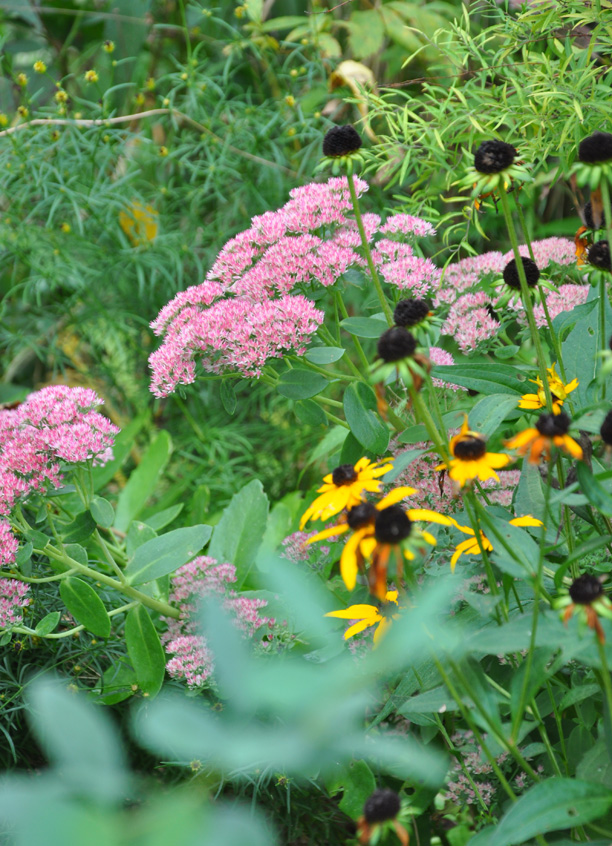
I have come to love sedums for the element of surprise they add to the autumn garden. 

As the days shorten and the nights grow colder, a sedum's color changes with the advancing season. I delight to find flower buds, which were cream one sunny afternoon, have taken on a peachy tone a few days later. On yet another day, on my way to the back of the garden, I'll discover a pretty pink sedum has deepened into a fiery shade of magenta almost overnight.


Industrious bumblebees seem to tap dance on top of the parachute-shaped flower heads. Wasps love them too, but butterflies seem to prefer the small white flowers of the Joe Pye Weed in another part of the garden.

Frost always seems to strike just as the flowers become their most vibrant. In late October, they continue to stand tall amongst the storm of falling leaves, their color having morphed yet again into a mellow reddish-brown. 


Even in the dead of winter sedums seem to have a certain melancholy beauty.


If you look closely, you see that each plant lights hundreds of miniature firecrackers each fall.


Sedum spectabile 'Neon' has light green foliage and magenta-pink flowers.  Full sun. Height: 45-60 cm (18-23 inches) Spread: 45-60 cm (18-23 inches). USDA Zones: 2-9.


Some of my old favourites include Sedum 'Autumn Joy', Sedum 'Autumn Fire' and Sedum 'Matrona'. Making new plants is easy, so I have them scattered throughout the garden in both sun and part shade.

(To make new plants, pinch back your plants in June about 4-5 inches. As well as giving you lots of cuttings to create new plants, this will help prevent tall, heavy flowering varieties from flopping. Strip away all the leaves on the bottom half of each cutting. Plant your sedum in pots, or as I do, directly into garden soil ( but keep the cuttings out of direct sunlight). Water them well and keep an eye on them to make sure the soil doesn't dry out while the cuttings are establishing roots. Your sedums should root within a couple of weeks.)


Sedum telephium 'Matrona' is one of the taller sedums in my garden. The reddish stems and pink flowers are a great combination. Full sun. Height: 60 -70 cm ( 23- 28 inches) Spread: 45-60 cm (18-23 inches). USDA Zones: 3-9.

The deepening color of Sedum telephium 'Matrona'.

I find the mature plants and ones that are in part shade flop the most. Again, pinch them back in early June to avoid this problem.


Every summer I try to add a few new plants. Last year I added these two low growing varieties:

Sedum 'Pure Joy' is a keeper because of its neat mounded shape. Sadly, I find it isn't as pretty as others once the flowers start to fade. Grow it in poor to average well-drained soil. Full sun. Height: 20-30 cm (10-12 inches) Spread: 45-50 cm (18-20 inches). USDA Zones: 4-9.

Sedum 'Dazzelberry' has really nice purplish-grey foliage. The deep raspberry flowers are amazing, but the flower stems are so fine that I find it flops unattractively. Next year I need to figure out some form of low support for it. Again poor to average well-drained soil. Full sun. Height: 15-20 cm (6-8 inches) Spread: 30-45 cm (12-18 inches). USDA Zones: 4-9.


This year's additions include:

Sedum 'Class Act' is a recent introduction. 'Class Act' has flowers that are such a vivid shade of magenta they immediately grab your attention. Full sun and average, well-drained soil. Height: 45-60 cm (18-23 inches), Spread: 45-60 cm ( 18-23 inches). USDA Zones: 4-9.

Sedum 'Class Act' is the deeper raspberry colored sedum.


Sedum 'Lemonjade' has interesting creamy-green colored flowers that take on a peachy tone as they mature. Full sun and average, well-drained soil. Height: 40-45 cm (16-18 inches), Spread: 45-70 cm (26-28 inches). USDA Zones: 3-9.

Sedum 'Lemonjade' in front of Sedum 'Matrona'


Sedum telephium 'Munstead Dark Red': This is an older variety that deepens into a dark rose color. It can be floppy in moist, rich soil. Height: 45-60 cm (18-23 inches) Spread: 45-60 cm (18-23 inches). USDA Zones: 3-9.


Here I have planted Sedum 'Munstead Dark Red' with my favourite hydrangea 'Little Lime'.

Autumn is all about changing leaf colors, so it is better to think of companion planting in terms of complementary foliage rather than flowers. Sedums look great at the feet of tall ornamental grasses, as well as alongside plants like hosta and heuchera.


Sedum 'Autumn Charm' sits above a peach-colored heuchera and next to a hosta with a golden leaf. 


Sedum 'Autumn Charm' has this terrific variegated foliage and salmon-colored flowers. Full sun and average garden soil. Height: 35-40 cm (14-16 inches), Spread: 45-60 cm (18-23 inches). USDA Zones: 3-9.

Sedum 'Autumn Charm' peeking in on the left. 'Autumn Fire' on the right with 
'Class Act' in the background.


I end with one of my favourite images. It's a nice reminder that, while the gardening season is coming to close, there is still magic yet to be found.

Bookmark this post with a PIN.