Showing posts with label Pond-less waterfall. Show all posts

Thursday, April 5, 2018

An Asian-Inspired Garden, Part 1: The Pond-less Waterfall


"It was the 60+ year old English house I bought in 1982 that had an established though long neglected garden that started my love of gardening," says Carina Wong.

Originally from Malaysia, Carina had gone to England to study nursing and decided to stay on after she graduated. When she purchased her first house in March, she had no idea there was a large garden sleeping through the final days of winter. 

When spring brought the garden to life, Carina was at a loss how to handle the mature garden she'd inherited. At that time, she had no experience with gardening. Feeling a bit overwhelmed, she hired someone to help her in those early days. Then, slowly over the next seventeen years, the garden ended up teaching her how to be a gardener. 

A move to Canada saw a fresh set of gardening challenges. 

A visitor to the garden sits by the pond.

"I wanted an English-themed garden for the front of my new house," Carina recalls.

The property she bought in Mississauga had two large maple trees in the front yard that cast a tremendous amount of shade. Carina had one removed and limbed up the other to let in a little more sun for the roses she hoped to grow. Other than the two maples, the garden she inherited had a lawn and a narrow flowerbed that ran along the front of the house. 

"I had many lovely roses, but sadly the arrival of Japanese beetles nine or ten years back became too big a problem to keep under control. The roses were sad and any blooms were quickly decimated. In the end, I got rid of over 30 rose plants! How should I put it - gardening phases come and go with the gardeners' aging process!"

The idea of installing a pond in the front yard began as a solution for a grub problem in the lawn. On the advise of her local garden centre, Carina tried to treat the problem with a pesticide. The chemicals smelled horrible and they were expensive. Worst of all, the grub problem persisted even after a couple of treatments. So Carina decided to dig up the lawn and put in a pond.


Over the years the pond went through a number of phases. In its first incarnation, it was a small preformed plastic pond. Not satisfied with that, Carina hired someone to come in and create a larger pond. A number of years later the skimmer broke, and rather than replace it, Carina decided to replace the high maintenance pond with a pond-less waterfall that was a lot less work. 

The interlocking brick was another time saver. No more lawn tomow! 

The garden along the front of the house.

1. Bearded Iris with variegated foliage 2. Tall allium 'Purple Sensation' 3. Rhododendron 4. Stonecrop or Creeping Sedum 5. Allium 6. Thyme 7. Moss Phlox, Phlox subulata 'Emerald Cushion Blue'


A closer look at the Moss Phlox (left) and the Thyme (right)

Phlox subulata 'Emerald Cushion Blue' creates a low mound of green needle-like leaves. In the spring, it is covered with lavender-blue flowers. This is a clump-forming perennial and is not invasive. Good drainage is essential for over-wintering moss phlox. Once established this plant is quite drought tolerant. Height: 10-15 cm (4-6 inches), Spread: 45-60 cm(18-23 inches). USDA zones: 2-9.


"I have happy memories of sitting on the park bench under the Canadian Maple in the evenings and listening to as many as 13 pairs of frogs' croaking - is there a better way to describe the beautiful sounds they make? Sitting on that bench also offered me the perfect vantage point for improving the layout and making changes over the years as well as enjoying a glass of wine or two!", smiles Carina. 

A birdbath and one of the roses that still remain in the front garden.

In the part 2, we'll head into Carina's wonderful backyard.

Monday, June 23, 2014

Cynthia's Garden


Today I have a local garden to share with you. This is Cynthia's garden in Georgetown, Ontario (approximately 10 minutes northwest of my garden here in Huttonville).


A walkway leads us around the side of the house to the back garden.


One of the walkways prettiest features is this Honeysuckle vine. Butterflies and hummingbirds just love this flower's sweet nectar.

Honeysuckles prefer sun, but will tolerate some light shade. They will grow in a variety of soil types and are quite drought tolerant once established. Allow honeysuckle vine to mature before pruning (2 yrs). Prune very lightly during the growing season to encourage more flowers. Thin the top half of a Honeysuckle in late February to March to prevent the lower portion of the vine from becoming woody and unattractive. Also remove any damaged or diseased vines each spring.


As you round the corner of the house, there is a small seating area, as well as an area for outdoor dining.


A mature tree casts most of the right side of the garden in shade and part-shade.


At the base of a small birdbath, Cynthia has planted a groundcover conifer, several hosta, 
and a couple of varieties of euonymus. 


Covering the fence is a Climbing Hydrangea. At its feet are a couple of shade tolerant Yew.


The corner shed.

Here is a very rough layout of Cynthia's garden. 

This next area I want to show you was my favourite part of Cynthia's garden. So often in a suburban garden you find yourself standing on a central lawn, looking with the detachment of a spectator, at plantings that run along the property's outer perimeter.  Like masterpieces hung on a museum wall, the plants often feel like they are there only to be admired from a polite distance. 

In Cynthia's garden however, a series of flagstone paths invite you to enter inside a large corner section of the garden. As you wander through the plantings, stepping on the fragrant thyme and brushing past the white satin petals of the peonies you are no longer a simple onlooker. You are a participant.


One of the flagstone pathways in Cynthia's garden.


Among the flowers and shrubs in this section of the garden are these magenta geraniums 
and vivid blue Delphiniums.

 Lady's Mantle and blue Salvia in the foreground.

When the plantings in a garden are too dense, they can become a bit of a jungle. Not here.

Groundcovers knit together to form a neat carpet that keep the pathways feeling open and breezy. 


The groundcovers include lime-colored Irish moss (upper left), thyme and veronica.

Veronica whitley (seen above): This drought tolerant groundcover has sapphire-blue flowers in spring. Full sun. Normal or sandy soil. Hardy USDA zones 3-9.


Out of sight and toward the back of the corner garden there is a small, but important black bin 
that is used to make compost.


There is also a lovely pond-less waterfall in this part of the garden.


Peonies are finally in flower here. Aren't these white peonies beautiful?


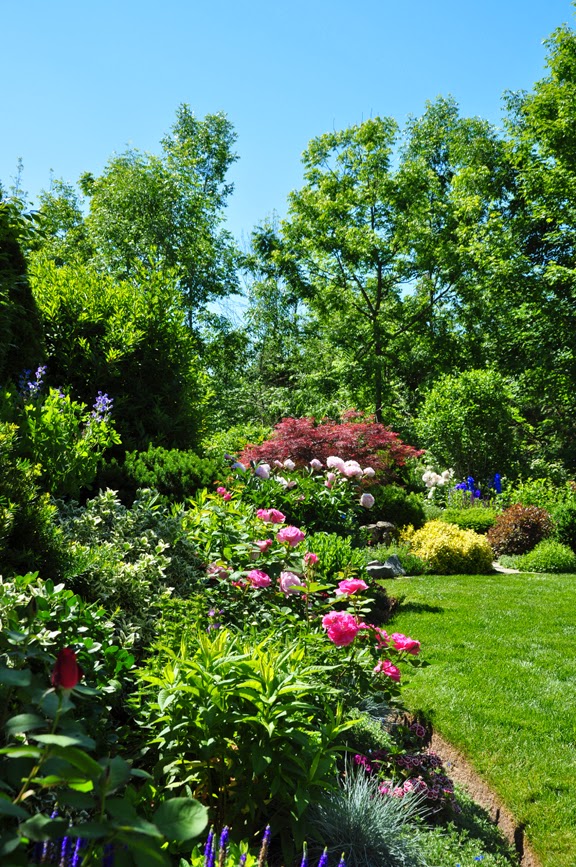
Along the far side of the garden there is a long border in full sun.


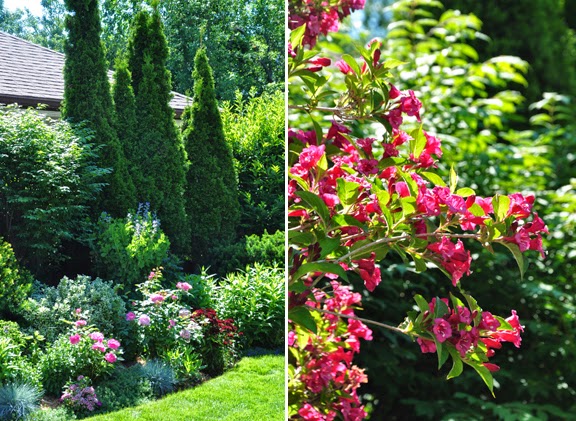
Disguising the yard's fencing there are a number of conifers and shrubs. (Above right) A Weigela, with its vivid cherry flowers. (Below) A soft, mauve-colored Lilac.


Stepping down one level to mid-height, the plantings include the False Indigo, Baptisia australis, Yew, pink peonies, and euonymus.


At the front of the long border there are among other things: 
pink roses, blue Veronica and Sweet William.


In my humble opinion, Sweet William is a cottage garden flower that you don't see in gardens often enough. 

Dianthus barbatus dwarf double mix: Height: 15-30 cm Spread 20-30 cm. Sweet William require full sun and bloom mid-summer. They are usually grown as a self-seeding biennial flower. This strain produces a low mound of green leaves and bright, double flowers in shades from white through to pink, magenta and red.  Remove fading flowers to encourage more buds.  Pruning plants back hard in fall will enourage them to live for a second year. They make excellent cut flowers. Hardy USDA zones 2-9.


I hope you enjoyed seeing Cynthia's garden as much as I did.