
Today I have a local garden to share with you. This is Cynthia's garden in Georgetown, Ontario (approximately 10 minutes northwest of my garden here in Huttonville).

A walkway leads us around the side of the house to the back garden.

One of the walkways prettiest features is this Honeysuckle vine. Butterflies and hummingbirds just love this flower's sweet nectar.
Honeysuckles prefer sun, but will tolerate some light shade. They will grow in a variety of soil types and are quite drought tolerant once established. Allow honeysuckle vine to mature before pruning (2 yrs). Prune very lightly during the growing season to encourage more flowers. Thin the top half of a Honeysuckle in late February to March to prevent the lower portion of the vine from becoming woody and unattractive. Also remove any damaged or diseased vines each spring.


As you round the corner of the house, there is a small seating area, as well as an area for outdoor dining.


A mature tree casts most of the right side of the garden in shade and part-shade.

At the base of a small birdbath, Cynthia has planted a groundcover conifer, several hosta,
and a couple of varieties of euonymus.

Covering the fence is a Climbing Hydrangea. At its feet are a couple of shade tolerant Yew.

The corner shed.

Here is a very rough layout of Cynthia's garden.
This next area I want to show you was my favourite part of Cynthia's garden. So often in a suburban garden you find yourself standing on a central lawn, looking with the detachment of a spectator, at plantings that run along the property's outer perimeter. Like masterpieces hung on a museum wall, the plants often feel like they are there only to be admired from a polite distance.
In Cynthia's garden however, a series of flagstone paths invite you to enter inside a large corner section of the garden. As you wander through the plantings, stepping on the fragrant thyme and brushing past the white satin petals of the peonies you are no longer a simple onlooker. You are a participant.

One of the flagstone pathways in Cynthia's garden.

Among the flowers and shrubs in this section of the garden are these magenta geraniums
and vivid blue Delphiniums.

Lady's Mantle and blue Salvia in the foreground.
When the plantings in a garden are too dense, they can become a bit of a jungle. Not here.
Groundcovers knit together to form a neat carpet that keep the pathways feeling open and breezy.

The groundcovers include lime-colored Irish moss (upper left), thyme and veronica.
Veronica whitley (seen above): This drought tolerant groundcover has sapphire-blue flowers in spring. Full sun. Normal or sandy soil. Hardy USDA zones 3-9.

Out of sight and toward the back of the corner garden there is a small, but important black bin
that is used to make compost.

There is also a lovely pond-less waterfall in this part of the garden.


Peonies are finally in flower here. Aren't these white peonies beautiful?
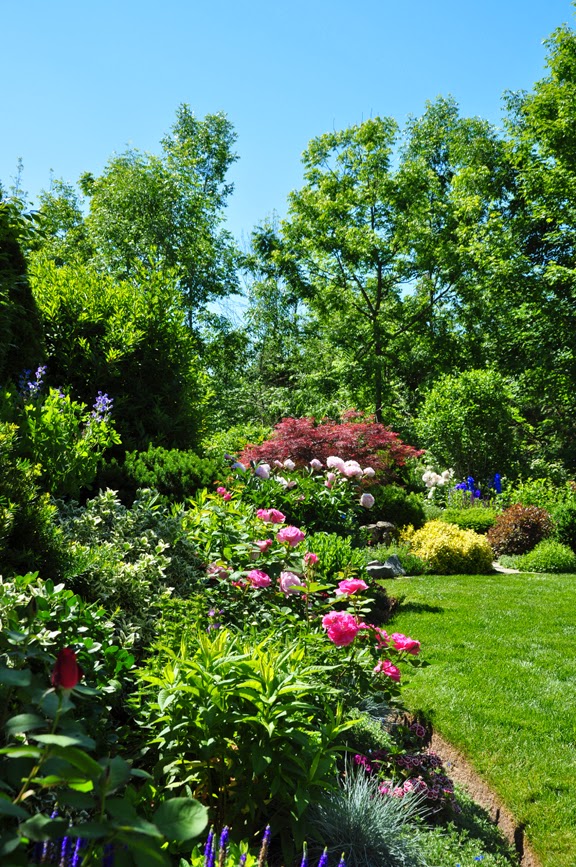
Along the far side of the garden there is a long border in full sun.


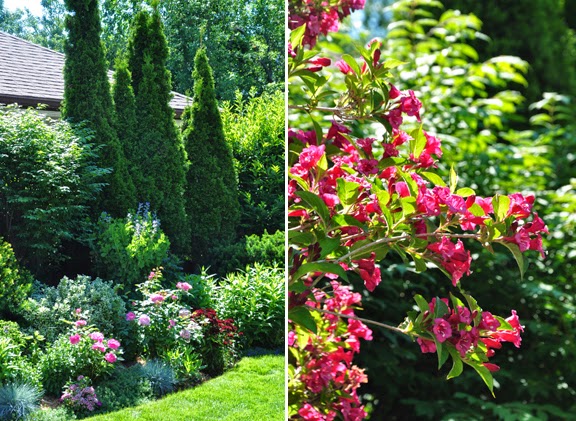
Disguising the yard's fencing there are a number of conifers and shrubs. (Above right) A Weigela, with its vivid cherry flowers. (Below) A soft, mauve-colored Lilac.


Stepping down one level to mid-height, the plantings include the False Indigo, Baptisia australis, Yew, pink peonies, and euonymus.

At the front of the long border there are among other things:
pink roses, blue Veronica and Sweet William.

In my humble opinion, Sweet William is a cottage garden flower that you don't see in gardens often enough.
Dianthus barbatus dwarf double mix: Height: 15-30 cm Spread 20-30 cm. Sweet William require full sun and bloom mid-summer. They are usually grown as a self-seeding biennial flower. This strain produces a low mound of green leaves and bright, double flowers in shades from white through to pink, magenta and red. Remove fading flowers to encourage more buds. Pruning plants back hard in fall will enourage them to live for a second year. They make excellent cut flowers. Hardy USDA zones 2-9.

I hope you enjoyed seeing Cynthia's garden as much as I did.
