
Marnie's shade garden is one of the first things you see when you turn off the gravel road. It's right off the long driveway tucked under a cluster of pine trees.
Marnie started her shade garden back in the early nineties when she had several dump truck loads of compost delivered and then spread to create the long borders that frame the outside edges of the garden.
"There was no design thoughts whatsoever in choosing the spot," Marnie recounts, "The shade garden was just an unused area of the property down by the road. My sister loved hostas and got me interested in them. So I started collecting. I didn't really think about mood or feeling. I just started planting things that appealed to me."

Marnie lives in the countryside not far from the town of Bracebridge, Ontario, which makes her garden zone 4a. In winter, it can get pretty cold (By way of example, this coming Sunday will be a bone-chilling -18 Celsius). Spring, which arrives sometime in May, brings rain and lots of black flies (Marnie wears a bug suit). Summers can be hot and dry.
I asked Marnie about soil moisture– another key consideration in any shady garden.
"Most of the area has average moisture, but there is a swale that fills with water after a rain and takes a while to drain. That is where the big Damera and the Filipendula rubra are planted," she says.


You can get a good idea of the size of this first featured plant in the pervious image (middle foreground).
Umbrella Plant or Indian Rhubarb, Darmera peltata has leafless flower stems that emerge in the spring, with clusters of white or soft pink flowers. The large, lobed leaves are cupped and can reach almost 24 inches across. This is a plant native to mountain stream banks and woodlands from southwestern Oregon to northern California. It needs moist, clay soil and some protection from the sun (i.e. shade/part-shade). Darmera peltata plant prefers cooler climates and does not do well in southern parts of the States. Divide this perennial's rhizomes in the fall. Height: 90-120 cm (35-47 inches), Spread: 90-120 cm (35-47 inches). USDA zones: 3-9.

"The white pines were there at the beginning, but are a lot bigger now. Some are starting to die back for some reason and the canopy is not as dense. I can see this area not being a shade garden ten years from now," says Marnie.

Marnie: "With my hands, I gently rake up the pine needles on the beds and spread them over the paths– lovely and soft to walk on."
Over the years, Marnie's shade garden evolved to cover a fairly large area. Hostas still form the backbone of the plantings, but there are lots of other unique and unusual perennials, many of which Marnie has grown from seed.
Hopefully, you now have a general picture of what Marnie's shade garden is like. Now, with a mix of pictures taken by Marnie herself, and some I took during a summer visit, we'll follow the seasonal shifts in this part of the property from early spring through to the fall. (Go make yourself a coffee and settle in. This is a long post even by my standards! LOL)

A pink variety of Pulmonaria. Photo by Marnie Wright.
Spring
As the days warm and spring rains arrive, the the plants in the shade garden begin to emerge. "Spring here is very wet and I have to slosh around in my bog boots well into June some years. I have loads of color in spring with ephemerals and then the peonies," Marnie tells me.
Marnie's Spring Plant List for Shade:
Hellebores, Primulas, Pulmonaria, Epimediums, Brunnera, Hepaticas, Darmera peltata, Dicentra spectabilis (Bleeding Heart), Glaucidium palmatum (Japanese Wood Poppy), Peony obovata (Species Peony), Chrysogonum virginianum, Stylophorum diphyllum (Native Wood Poppy), Phlox divaricata (Woodland Phlox), Azaleas, Anemonella thalictroides, Mertensia virginica (Virginia Bluebells), Erythronium, Tiarella, Chrysogonum virginianum (Golden Star), Diphylleia cymosa

The Hellebore on the left is an unnamed seedling. The one on the right is Hellebore 'Banana Cream Pie'. Photos by Marnie Wright.
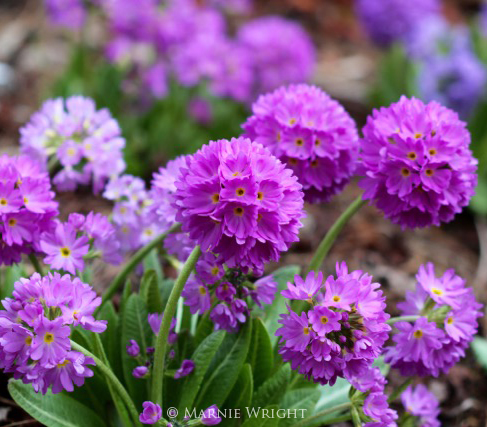
Drumstick Primula. Photo by Marnie Wright.

Wild Columbine, Aquilegia canadensis (on the left) and Woodland Phlox, Phlox divaricata (on the right). Photos by Marnie Wright.

Photo by Marnie Wright.
Marnie has taken some lovely pictures of her spring garden, but this is one is my favourite.
I love, love the mixture of textures and colors here; the contrast of the big, bold blue-green hosta with the smaller chartreuse hosta in the foreground, the coral leaves of the Heuchera mixing with all the greens, the little cloud of purple Phlox divaricata and the dots of hot pink provided by the Candelabra primula. Pure shade garden magic (and something to aspire to in my own garden)!

Photo by Marnie Wright.
Candelabra Primrose, Primula japonica is a group of woodland plants with fresh green foliage and a crown of flowers in late spring. They prefer part-shade and moist or wet clay soil that is rich in organic matter. Height: 30-60 cm (12-23 inches), Spread: 25-30 cm (10-12 inches). USDA Zones: 5-9

With a mix of colorful blooms, Pulmonaria is an early spring standout.
Photo by Marnie Wright.

The purple stems of this plant caught my eye when I was in Marnie's garden in July. They're a great reminder that more than flowers can be a source of color.
Here's what this native plant looked like earlier in the spring.

Golden Star, Chrysogonum virginianum is a lovely native ground cover. It forms a low spreading mound of green leaves, but does not run rampant. In spring, it has yellow, star-shaped flowers. This plant likes moist, sandy or clay soil. Part-shade to full shade. Height: 15-20 cm (6-8 inches), Spread: 30-45 cm (12-18 inches). USDA zones: 5-9.

Summer
It's July and the boggy areas of the garden have dried out. Everywhere in Marnie's expansive garden there are flowers (see the main garden here and here). Under the pines, the shade garden is a welcome respite from the heat of summer.
Marnie's Summer Plant List for Shade:
Angelica gigas, Thalictrums, Hosta, Japanese Ferns, Maidenhair Fern, Glade Mallow, Napaea dioica (Glade Mallow), Astilbe, Heuchera.


Marnie
So often shade is viewed as a hinderance– an unfavourable growing condition that a gardener must struggle to overcome. So I asked Marnie for some advice: how might a gardener best use plants to make a shade garden just as attractive as a garden in full sun?
Marnie had a number of really great tips:
• First, you have to be thankful for the wonderful greens that form the backbone of the shade garden. Enjoy how lush the shade garden is, and how restful and soothing a place it can be. Take advantage of leaf form, texture and variations in green coloring. Then use these green plants as a backdrop and as a contrast to the flowering plants that will grow in shade.
• Take note of the degrees of shade and research which plants can tolerate deep shade and which like a bit more sun. Plant accordingly.

• Be thoughtful of bloom time and plant for all-season interest.
• Plants with subtle colors can benefit from being planted in larger groupings or planted closer to a pathway where they can be observed in detail.
• If a perennial is tall, and I like it, I will even plant it up closer to a path or edge of a bed where I can enjoy it better.


Meadow Rue, Thalictrum

False Hydrangea, Deinanthe is native to cool, moist regions of China. Large hydrangea-like leaves arise from woody rhizomes in the spring. In June or July clusters of nodding, cup-shaped blooms stand above the foliage. This plant likes moist, humus-rich soil. It needs full shade and protection from strong winds. Height: 30-45 cm (12-18 inches), Spread: 60-75 cm (24-30 inches). USDA zones: 5-7.

Astrantia flowers in among the hosta. You can read more about Astrantia here.

Japanese Ferns.

You can see the plant featured next in the left foreground.

Marnie grew this impressive looking plant from seed.
Glade Mallow, Napaea dioica is an endangered native plant that is found on riverbanks, lake margins and on floodplains from Ohio to Illinois and Minnesota. In mid-summer it has white flowers that open in the daylight and close each night. This native has flowers that are both male and female on separate plants. Grow them in clumps to insure cross pollination. Schizocarpic fruit appears on the female plants in late summer. They like a sheltered location in moist, loamy soil. Full sun to part shade. Height: 4-8 ft, Spread: 2-3 ft . USDA zones: 3-8.

On the left is Solomon Seal, mixed with the pink flowers of Pink Cow Parsley, Chaerophyllum. You can read more about Solomon Seal here. Photos by Marnie Wright.

Photo by Marnie Wright.
Fall
It's September and though the afternoons are still pleasant, the nights have begun to get cool. "I enjoy the way the colours change as plants die back, which is a bit of an unusual way of looking at garden plants. I don't cut anything down in the fall. The hostas, the Damera, the Bergenia (has red-colored foliage in part-shade) all contribute great fall color," says Marnie.
Marnie's Fall Plant List:
Heuchera (fall-colored foliage), Cimicifuga, Paeonia obovata (attractive seed heads in fall), Tricyrtis hirta (Toad Lily), Jack-in-the-Pulpit, Diphylleia cymosa (Umbrella Leaf), Ligularia, Gentiana asclepiadea (Willow Gentian), Gentiana andrewsii (Bottle Gentian which can flower into October), Thalictrum rochebrunianum, Angelica gigas (colorful through September and has attractive seedheads), Mukdenia rossii (a groundcover with good fall color).

The plants with the yellow flowers are Ligularia. The tall maroon flowers
are Angelica gigas. Photo by Marnie Wright.

1. Brunnera 'Jack Frost' 2. Cimicifuga 3. Hosta (unknown cultivar) 4. Astilbe 5. Heuchera villosa (specific cultivar unknown ) 6. Heucherella 'Sweet Tea'

Who needs flowers when you have foliage like this? Black Cohosh, Cimicifuga

The flowers of Black Cohosh, Cimicifuga. Words can not describe how incredibly fragrant these flower are. Photo by Marnie Wright.

Toad Lily, Tricyrtis hirta. Photo by Marnie Wright.

Photo by Marnie Wright.
Devil's-bit Scabious, Succisa pratensis is a member of the honeysuckle family. The wild form of this plant is often found in damp meadows in Britain and Ireland where blooms in late summer and fall. It has herbal uses and has been used as a remedy for everything from eczema to syphilis and the plague. It has obovate leaves and a pale mauve flower on a long stem. Loved by butterflies and bees. Part-shade. Can self-seed generously. Height: 60 cm, Spread: 30-40 cm. USDA zones: 5a-9b.
Apart from flowers, Marnie suggests shade gardeners consider interesting seeds and seed pods as sources for color and interest: "The blue seeds are red stems on the Diphylleia cymosa or the red seeds on Jack-in-the-pulpit are great examples", she says.

Umbrella leaf, Diphylleia cymosa
Umbrella leaf, Diphylleia cymosa is another North American native. It has small, white flowers which transform into the amazing berries you see here. The large, round, umbrella-like leaves give the plant its common name. Diphylleia cymosa likes moist, rich soil. Part-shade to full shade. Height: 60-90 cm (24-36 inches), Spread: 60-90 cm (24-36 inches). USDA zones: 4-9.

Paeonia obovata Photo by Marnie Wright.
Japanese Forest Peony, Paeonia obovata is a wild species of herbaceous peony that is native to Siberia, China and Japan. As you can see, it has amazing seedpods in the fall. The somewhat plain, single flowers are white or rose-purple. By late summer, the pods have begun to split revealing shiny blue-black seeds in amongst the bright-red seeds that have remained infertile. This peony likes rich, somewhat moist soil and part shade. Do not remove spent flowers, if you want these attractive seed pods. Peonies are long-lived and do not need to be divided. Height: 30-60 cm (12-24 inches), Spread: 30-60 cm (12-24 inches). USDA zones 5-8.

The golden hues of fading Solomon Seal, Polygonatum. Photo by Marnie Wright.
Hopefully more experienced gardeners have found a few new plants to try in this post, but if you happen to be a more novice shade gardener, where should you even begin to create a garden like this one? Marnie recommends you don't over think things. She suggests starting simply:
"Begin with a collection of a plant you like. For instance, I have a lot of different varieties of ferns interspersed with hostas. The contrast of their leaf forms is pleasing. Mostly, don't stress! Green is the best color of all– so just go nuts with that palette and use color where you can. Have fun!"
Have fun! A simple, but terrific bit of advice. Gardening should always be a joy, not a chore.
Many thanks to Marnie for allowing me to use the images and the assistance
she gave me in putting this post together!

Bookmark this post with a Pin.


