Showing posts with label Late Summer color. Show all posts

Wednesday, September 5, 2012

Gratitude

Perennial Fountain Grass

When is life ever simple or straightforward?

The other day, I opened the back door to discover that a tiny chickadee had become trapped in our enclosed porch. The screen door, which is always propped open so the dogs can come and go in the summer months, meant that the chickadee actually had an easy means of escape. Instead all his attentions were focused on the freedom clearly visible through the glass windows.

I watched helplessly as he flung himself repeatedly against the panes of glass; wings beating furiously against the unyielding window. Something had to be done or he was going to injury his wings, or even worse, break his neck. But how could I catch him?


Annual Cleome

This was not the first time that I have had to rescue another creature in recent days. Just last week, I was in out driveway putting away our recycling bins, when a golden retriever appeared out of nowhere. We have a small community, so I know all the neighbourhood dogs, and the retiever was not among them. This dog was clearly lost.

Our house on the corner is the last respite. The retriever would have to face the prospect of crossing a very busy road before she could wander further. Quickly, I hatched a plan to put her in the fenced back garden, until I could find her owner.

"Well, hello there!" I said in greeting. The tail started to wag. I have never, ever met an ill-tempered golden retriever.

"Aren't you a good girl! Come here!" I commanded in friendly voice. Obediently she trotted over, relieved to be rescued with a few kindly words and a gentle pat on the head.

Looking to gain her complete trust, I gushed further praise, and rubbed behind her ears, while sneaking my hand around to gently grab hold of her collar.

She did not object when I opened the back gate and lead her into the garden.


Annual pink cosmos and blue Salvia.

Do you have a personal I.D. and phone number on your pets?

The golden retriever had none; just a city dog license and a tag with her vet's contact information. The vet's number was long distance. How far had this dog come I wondered? Hmm...perhaps the vet's tag were old and the owner had moved. The only local number was the dog licensing offices. Would the owner face a fine for letting their dog run loose? Probably! But without a personal I.D. tag, I had no choice but to call the city's animal control offices.

"She's a repeat offender!", the woman on the other end of the phone declared after I read off the retriever's license number to her. Repeat offender? I looked over at the retriever's round, joval-looking face in dismay. Was she really suggesting this dog was a criminal of some kind?

"Will the owner face a fine before they can reclaim their dog?", I asked. In my head, I wondered just how grateful the owner was going to be for this rescue.

"Yes, but she's been warned several times to keep better control of her dog, so don't feel too sorry for her." I waited on the line while the animal control officer tried to get the dog's owner on the phone. No answer! Instead an officer was dispatched to pick up the poor retriever to take him to doggy jail until his owner came to pay the fine and claim him.

Had I done the right thing?


 Feather Reed Grass and Perennial Fountain Grass

The same nagging doubts made me hesitate when I found the chickadee trapped in the back porch. I didn't want to cause injury in an attempt to do good.

In spite of my trepidation, I seized the opportunity to act when the exhausted bird slid down the glass to the shelf along the bottom of the window. For a brief moment, he was trapped between the little decorative bottles on the shelf and the window pane. I cupped my hand around his tiny body, taking care not to damage his wings...ah-haw, caught him!

Holding this little soul in my hands was like holding air.

For a brief moment, we regarded one another. Then with his black beak, the chickadee pecked at my hand just to let me know who was boss.His beak was so tiny however, it hurt not at all. My grip remained firm. The poor chickadee grew still, resigned to his fate. I am sure he must have thought that he was lunch.

I walked to the door and opened my hand. Gratitude took wing and then was gone.

All the images in this post were chosen for their delicate, bird-like qualities. 
The pictures were shot recently in one of the city's parks.

Tuesday, August 23, 2011

Taking Notes on Late Summer Color at Larkwhistle Gardens


When I was but a young thing, with not much more than dreams of my very own garden, I turned to books to teach and inspire me. 


Of those books, some of the most influential were the ones written by Patrick Lima, with beautiful photographs by his partner John Scanlan. Their garden, located in the northwestern corner of the Bruce Peninsula in Ontario, was everything I hoped to create myself one day.

When I was finally able to visit the garden I had studied in books for years, I was not disappointed. The garden was every bit as amazing as it had appeared in the glossy pages of my books. 

Recently, we were able to return for a second visit to the garden Patrick Lima and John Scanlan have named 'Larkwhistle'.

Although I have now been gardening for years, I think that I still have lots to learn. I find that there are always plants that I have forgotten about or otherwise overlooked. And I am always delighted to discover perennials that I have never attempted to grow myself. Color combinations still leap out and surprise me. 

The plan of Larkwhistle Garden from the book The Art of Perennial Gardening by Patrick Lima, 
Photographs by John Scanlan, Published by Firefly Books in 2000. 

So, come along with me and take a stroll down the soft, sandy paths of Larkwhistle. It is late summer, a time when many perennials have faded, yet there is lots of color here. Let's take a look and see what is in bloom.

The three tall perennials in a row just inside the front gate are Mullein. Two varieties of Mullein are grown at Larkwhistle, Verbascum olympicum (Greek Mullein) and Verbascum bombyciferum (Turkish Mullein). 

Mulleins are a biennials plants, which produce leafy rosettes in the first year, and flowering stalks in the second year. Verbascum olympicum is the branching Greek relative of the North American native Verbascum thapsus, which can often be seen growing in fields of wild flowers. The second variety of mullein, Verbascum bombyciferum is thickly coated with downy wool and has clear yellow flowers. Both mulleins prefer sun and light, sandy soil.


At Larkwhistle, the mulleins are left to self-seed. Patrick Lima writes that the spent flower stalks are a winter favourite with chickadees. In spring, the young seedlings are lifted from wherever they have happened to have appear and are transplanted towards the back of the flower borders.

When it comes to color, sedums are indispensable at this time of year.

Opposite the sedums and just beyond the pond are these pretty lilies.


Hummingbirds were going wild for these 'Black Beauty' Lilies. 


Now, we will turn and head into the main garden.

Just as you enter the garden, there is a garden bench. Behind it is a mixed planting that includes navy-colored Monkshood, Aconitum and white Phlox, Phlox paniculata 'David', yellow daylilies and tall yellow-orange Helenium.

Opposite the bench is a cluster of Torch Lilies (Kniphofia). Torch lilies, which have elongated heads of tubular flowers, are listed as hardy to Zone 6, yet they survive the harsh winters of the Bruce Peninsula. Patrick Lima writes that the secret of getting them to over-winter is to plant the lilies in light, sandy soil that provides good drainage. As an extra measure, he also suggests that in fall you bunch the spent leaves to make a sheltering tent. Then, a light soil is heaped over the crowns, and leaf mulch is placed around (not over) the tuft of tied foliage.

False Mallow, Sidalcea 'Party Girl'


Did you notice the tall perennial just behind the False Mallow? It is Helenium or Sneezeweed. I have found that this North American native is a great upright plant in my own late summer garden. They prefer rich moist earth and sun, but it will tolerate light shade.


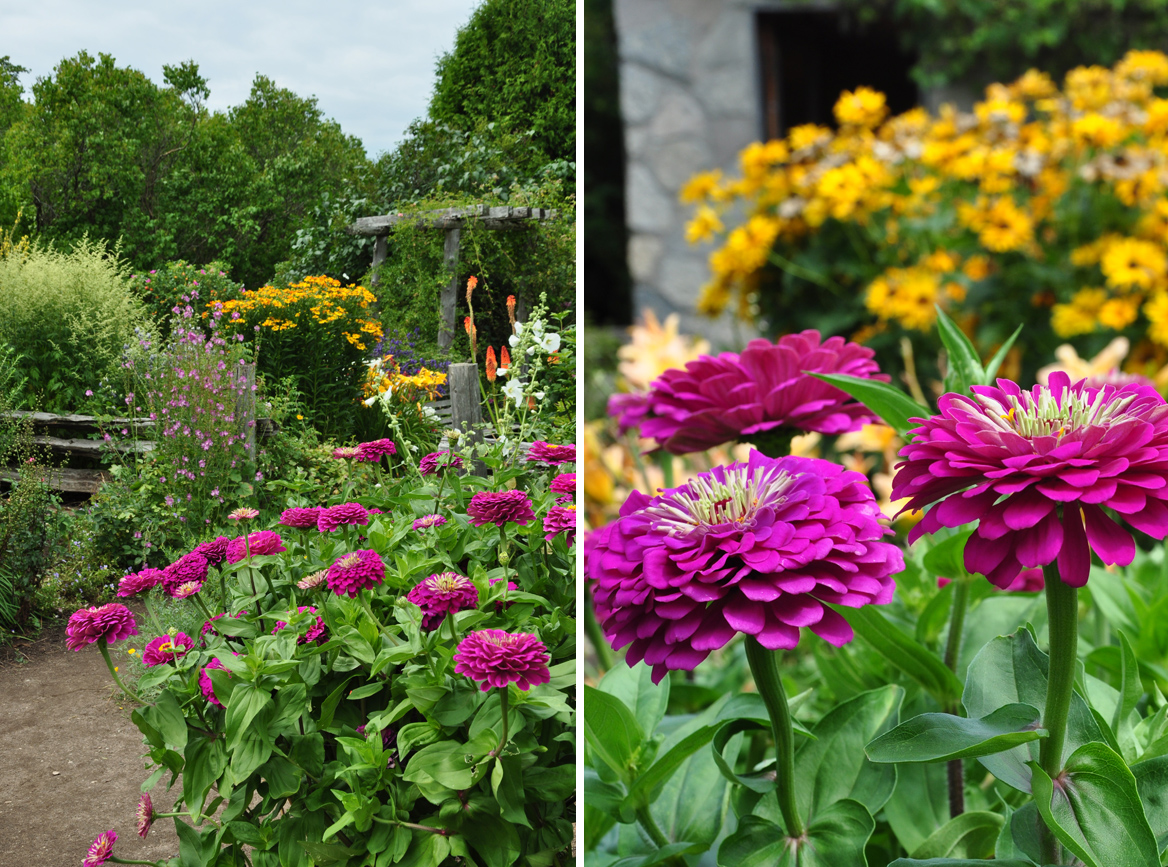
I was blown away by this zinnia and when I got home I was kicking myself for not remembering to go back and ask its name. A little research online leads me to believe that it is Zinnia 'Purple Prince'. The magenta colored flowers were an impressive 3" or 4" inches in circumference.


We are now going to head down another pathway at the top of the garden to see what is in flower there.

Another hummingbird magnet is scarlet Crocosmias. Though Crocosmia is native to South Africa, they can actually be made to over-winter in a northern garden if they are given good drainage and a generous topping of mulch. Grown from spring-planted corms, Crocosmia require sun and light, sandy soil. Interesting to note, is the fact that deer apparently dislike the taste of them.  


You can always depend on phlox for great, late summer color.


Phlox blossoms float on the surface of a small pond.

Right beside the phlox are soft blue Globe Thistles, Echinops ritro. Globe thistles like full sun (although I have a plant that puts up with light shade).


Just opposite the Globe Thistles are Sea Holly, 'Eryngium planum'. I made the mistake of planting one in light shade and can tell you from disappointing results, that it is a plant that will only be happy if planted in full sun. 

This post is getting a bit long and so we will head into the garden's core in my next post.