I am sure I am not alone in this, so I have visited a couple of nurseries and have come up with a list of ten perennials that will give that a bit of refresh to areas of your yard that are looking a bit tired.

In previous years, I let myself get discouraged by lily beetles and stopped planting any new bulbs. This is a bit of a shame because lilies really add color and drama to any mid-summer garden.

Lily Beetle eggs on the left and larvae on the right.

A mature Lily Beetle.
So I've begun to watch the underside of the leaves for the bright orange eggs and the rather ugly larvae. As Jean Godawa wrote in her helpful article, "Understanding the lifecycle of a garden pest is the first line of defence." I find that wiping away the eggs and larvae keep the bright red insects in check quite nicely. Now I feel confident enough to plant more lilies.

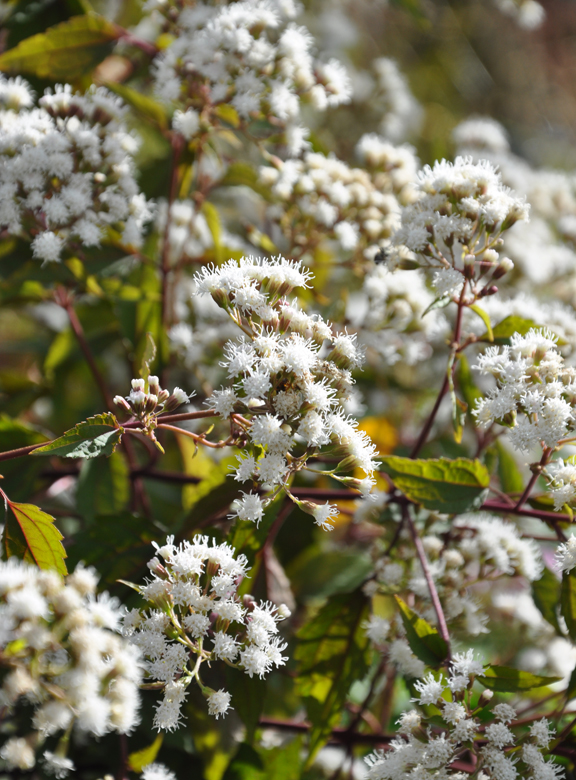
This is Duff and Donna Ever's garden in Nova Scotia. I particularly like the way Donna has tucked the pinky-orange lilies in behind the dark foliage of Eupatorium rugosum 'Chocolate'. Later in the summer, 'Chocolate' will be covered in a cloud of starry, white flowers.

Photo by Sandi Duclos
This is interior designer Sandi Duclos' garden in Kitchener, Ontario. The pink Oriental Lilies looking stunning set against a wall of purple clematis. (Sidenote: I will be showing you more of Sandi's garden in upcoming posts).
I already have a purple clematis. All I need to recreate this combination are some lilies and I know I can find some at our local Farmer's Market.
I already have a purple clematis. All I need to recreate this combination are some lilies and I know I can find some at our local Farmer's Market.

If you would also like to add some lilies to your garden, you may be able to find some potted up at a local nursery. Alternatively, bulbs are usually sold in by mailorder in both spring and fall.

I haven't forgotten you shade gardeners. There is a type of lily that can handle part-shade.
Martagon Lilies' downward-facing flowers are smaller than other types of lilies, but the quantity of blooms on a single stem makes up for the tiny size. There can be up to fifty of these delicate blooms on a single stem. Martagon Lilies like part-shade and moist, well-drained soil. USDA zones 3-7.
Lilium martagon 'Album' in Redford Garden, Quebec.
I haven't forgotten you shade gardeners. There is a type of lily that can handle part-shade.
Martagon Lilies' downward-facing flowers are smaller than other types of lilies, but the quantity of blooms on a single stem makes up for the tiny size. There can be up to fifty of these delicate blooms on a single stem. Martagon Lilies like part-shade and moist, well-drained soil. USDA zones 3-7.

Veronica 'Perfectly Picasso'
On its own, it can be a little understated, but as a companion plant, Veronica is hard to beat. It seems to compliment so many other perennials!
Veronica requires full sun and are quite happy in average garden soil. Depending on the cultivar, they're hardy USDA zones 3 or 4-9. If you deadhead them after they flower, Veronica may even produce a second flush of blooms.

An all-white mix of Hydrangea paniculata 'Bobo', Sweet Alyssum and Veronica
'White Wands' in my own garden.

Last year I created a brand new flower border in full sun and was able to incorporate a big patch of Echinacea for the first time. As I result, I am noticing more butterflies in the garden this July. A big clump of Blue Star may now be sacrificed so I can plant yet more Echinacea!
Echinacea is easy to grow. Give them full sun. I have tried them in part shade and I find they don't do nearly as well. Like most perennials, they like well-drained soil. Too much moisture can cause root rot. Echinacea forms a slowly expanding clump that should be divided every few years to maintain its vigour. Depending on the cultivar, they're hardy USDA zones 3 or 4-9.
Echinacea is easy to grow. Give them full sun. I have tried them in part shade and I find they don't do nearly as well. Like most perennials, they like well-drained soil. Too much moisture can cause root rot. Echinacea forms a slowly expanding clump that should be divided every few years to maintain its vigour. Depending on the cultivar, they're hardy USDA zones 3 or 4-9.

Pink Coneflowers (Echinacea) along with Shasta Daisies and Globe Thistle, Echinops ritro in
Mira's garden in Guelph, ON.


Here's a pretty plant combination to inspire you to plant Echinacea. It also works really well with Joe Pye Weed (Eupatorium), Agastache, Black-eyed Susan (Rudbeckia), and Phlox Paniculata.
Helenium autumnale Mariachi 'Fuego'
Sneezeweed or Helenium autumnale is a North American native plant that can often be found growing in wild, damp meadows. The hybrids that you'll find at the nursery are tall, upright perennials with daisy-like flowers in an array of hot colors. They like full sun and average to moist garden soil. Hardy USDA zones 3 or 4-9.
Plant Helenium along with Phlox, Russian Sage, Rudbeckia and Ornamental Grasses.
While the best time to plant Helenium is in the spring, they are showy now, so nurseries usually have displays of them at this time of year. If you do purchase a plant, make sure to keep it well watered until it is established.

Have you ever planted something and then promptly forgotten what it is you planted (learning once again that it pays to add plant markers)?
For the last couple of months, I have been completely puzzled by something I added to my old nursery bed. I knew it wasn't a weed. Finally, it's blooming last week and I know what I planted. It's a Liatris ligulistylis!


Liatris in a prairie style planting at Edward Garden in Toronto.

White Liatris spicata in my own garden.
You may be more familiar with Dense Blazing Star, Liatris spicata. It's a native plant that has vertical flower spikes and thin, strappy foliage. The lavender or white flowers open from top to bottom over a period of several weeks. This plant grows two to four feet tall, likes full sun and moist to average, well-drained soil. USDA zones 2-9.
Meadow Blazing Star, Liatris ligulistylis is less commonly seen in gardens and is a perennial native to the Canadian Prairies. The flowers are more tufted and the plant stems are eggplant in color. Liatris ligulistylis is taller than Liatris spicata and can reach a height of 5 feet when planted in rich garden soil. Liatris ligulistylis likes full sun and average to moist soil. It's hardy USDA Zones: 3-7.

The reason to track down Liatris ligulistylis are the butterflies. They seem to love this plant! When the flowers are finished, the seeds are popular with goldfinches.
You should be able to find potted Liatris spicata in creamy-white and purple at your local nursery. Liatris ligulistylis can be tracked down at speciality nurseries and online.


There was a time you rarely saw this plant, but Betony, Stachys monieri has become more popular of late. I like this perennial's versatility. I have it planted in full sun in rather dry conditions and also in part-shade. It does have one minor drawback – the soft, slightly furry leaves are prone to insect damage.

If you are a plant collector like me, you may want to watch out for this plant. I rarely see it in gardens, which is a shame.
It is Big Betony, Stachys macrantha 'Rosea' and is sometimes listed as Stachys Grandiflora (I hope I have the I.D. right-please correct me if I am mistaken). The notes I found suggests moist, rich soil and full sun, but I have my plant in dry, part-shade. USDA zones 2-9. Again, a great option for mid-summer.


With climate change, many gardeners are looking for plants that can handle heat and drought conditions. Yarrow is a tough, drought-tolerant perennial that likes a hot, dry, sunny location.
While the species plant Achillea millefolium spreads by underground rhizomes, many of the modern cultivars and hybrids have improved features like stronger stems, larger flowers and clump-forming habits. They like full sun, good drainage and average to poor soil. Depending on the cultivar, hardy USDA zones 2-9. I have written about Yarrow in the past, so I am going to refer you back to that blog post for more information on Yarrow.
Daylilies have to make my list. They put on such a nice display of flowers mid-summer and are such easy-to-grow perennials. Full sun and average garden soil are all you need to be successful with these plants. Soil moisture is key to having spectacular blooms and will even encourage re-blooming.
Daylilies in a private front garden.
Two different colors of daylilies along with orange Butterfly Weed and purple Liatris in Mira's garden in Guelph, ON.
Ideally, daylilies should be planted in the spring or the fall. One advantage to shopping for daylilies now is the opportunity to hand-select the perfect combination of flower form and color from a local grower. Many daylily farms have open houses at this time of year. Alternatively, you should be able to find a limited selection of daylilies at most nurseries. In the spring, you can order them from many online sources.

It is Big Betony, Stachys macrantha 'Rosea' and is sometimes listed as Stachys Grandiflora (I hope I have the I.D. right-please correct me if I am mistaken). The notes I found suggests moist, rich soil and full sun, but I have my plant in dry, part-shade. USDA zones 2-9. Again, a great option for mid-summer.
Butterfly weed

Asclepias incarnata 'Ice Ballet'
Swamp Milkweed, Asclepias incarnata is a clump-forming perennial that is an important food source for Monarch butterflies. I have the pink form as well as the white variety called 'Ice Ballet'. Both are growing in light shade, but they would be just as happy in full sun. Butterfly weed, Asclepias tuberosa is newer to my garden. I just love that bright orange color mixed with the soft blue flowers of Calamintha.
Again I have written rather extensively about these plants, so I will refer you back to an earlier blog post for more information.
You can just make out the legs of the spider under the bee.
Why is this honey bee upsidedown?
It's because he has been captured by a white spider who has been lying patiently in wait on the blue spike of this Agastache flower. Insects flock to this mid-summer bloomer, so it is a good place for a spider to hide.
It's because he has been captured by a white spider who has been lying patiently in wait on the blue spike of this Agastache flower. Insects flock to this mid-summer bloomer, so it is a good place for a spider to hide.
I love the frosty blue flowers of Agastache and the pinkish cast the leaves take on as the temperatures drop. 'Blue Fortune' blooms from mid-July well into October. Full sun to light shade and average soil and moisture conditions. USDA zones 2-9.

A couple of bonus plants for shade. While hosta are primarily a foliage plant, they can be quite pretty when in flower. 'Blue Mouse Ears' is a mini-hosta that has sweet little flowers mid-summer.

Please forgive my soft focus here. I really wanted to show you the Corydalis elata that I admired in Donna Ever's garden during my recent visit to Halifax, Nova Scotia. I saw it a second time at Redford Garden in Quebec where it was planted in among ferns and other shade-loving plants.
Corydalis elata hails from Southwest China. It has elegant green foliage and tubular blue flowers that are fragrant. Donna tells me, "It blooms forever." It likes dappled sunlight and rich, woodland soil that remains evenly moist. USDA zones 5-9.

If you are purchasing any of the perennials off this list, please keep in mind the days in early August are hot and dry. This isn't an ideal time to plant anything. I don't think you'll have a problem however if you make sure any new plant is watered routinely.
Do you have a favourite mid-summer perennial that I should have included in this list? Please share!