Showing posts with label DIY. Show all posts

Saturday, April 18, 2020

10+ Ways to Dress up the Side of a Garage (or Wall)


Of all the crazy things, a garage can be a bit of a design dilemma for gardeners. Whether it's stuck out at the front of your house or recessed on one side, the wall of the garage often stares the gardener in the face. How can you make that big blank surface work with the lush green space of your imaginings? 

I've gathered together some of the creative solutions people have found to deal with the problem. With most home stores and nurseries closed, executing these ideas may have to wait, but having a plan is a huge step forward. 

If you don't have a garage, many of these ideas might be useful to dress up any kind of wall or fence. 


Idea #1 Simply cover the face of your garage with a climbing vine. 

An empty wall contributes nothing to the relaxing atmosphere of a garden. In this shady backyard, the homeowner has opted for a Climbing Hydrangea. A low boxwood hedge outlines the formal boundaries of the flowerbed below it.


Some information on the vine used:
Climbing Hydrangea, Hydrangea Petiolaris is a deciduous, self-clinging vine that has bright green foliage and large, white, lace-cap flowers. It is slow-growing until established and then becomes quite vigorous. Climbing Hydrangeas like a regular source of water especially in hot weather. Prune right after it flowers. Full sun to full shade. Height: 50 ft., Spread: 80 ft. USDA zones 4-9.


If your garage has a full sun exposure, clematis, sweet peas or even a climbing rose might be possible (unlike the climbing hydrangea in my first example, these climbers will require the underlying support of some trellising).


Idea # 2 Frame and then paint panels of wooden lattice to create a trellis for climbing vines.


Idea #3 Create a focal point with a decorative panel. 

In this formal garden, the trelliswork and bench turn a red brick wall into something special. If you don't have a carpenter in the family, you could purchase and hang a decorative, laser-cut panel on the wall. Here are just two of the many options available:


On the left is the Matrix Woodland Plastic Decorative Screen (Bundle of three $249 US from the Home Depot. Note: not sponsored link. Other home improvement stores sell these panels as well) and on the right is Matrix Jungle Charcoal Recycled Plastic Decorative Fence Panel ($99 US also from the Home Depot). To get a similar look to my inspiration photo, I'd spray paint them cream (using a paint specially formulated to adhere to plastic).

If you have a larger budget, there are really nice panels with a rusted metal finish.


Idea # 4 Make a DIY trellis for a climbing vine. 

If you feel confident enough to make a few forty-five-degree cuts, a wooden trellis might be a great weekend project. Strings or wires run vertically from a row of nails at the top and bottom of each trellis as additional support for the fine tendrils of this clematis.


Idea # 5 Create a garden that runs the length of the garage.

This garden sweeps out in a curve from the straight line of the garage and incorporates a range of shade-loving plants. The brown ceramic pot sitting on top of a concrete pedestal gives the eye a resting place. You can identify some of the plants and see more of this shade garden here


Idea # 6 Use potted annuals for summer-long color.

Hardscaping can make an area wonderfully low-maintenance, but it can also look a little lifeless. In the previous set of photos, the narrow corridor that runs between the house and garage leads to the garden beyond. Pots of annuals bring color to all that neutral stone.


Idea # 7 Create an entrance.

When the garage and garden sit side-by-side, it's nice to create an entrance that distinguishes the two areas. Here, a wooden arbour marks the transition from driveway to the green space.


In this example, a stone gate separates the garden from the driveway and garage.


Idea # 8 Install a wall fountain.

The vines have covered the wall fountain in my inspiration photo above, so I have included a second example below. Trickling water is soothing and can mask street sounds.


Technically this is a shed, but it nicely illustrates my next idea.


Idea# 9 Transform the garage into a "cottage" with an infusion of charm.

In a small townhouse garden like this, the back of the garage seems inescapable. The roses, green ivy, lantern and the pretty wreath all combine to make you feel that there is something inviting on both sides of the door. 


Honeysuckle


Idea # 10 Use repetition to make the most of every inch. 

Often the space you have to work with is quite narrow. That's why climbing vines are such a popular solution. In the first photo, a honeysuckle vine is repeated for maximum impact. In my second example, hanging baskets carry the color up to eye level.


Idea # 11 Use architectural salvage, corbels, mouldings and decorative objects to personalize a space. 


Idea #12 Use an old frame and a planter box filled with colorful annuals to create a faux window on a blank wall.


I hope you and your family are staying well. COVID19 has directly touched my extended family, but I am glad to report that, after some weeks of serious illness, my brother-in-law has now fully recovered. Thank goodness for that!

Warm weather and better times are coming our way soon. In the meantime, I will continue to post lots of new plants, ideas and gardens that are inspirational.

Thursday, May 11, 2017

Walking on Eggshells; Fun with Spent Shells in the Garden, Kitchen, and Craft Studio

Photo by Signe Langford

By Signe Langford


The old adage is true; you do have to break a few eggs to make an omelette. But if you break the eggs carefully, there are a few fun things you can do with the shells too!

Okay, most of us gardeners already know the value of saving eggshells for the garden. They’re made of calcium – which plants need to thrive – and when crumbled up, they’ve got sharp edges that wreak havoc on those tender-bodied-but-tenacious snails and slugs. Shell shards are especially helpful all around the base of delicious hostas! Dig them into the soil around tomato plants to help stave off blossom end rot, too.

In the kitchen and craft studio, eggshells can enjoy a decorative and functional second life as mosaics, jewellery, candles, seedling pots, and even tiny serving dishes! For the last three crafts – candles, seedling pots, and dishes – the key is making a clean break. Thankfully, there’s a tool for that: it’s called an “egg topper” and there are a few on the market. I’ve only used this one from Swissmar, and I’ve found it works well, but only on cooked eggs; the shell needs the inner support of cooked white for a clean cut. Once you’ve mastered topping eggs, you’ll have some perfect specimens for playing with.

Photo by Signe Langford

Start Seedlings: Simply fill each eggshell with soil, plant the seeds, water, top up with a little more soil, and set them where you usually start seedlings – somewhere warm and sunny. Save the egg carton to hold them in, and set the egg carton on a plastic tray or pan, as they will leak. I have a couple of ceramic egg holders that look great on the windowsill!

When it’s time to transplant into the garden bed or pots, no need to take the delicate seedling out of its first home; just dig a hole big enough to accommodate the shell and all. I like to tap the bottom on a rock or something hard enough to crack the shell; that makes it easier for the roots to bust through. Tomatoes love getting started this way; that extra dose of calcium right from the get-go is just what the doctor ordered.

From the book Happy Hens & Fresh Eggs: Keeping Chickens in the Kitchen Garden – with 100 Recipes, ©2015, by Signe Langford, Photography by Donna Griffith. Published by Douglas & McIntyre. Reprinted with permission of the publisher.

Candles: If you’ve never made candles before, you’ll want to watch a tutorial on YouTube or take a class, and you’ll need to buy a few supplies, but it’s really very simple. I made mine with pure beeswax – the aroma is wonderful, they’re the healthiest and cleanest for burning, and when it’s dead, it’s still fine to add to the garden. So, stand the eggshells up – again, use the handy-dandy egg carton – add the wick, and gently pour in the melted wax, let cool, then trim off any excess wick. That’s all there is to it!

From the book Happy Hens & Fresh Eggs: Keeping Chickens in the Kitchen Garden – with 100 Recipes, ©2015, by Signe Langford, Photography by Donna Griffith. Published by Douglas & McIntyre. Reprinted with permission of the publisher.

Serving Dishes: Gorgeous little eggshell cups look amazing on the table filled with custard, fancy truffled scrambled eggs topped with a pinch of caviar, or even lined with chocolate and filled with mousse. Mother’s Day brunch will never be the same!

Here’s how you do it: invest in an egg topper or another sharp eggshell-cutting tool specifically designed to cleanly slice the tops off boiled eggs. As mentioned earlier, I have one from Swissmar that does the job. It works well with boiled eggs, either soft or hard, but with raw eggs, it tends to shatter the shell. once you’ve got a nice clean-cut edge, you’ll need to wash out the shell until it’s squeaky clean. Do this under just-warm, gently running water. If you use hot water, you’ll cook any remaining egg right onto the shell. As you wipe inside the shell with a finger – very carefully – look for a tear or lifted bit of the inner membrane; you’ll need to peel this out. But don’t worry, once you find a loose bit, it comes out super-easily. Once the membrane is out, give the shells one last rinse and set upside down on a cooling rack to dry thoroughly. Always prepare more eggshells than you need, in case of breakage.

Here’s my Recipe for Teeny Tiny Lemon Meringues en Coquille d’OeufThis dessert is about as sweet and adorable as a fluffy baby chick, and absolutely perfect for brunch.

About the author:


Signe Langford is a restaurant-chef-turned-writer who tells award-winning stories and creates delicious recipes. She is a frequent contributor to the Globe and Mail, National Post, Toronto Life, Canadian Living and Garden Making magazines. In 2105, Signe published her first book Happy Hens & Fresh Eggs; Keeping Chickens in the Kitchen Garden- with 100 Recipes
Raised in the town of Hudson, Quebec Signe grew up surrounded by an ever changing menagerie of critters, both wild and domestic, and her special affection for all feathered creatures has never flagged. At present, she shares a downtown Toronto Victorian with a tiny flock of laying hens. For more stories and recipes please visit www.signelangford.com

Photographer Donna Griffith is based in Toronto. She has taken photographs of food and drink, homes and gardens for a number of publications and books.

Bookmark this post with a Pin.

Monday, December 26, 2016

Illuminating Christmas


Happy holidays everyone! The two younger boys and I have been having fun playing in the white stuff. 

Despite what the seasonal calendar says, winter arrived a little over 2 weeks ago with a snow storm that hit its peak right at the 5 pm rush hour. We live in a deep river valley with a rollercoaster-ride-of-a-hill on one side and a steep slope that would be perfect for sledding on the other. Cars don't fair well on either of the two hills when there is a storm. Our street was a parking lot for hours. No one could get out of the valley.

Other than shovelling, my spare time in the weeks leading up to Christmas was filled with wrapping gifts, baking and decorating for the holidays.  I thought I would share a couple of the wreaths I made this year. Both make use of strings of little fairy (LED) lights. 


The start of the first decorating project was a plain evergreen wreath from the grocery store. 


To illuminate it, I used two strings of lights from the dollar store. Here's how I put it together:  


Step 1: 
I turned the wreath over to the wire frame at the back. Then I passed the first string of lights through an opening in the greenery to the front of the wreath. I left the string of lights hang loosely at the front of the wreath for now. Then I turned the wreath back over and attached the first battery pack to the wire frame with some green florist's wire. 


Step 2: Now we are going to attach the second string of lights in the same manner. It is critical to balance out the back of any wreath so it will sit flat to your door.  With a fresh piece of wire,  I attached the second battery pack on the opposite side of the wreath. 


Step 3: I turned the wreath over to the front and roughly placed my strings of lights in amongst the foliage. I ran the first string of lights clockwise around the wreath and the second string of lights counter-clockwise. 

Once I was happy with the placement of my lights, I used some florists wire to hold them in place. To do this, I used loops of wire that I twisted closed on the back of the wreath.


Step 4: If your wreath was as basic as mine, you may want to augment it with more greenery, berries, pinecones and a bow. That's just what I did next.


Here's the first finished wreath. You can't see the glow of the lights really well in the daytime, but at night the they shine nicely.

One important thing to note: These cheap LED light strings are for indoor use only. I have a covered porch and a screen door with a glass front, so I was able to get away with using indoor lights. If your door is exposed, this type of light string may or may not short out in wet weather.


For the wreath I made for the back door, I used three strings of lights. There are two LED sets ($2.50 each from Walmart) and a string of larger stars ($5 from the Real Canadian Superstore).


This time the 3 battery packs were placed in thirds by dividing the wreath circumference into three equal parts. Again, it is critical to balance out the back of the wreath so it will sit flush to the door.

Step 1: The first step is to attach the two strings of mini-lights. (The third string of lights will go on later after the greenery is attached. If you try this, make sure you space the battery packs so you leave room for the third battery pack that you will add later).

To work my lights through the maze of grapevines, I used a pencil and poked it into the the vines to create a gap. Then I worked each of the lights up through those gaps. Once the pencil is removed, the gaps disappear.


Step 2: Next add your greenery to the front of the wreath, some berries and a bow. (Tuck the greenery right into the vines. Loops of florist's wire can then be added to hold it securely in place.)


Step 3: Turn your wreath over to the back and attach the third battery pack for the larger string of lights with two loops of wire. Flip the wreath back to the front and roughly place the lights using the greenery to conceal the wire for the lights. Using more loops of florist's wire secure this final string of lights to the wreath.

If you are having trouble disguising some of the wires, add a few more pieces of greener to conceal them.


I am especially happy with the way this one turned out. 

Again, these light strings are for indoor use only. The back door has screen door with a glass front, so I was able to get away with using indoor lights. If your door is exposed, these type of lights might short out in wet weather. 


Outdoor strings have larger, more weatherproof battery packs, but it's hard to work with the larger sized packs. As an experiment I made a wreath for the back gate using strings of indoor LED lights. It held up remarkably well and shone every evening through the holiday season.

Have fun decorating for the holidays!


Friday, December 9, 2016

Grapevine & Ivy Topiary


What does this gardener do when the weather turns cold and grey? She taps into her artistic side and gets crafty! One of my recent projects is a grapevine topiary.

Here is how I made it.


Materials & tools you need to make a grapevine topiary:

• A grapevine sphere (I found mine at Michaels) 
• Bundle of grapevine twigs (sold in a bundle also at Michaels)
• 24 gauge copper colored wire (look for colored wires in the jewelry section at the craft store)
• wire cutters
• Pruners or scissors to cut the grapevine (not shown)
• Wire coat hanger or wire of a similar gauge (not shown)
• A 6" pot of your choice (I found my pot at Walmart)
• A 4" pot or green or variegated ivy (if you can, choose an ivy that already has long tendrils)


Step 1: In step one, you are going to create the wire framework that will be hidden inside the trunk of your topiary. Take an old wire coat hanger, score it with your wire cutters, and then cut it. Straighten the wire and cut the full length in half.


Step 2: Wrap one end of the two pieces of coat hanger wire with the copper 24 gauge wire to hold them together.


Step 3: Select a number of straight pieces from the bundle of grapevine twigs.

Cut eight to ten grapevine twigs to be the desired length of your topiary's trunk. For the outdoor topiary I made, I cut 12" lengths (the outdoor version is shown at the end of the post). For the indoor topiary, I cut 6" lengths of grapevine.


Step 4: Place your coat hanger wire in the centre of the twigs you just cut. Try to hide it as much as possible with the twigs. Wrap the top of the bundle with some of the 24 gauge wire. (Note: we got a little carried away here with our wrapping. Circling the bunch 6-8 times will do!)

Next wrap the bottom of the twigs in exactly the same way. Here's what you end up with:


As well as adding strength to the trunk of your topiary, the wire supports the topiary structure underground. Twigs on their own would only rot in the damp soil of your plant pot. 

Now to attach the topiary's sphere!


Step 5: Locate the metal framework inside the grapevine sphere. Now look even closer until you find the join where the three parts of the metal frame meet.

Take a length of 24 gauge wire and insert it into the sphere, around that join in the framework, and then back out of the sphere.


Step 6: Feed one of the ends of the wire through the trunk and out the other side. Feed the other end of the wire through the trunk in the opposite direction and out the other side. Pull the ends of the wire tight until the ball is joined to the trunk. Alternating with one end of the wire and then the other, pass each of the ends of the wire back up through the sphere and then down and around the trunk. 


For one final bit of security, we ran one more loop of wire from the top of the sphere to the bottom of the sphere and then wrapped the loose ends around the trunk of the topiary (see red arrows above).


Step 7: Pot up your ivy and then insert the finished grapevine topiary. 

Take one of the long ivy tendrils, and moving upward, twist it around the trunk of the topiary. When you get up to the sphere, weave the end of the ivy in among the grapevines. Don't cut the ivy off when you get to the end! Leave the ivy tendril and allow it to grow further. As the new leaves appear along the length of the stem, continue weaving them into the sphere.

To make the shape of the topiary cleaner, go back and pinch off any ivy leaves that obscure the trunk.


Ongoing Care: I have had numerous ivy topiaries over the years, so I feel confident in predicting that it may take 4-6 months before a topiary will fill in and look as full as the one you see here. 

As far as ongoing care, keep working any new growth at the base of the topiary upward. Weaving the fresh foliage into your frame or trim any excess to maintain a neat, rounded shape. To keep my ivy healthy, I use a water soluble fertilizer every other watering.  

The only problem I have had with my topiaries is spider mites. Ivy seems particularly susceptible to spider mites. If you see faded leaves and fine webbing, treat the plant with repeated applications of insecticidal soap.


We are well into the holidays, so you may want to give your topiary a seasonal look. With the change of container, this grapevine topiary has a whole new look:


Love the idea of creating an ivy topiary, but don't want to have to craft your own frame? No problem!

You should be able to find ready-made topiary frames online.  By way of example, I found a few options at the Gardener's Supply Company. On the left are their Cone Topiary Frames and on the right are their Twist Topiary Frames.


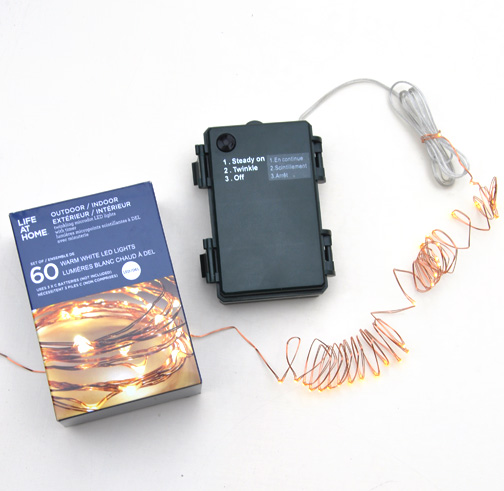
One final twist on my grapevine sphere. This year there seems to be lots of terrific, inexpensive LED lighting options available. In the past, Christmas lights always meant ugly wires in the daytime and long extension cords. 

Now, with these new LED options, the lights are on a fine filament that virtually disappears into the greenery of an arrangement. With the battery packs, there are no long electric cords. 

I found this set of 60 lights at The Real Canadian Superstore. The copper-colored string of lights seemed like it would be perfect to wrap around one of my grapevine spheres. In the daytime, the copper filament all but disappears. At night, the tiny LED lights add a sparkle to my holiday urn.


Have a great weekend!

P.S. The announcement of the book draw winner is coming up next!