Wednesday, June 7, 2017

Welcome to my Spring Garden

In the middle distance: maroon colored Clematis 'Bourbon' reaches a height of 4-5 feet.

Wild, untamed and wonderfully fragrant! Welcome to my spring garden!

Gas Plant with blue Amsonia in the foreground. Manchurian Lilac 'Miss Kim' in the distance.

Gas Plant with blue Amsonia.

Gas plant, Dictamnus albus forms a bushy, upright clump of bright green leaves and has tall spires of white flowers in late May/early June. The plant gets its common name from the tiny amount of methane gas its flowers produce. A lighted match will flair if held near the flowers.
This plant is very slow to establish. Average soil is fine. Height: 60-90 cm ( 23-35 inches), Spread 45-60 cm (18-23 inches). USDA Zones: 2-9.

Catmint, Nepeta racemosa 'Walker's Low' 

Catmint, Nepeta racemosa 'Walker's Low' 


Deutzia x lemoinei 'Compacta': has an upright habit and white flowers in spring. Plant it in sun to part-shade in average garden soil. It likes growing conditions to be on the moist side. Height: 4-6', Spread: the same. USDA Zones: 4-8. No serious diseases or problems. Prune in spring after flowering.


Lychnis viscaria 'Splendens': When not in flower forms Lychnis viscaria 'Splendens' forms a low mound of grass-like foliage. Then in early spring magenta flowers appear on tall stems. Height: 45-50 cm (18-20 inches), Spread: 30 cm (12 inches). USDA zones: 3-7.


Centaurea montana 'Amethyst in Snow' has shaggy white flowers with a purple centre. The foliage has a downy texture and a silver-grey-green color. Full sun and average garden soil. Cut the plant back hard after it finishes flowering and it will bloom again. (Note: the common blue form of this plant, Centaurea montana has proved to be problematic in some areas of the Canada and the States. I could not find an notations about this cultivar being invasive). Height: 30-40 cm (12-16 inches), Spread: 30-60 cm (12-23 inches). USDA Zones: 3-9.

Just inside the back gate is the beginnings of a white garden.

The almost-blind, 18 year old Buddy who we've nicknamed "Old Man".

Looking toward the back garden. 

One of the birdbath planters.


Sweet Rocket and Anemone canadensis.

The infamously invasive Anemone canadensis from my last post.

Piper

The first of the Siberian Iris.

Columbine and alliums with a hosta in the near distance.

An apartment style birdhouse and a Dogwood tree on the right.

Columbine


Lupins grown from seed.

Columbine and Lupins.

Pink Columbine and and an Allium.


The path leading toward my four raised beds. 
Dwarf Korean Lilac tree form, Syringa meyeri 'Palibin' in the near distance.

'Boomerang' Lilac on the left. 

'Boomerang' Lilac blooms in the spring, and then after a short rest through the heat of summer, again in the late summer/fall. Fragrant. Full sun. Height: 4-5 ft, Spread: 4-5 ft. USDA zones:3-7.

Scraps

Not sure of this one. Geranium cantabrigiense ' Biokovo Karmina' maybe?


Prairie Smoke, Geum triflorum is a western native with decorative seed heads that look like puffs of smoke. Well-drained soil is crucial for this plant. Full sun and summer weather that is not too hot are best. Once established Geum triflorum is pretty low maintenance and is very drought tolerant. Height: 25-30 cm (10-12 inches), Spread: 40-60 cm (16-24 inches). USDA zones 3-7.


Viola sororia 'Freckles' has white flowers with china-blue speckles and heart-shaped, bright green leaves. This violet is native to Eastern North America. Part-shade or full shade. Average garden soil and average moisture levels will suit this violet. Viola sororia 'Freckles' will spread through self-seeding. Height: 15-20 cm (6-8 inches), Spread: 15-30 cm (6-12 inches). USDA zones:3-9.

The herb garden.

Pinks, Dianthus are sold as an annual here, but they usually come back the second year. 
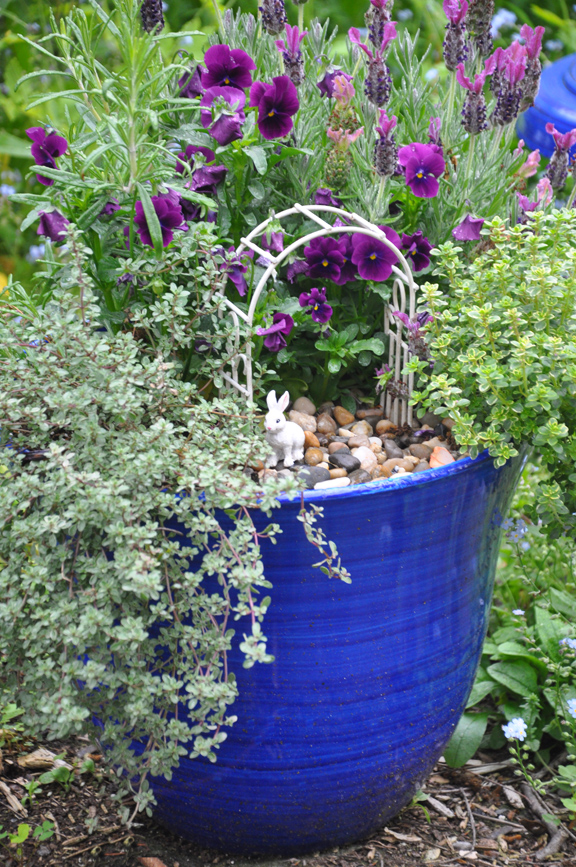
My fairy garden project from a few weeks ago.

Tall bearded Iris with a Columbine in the background.

 Columbine

Woodland Phlox, Phlox divaricata

Blue Forget-me-nots, Geranium 'Sambour' (burgundy flowers) 
and a white variety of Woodland Phlox on the right.


Woodland Phlox, Phlox divaricata 'May Breeze' has fragrant, star-shaped white flowers in early spring. Unlike more familiar Phlox paniculata that blooms much later in the summer, this plant has fine, delicate foliage. Phlox divaricata 'May Breeze' slowly spreads to form a small clump. Divide in the fall. Moist soil and part to full shade are this plants preferences. Height: 30-40 cm (12-16 inches), Spread: 30-60 cm ( 12-23 inches). USDA zones: 3-9.

My picture does not do the unusual blue-grey color of this hosta justice.

Hosta 'Joy Ride' not only has great curves, it also has foliage with a wonderful powdery, blue-green color. Light lavender flowers appear mid-summer. Part-shade to full shade. Height: 40-45 cm (16-18 inches), Spread: 90 cm ( 35 inches). USDA zones: 3-9.

An island-shaped shade garden in the back part of the yard.

A Buddha meditating in the same island-shaped bed.


Mourning Widow Cranesbill, Geranium phaeum 'Samobor' has deep red flowers and green foliage splashed with maroon. One great thing about many geraniums are their versatility in terms of sun exposure; full sun, part-shade or full shade will often work for them. Geranium phaeum 'Samobor'  is a prolific self-seeder. Cut the plant back hard to the ground after it flowers and you'll get rid of unwanted seedlings and have nice, fresh green leaves in a week or two. Height: 60-80 cm (23-31 inches), Spread: 60-70 cm (23-27 inches). USDA zones: 4-9.


Shooting Star, Dodecatheon meadia is a short-lived perennial that takes a year or so to flower. Typically they put on their best display in year three and then they disappear. Plant it in rich, moist soil. Full sun to part-shade. Height: 20-30 cm ( 8-12 inches), Spread: 15-20 cm (6-8 inches). USDA Zones: 2-9.

Pots of Pansies at the very back of the garden.


Such a weird color combination, but I love it!

Hope you enjoyed this little tour of my spring garden!

Sunday, June 4, 2017

The Temptation of Two Spring Anemones


This spring, two perennials that may tempt you at nurseries are Anemone canadensis and its kin Anemone sylvestris. Both have really pretty white flowers that may stop you in your tracks, but be cautious, both are very aggressive plants. If you're aware of this and can choose a location where their spread can be curtailed, adding them to your shopping cart won't be something you come to regret.

As you probably know, I usually shy away from aggressive plants. I've had too many problems with them in the past. Groundcovers, like Anemone canadensis, do have their uses such as under a large tree. That's exactly where I have this spring perennial. 

In early June, the small area under our black walnut tree is a sea of little white flowers. It has colonized the entire area crowding out my hostas. I ended up having to transplant the hostas to another part of the garden. Thankfully a rocky lip generally keeps Anemone canadensis's spread in check on all sides. Even so, it occasionally pops up in the adjacent pathway, where I have to pull it out.

Anemone canadensis makes a great understory for spring bulbs. Late flowering tulips, daffodils and alliums look even nicer with a carpet of white at their feet.


Anemone canadensis is a North American native that can be found growing in dense colonies on river margins and in moist meadows. This is a plant that's adaptive to a range of conditions and can easily be grown in average, well-drained soil. In my garden, it gets morning sun and afternoon shade.

Meadow Anemone or Windflower, Anemone canadensis has upward facing white flowers on erect hairy stems. The plant has a mounded shape and deeply-cut, shiny green leaves. Again, this is not a perennial for a mixed flowerbed. This plant spreads by creeping rhizomes and is best left to naturalize in a controlled area. Height: 30-60 cm (12-23 inches), Spread: 30-60 cm (12-23 inches). USDA zones: 3-8.

Anemone sylvestris

Anemone sylvestris is native to Europe and Asia. The flowers are a little larger than those of Anemone canadensis and stand higher above the plant. Anemone sylvestris and Anemone canadensis have a similar mounded shape, but the foliage of Anemone sylvestris is a lighter, matt-green.

Again, Anemone sylvestris is a spreader that can quickly dominate an area.  The best place to use a plant like this is in a garden bed with a clearly defined edge that can control its spread. 

Snowdrop Anemone, Anemone sylvestris blooms just ahead of Anemone canadensis. The nodding white flowers are held high above the plant on wiry, green stems tinged by red. Anemone sylvestis has matt-green leaves and a mounded, bushy shape. Like Anemone canadensis, this perennial will spread and colonize an area. The flowers are followed by fluffy seed heads. Divide in fall. Full sun or part shade. Height: 30-45 cm (12-18 inches), Spread: 30-60 cm (12-23 inches). USDA zones: 2-9.


Here and in the two of images above is Anemone sylvestris
Private garden in Mississauga, ON.

My experience of this second anemone is rather brief. Anemone sylvestris has been on hold in my nursery bed while I decide where I'd be brave enough to plant it. 

On a recent garden tour, I had an opportunity to ask another gardener about her experience with its aggressive nature. She found it did spread, but was not the worst behaved plant in her garden.


As you can see, the flowers are quite beautiful. What do you think? Dare you invite either of the spring anemones home with you?

Thursday, June 1, 2017

Getting Creative & Saving Money on Hanging Baskets


Last year I ran out of money before I had a chance to fill the last of my hanging baskets. The baskets on the back fence sat empty and forlorn all summer. Determined to better this year, I decided to get creative and find ways to stretch my money.

For my first hanging basket, I bought nothing at all. One day in early spring I was pulling out some Lamium, which I have in great overabundance, when it occurred to me to use the surplus Lamium in one of the empty hanging baskets. I planted it up, watered it and then forgot about all about it. On a wonder through the backyard a few days ago, I was rather delighted to find that the Lamium was looking not half-bad for something I almost threw onto the compost heap.


The Lamium won't be as colorful as store-bought annuals, but hey, they're free! They will have mauve flowers and even when the flowers are done and gone, with a bit of deadheading, the foliage should remain green and attractive. 

This will be the first of many experiments making hanging baskets using foraged plants I think!


If I had a greenhouse, grow lights or even a bright window, I might try growing my own annuals, but I have none of these things. The one decent window ledge in our house is already crammed with houseplants. 

In many of the gardens I visited last summer, I saw container plantings in which houseplants had been used to great effect. Why not let some of my houseplants do double-duty and spend the summer outdoors? Then in the fall, I can bring them back inside or I can take cuttings.

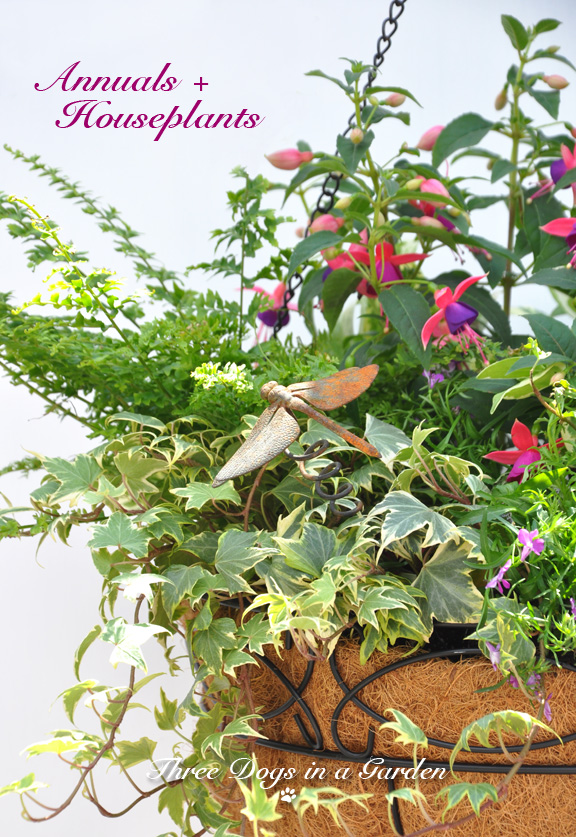
Here's my first hanging basket using a mix of houseplants I had on hand with a few annuals I purchased.


Boston Fern, Nephrolepis 'Fluffy Ruffles' has ruffled green leaves and is a medium-sized fern that likes part-shade and moist soil. 

Fuchsia are prolific bloomers that can spend their summers outdoors and can be brought inside for the winter (or you can take cuttings). Their dangling bell-shaped blooms make them prefect for hanging baskets. They like part-shade to shade and well-drained, but moist soil.


A few logistics. I find water can run right through some coconut liners, so I usually cut an extra piece of liner (you can buy a roll of coconut liner at most garden centres) and place it at the bottom of my wire baskets before I fill them with potting soil. 

To fill my hanging baskets, I used this moisture control potting mix which I hope will see my plants through the dry days of mid-summer. This potting mix feeds the plants as well. If you are using a regular potting mix, it a good idea to add a little slow release fertilizer to the soil before planting.


1. Fuchsia 2. Boston Fern, Nephrolepis 'Fluffy Ruffles'  3. Variegated Ivy 4. Annual Lobelia 5. Trailing green vine (sorry couldn't find a name for this one)


As well as using houseplants, I decided to be creative and use herbs. I chose mostly Mediterranean herbs that can take a bit of heat and even a little drought.


Tricolor Sage, Salvia Officinalis 'Tricolor' has aromatic purplish-grey-green and cream variegated foliage that is ornamental and flavourful. Plant it in well-drained soil. Full sun. Height: 60-80 cm (24-32 inches), Spread: 45-60 cm (18-24 inches) USDA zones: 4-9.

Silver Thyme, Thymus vulgaris has grey-green leaves that are edged in creamy-white. Thyme likes poor soil and good drainage. Allow the soil to dry out between waterings. Full sun. Height: 15-30 cm (6-12 inches), Spread: 30-35 cm (12-14 inches) USDA zones:4-9.


I have never grown Rue before. I liked its foliage and the promise of yellow flowers.

Rue, Ruta graveolens has yellow cup-shaped flowers in summer and fern-like foliage. In the past, it was used for medicinal reasons, but is rarely grown these days. I have read that it repels Japanese Beetles (interesting!). Full sun. Height: 80-90 cm (36 inches), Spread: 40-45 cm (16-18 inches) USDA zones: 4-9.


Golden Lemon Thyme, Thymus x citriodorus has green leaves edged in creamy-yellow. The foliage has a lemony taste. Thyme likes poor soil and good drainage. Allow the soil to dry out between waterings. Full sun. Height: 15-30 cm (6-12 inches), Spread: 30-35 cm (12-14 inches) USDA zones: 4-9.


1. Sage, Salvia Officinalis  2. Rue, Ruta graveolens 3. Tricolor Sage, Salvia Officinalis 'Tricolor'  4. Silver Thyme, Thymus vulgaris 5. Golden Lemon Thyme, Thymus x citriodorus 6. Creeping Rosemary, Rosmarinus prostratus (see below)


Creeping Rosemary, Rosmarinus prostratus is a low-growing form of rosemary that has little pale-blue flowers. It is easy to grow in poor, well-drained soil. Allow the soil to dry out between waterings. Full sun. Height: 15 cm (6 inches), Spread: 45-60 cm (18-24 inches) USDA zones:8-11.


There are lots of shady pockets in my backyard. Ferns and ivy seemed like the perfect solution for another of my baskets. To add a little color, I used a sky-blue Lobelia.


1. Annual Lobelia 2. Asparagus Fern, Asparagus retrofractus 3. Boston Fern, Nephrolepis 'Fluffy Ruffles'  4. Button Fern, Nephrolepis cordifolia 5. Blue Star Fern, Phlebodium aureum mandaianum 6. Variegated ivy, Hedera helix

Note: The ferns I used were all very small plants. If using larger ferns, you may have to limit the number and variety.


Asparagus Fern, Asparagus retrofractus has fine, needle-like foliage on barbed stems. It likes well-drained soil and to be watered often. In year's past, I have used Asparagus Ferns on the front porch and found it to be an easy plant to overwinter indoors in a window with morning sun. Height: 75 cm (30 inches).

Blue Star Fern, Phlebodium aureum mandaianum (sometimes sold as Polypodium) is from the tropical rainforest of south America. It has blue-green fronds and is easy to grow. A Blue Star Fern likes part-shade and plenty of moisture. Height: 30 cm (12 inches)


Once I had all my baskets made up, I went on to create a number of container plantings...but perhaps that subject is best left for another post.