Wednesday, July 6, 2016

How was your June Garden?


Salvia

How was your June garden? Mine at it's moments, but there is still lots of room for improvement. I'd like to see less of a lull after the tulips are finished and better companion plantings for the peonies and roses that come later in the month.

Whenever I'm stumped as to what to change or add, I turn to other gardens for inspiration. The gardens at the Toronto Botanical Gardens always inspire me. Let's take a look at what was blooming there in mid-June. 


Let's start off with a look at the alliums. I have lots of Allium 'Purple Sensation' dotted throughout my garden. It looks nice to have them interspersed among the other perennials, but it hadn't occurred to me to group alliums together until I saw this mass planting at the TBG. Gathered together like this, they make a billowy clouds of purple.

Alliums are odd flowers, if you ask me. They look soft and razor sharp all at the same time. I believe these particular alliums are Allium ' Christophii'.


Star of Persia, Allium 'Christophii' is a perennial bulb with umbels that are 10-12 inches in diameter. The star-shaped mauve flowers have a bit of a metallic sheen. Full sun and average, well-drained soil are perfect for these alliums. 'Christophii' may be left for years until fewer blooms indicate the bulbs have become crowded. Separate crowded bulbs after the foliage dies down. The flower dries also well. Note: handling or cutting the plant may cause some skin irritation. Wear garden gloves if you have sensitive skin. Height: 45-60 cm (18-24 inches), Spread: 15-22 cm (6-9 inches). USDA zones: 5-9.

Gillenia

As well as these closeups, I wish I had stepped back to take a picture of this great native plant. 

Gillenia a little larger than a Spirea and a bit more upright in its growth habit. The leaves are bright green and the stems are red, but the real reason to add this perennial to your June garden is the profusion of white flowers it produces.


Gillenia trifoliata: A tough, long-lived native plant with reddish stems, narrow leaves and white star-shaped flowers. Height: 60-120 cm, Spread: 60-75 cm. Full sun or light shade. Prefers rich, moist, well-drained soil. Good fall color. Zones: USDA 4-9


There are so many new and exciting cultivars of Baptisia to choose from these days! A June garden ought to have a least one Baptisia, don't you think?

Astrantia major 'Roma'. Read more about Astrantia in this blog post.

Peonies at the Toronto Botanical Garden

Looking at these single white peonies with their frilly petticoats, it is easy to see why all white gardens have become so popular. Sunlight plays off white petals so beautifully.

The peonies I have in my own garden have little in the way of companion plantings. I'd like to remedy that. Here are a few combinations I noted.


Peonies look great with a backdrop of deep blue Salvia.

Paeonia lactiflora 'Crinkled White'


Planted in front of any peony, Amsonia 'Blue Ice' looks terrific. This is a combination I've already experimented with in my own garden, but it seems to be taking a couple years for my Amsonia to really get established and flower.

Amsonia 'Blue Ice' has starry blue flower and leathery green foliage that becomes golden in the fall. Average moisture conditions and garden soil are fine. Height: 35-40 cm ( 14-16 inches), Spread: 45-60 cm (18-23 inches). USDA zones: 4-9.

Peonies and Catmint at the Toronto Botanical Garden.

Peonies and Catmint are another great June combination. 

I have say that I have become a big fan of Catmint. It blooms for an extended time, has great grey-green foliage, and if you cut it back hard, it can go on to have a great second act in late to mid-summer.


Last year I added quite a couple of the newer, more compact cultivars to my garden and I am really pleased with them. Catmint, Nepeta racemosa 'Walker's Low' is still an excellent choice, but I find that these newer varieties work really well at the front of a border. Here are a two:

Catmint 'Junior Walker' is a sterile dwarf form of 'Walker's Low'. The periwinkle blue flowers appear in June and last for weeks. Full sun and average garden soil. Cut back hard to encourage new flowers. Height: 35-40 cm (14-16 inches), Spread: 80-90 cm (31-35 inches). USDA zones: 5-9. 

Catmint 'Prussian Blue' has the same blue flowers on a plant that has a tidy habit. Again, cut back hard to encourage new flowers. Height: 35-45 cm (14-18 inches), Spread: 45-75 cm (18-29 inches). USDA zones: 5-9. 

Penstemon at the Toronto Botanical Gardens.

The delicate trumpet-shaped flowers of Penstemon start blooming toward the end of the month. They bloom for a number of weeks and look great with Veronica or Salvias.


 Penstemon 'Husker Red' has foliage that is beet-red in spring and fall and somewhat greener in the summer. Butterflies love the flowers, which are such a pale pink they are almost white. Full sun. Normal, sandy or clay soils are all suitable. Average to moist growing conditions. Height 75-90 cm, Spread: 30-45 cm. USDA Zones: 3-9.

Phlomis tuberosa 'Amazone' at the Toronto Botanical Gardens.

Super tall, this perennial always stands out in any June garden.

Phlomis tuberosa 'Amazone' is a recent introduction to North America, so the bad news is that this particular cultivar may be a little hard to track down and find. When not in flower this plant makes a large mound of coarse green leaves. Flower shoot skyward on these incredible reddish colored stems. Once finished flowering the spent flowers continue to add architectural interest well into winter. Normal or sandy soil that is on the dry side is best for this plant. Full sun. Height: 90-120 cm (35-47 inches), Spread: 45-60 cm (18-23 inches). USDA Zones: 2-9.


June seems to have passed in the blink of on eye! 

Already a new month has begun with a fresh set of challenges. Yesterday afternoon I startled baby bunny who ducked back back into the undergrowth. Then I noticed one of the first of the Japanese Beetles on a newly opened white rose. 

Monarda 'Purple Rooster' in my herb garden.

Thank goodness there is usually a balance of forces at work in the garden! As I walked to the back of the yard, I noticed that the Monarda in my herb garden has the prettiest grape colored flowers. I think I may just have a new favourite!

And the winner is...


Scrap and Piper oversaw the draw of the latest book draw and are thrilled that the winner just happens to be a blogger who excels at DIY projects. I am sure she's going to love all the great ideas in this book.


Congratulations Anne! I hope there isn't a postal strike, so I can get Raised Bed Revolution off to you in the mail. If there is a strike, I'll send it out as soon as I am able.

If you weren't a winner this time, take heart there is another book draw coming up very shortly!

Wednesday, June 29, 2016

Garden Sheds: Everything from Classic to Pretty and Rustic


There was a time when a garden shed was simply the place you parked the lawn mower, garden equipment and other tools. These days garden sheds are so much more. They're workspaces, creative studios and retreats for outdoor entertaining. 

Whatever end use you may have in mind, here is some inspiration to help you to get you started in creating your ideal space.

Classic Garden Sheds:


It's a little hard to see, but the weathervane on this classic garden shed is a grasshopper. How perfect!

So what makes a great shed? It's all in the planing and the details. In my first example, everything has been considered: the building's design, the colors on the exterior and the plantings that surround it. 

Notes on Design Choices:

• Before choosing a style for your shed, consider the design of your home. The style doesn't have to match, but it should be complimentary.

• It's also a good idea to think of the color of your home when choosing paint colors for your shed. Either repeat the trim and main colors of your home or choose a color scheme that coordinates.

Take function into account. Is your shed simply a place where you plan to store things or is this a space that will have other uses?

• Consider the seasons of use. If you plan to use the shed year round, you'll need insulation and a way to heat the interior.

• A shed can be a pretty dark place if there is no electric lighting, so incorporate enough windows to allow natural light make the space bright and airy.

• Think about how you plan to get equipment in and out of your shed. Make the door wide enough to accommodate what will be the largest tool or machine. In our own garden shed, we also added a ramp that makes it easy to roll the lawnmower in and out.

Here the trim and the shed are all one color making the dark olive-green doors really stand out.

Another great use of color. The red door is terrific on this greige shed!

Use the area that surrounds your shed to display a collection. Here the homeowner has displayed a menagerie of metal objects on the adjacent fence.

Take advantage of the walls of your shed to train climbers or to create a pretty vignette like this one.

Pretty Garden Sheds:


Location, Location, Location!

• Locate your shed close to the place where the equipment inside is needed most. Orient the shed in such a way that it is easy to move any equipment in and out.

• Integrate your shed into the surrounding landscape with attractive plantings. In the example above, curved flowerbeds sweep gracefully away from the maroon shed.

Window boxes are always a nice detail.

Another shed beautifully placed in a garden setting. See more of this garden here.

See more of this garden here.

It looks like a shed, but actually it's a playhouse for the grandchildren.

Before you build:

• Look up the rules governing the construction of sheds for your town or city. In the city where I live, there are bylaws that govern how many sheds you can build, where you can build them, how big or tall your shed can be and how close to the property line it can sit.

• Depending on your area, you may be required to get a building permit.

• Before building or installing a shed, lay down a sturdy foundation of cinder blocks, a concrete slab or crushed stone.

• Decide on a budget. The costs of building a shed can add up quickly. Price out the materials you will require and make sure they fit within your budget. 

Decorative trim, a screen door and accessories give this shed a romantic country style.

Rustic Sheds:


There's no worry here about repainting the exterior every few years. 

A shed with a weathered patina fits easily into any garden and is a very popular choice. Depending on the design elements, a rustic shed can feel like a remote cabin, or as in the example above, it can be quite traditional.

Each trellis is layered with container plantings.

A pretty circular courtyard sits in front of the french doors.

See more of this garden here and here.

A yellow rose looks wonderful on top of the weathered wood.

Love the x's on these double doors!

A shed with a slopping roof and lots of country charm.

A pair of old cowboy boots becomes a whimsical container planting.

See more of this garden here and here.

An old milk can filled with a succulents.

Pieces of driftwood over the porch make this shed into a rustic cabin.

This shed also functions as a poolside bar.

A overflowing window box, potted plants and black shutters make this shed charming.

Express your personality with decorative accessories.

Hanging baskets and some old crockery just in front of the back gate.

A birdhouse makes the perfect roof topper.

So, which shed is your favourite?

Bookmark this post with a Pin.

Sunday, June 26, 2016

Silk and Venom


In the third post in her series on garden insects, Jean Godawa writes about the benefits of having spiders in your garden.

To me, the beauty of a garden goes beyond the sensory enjoyment it provides. The vibrant colours, varying textures and fragrant air command our attention, but it is the inner workings of the garden, the things happening regardless of our horticultural skills, that make it a special place, worthy of our awe and appreciation.

Spiders are one of those creatures with a significant role in keeping garden plants healthy and they do this with little to no help from us. By eating the bugs that destroy plants, these eight-legged animals are always on duty as pest control agents.

Orb weaving spiders spin silken webs to attract flying insects. One of the most striking of the orb weavers is the black and yellow garden spider (Argiope aurantia). Although its bright colouring and large size make it look somewhat tropical, this species is quite common in gardens throughout the U.S. and Canada.


The female creates a complicated web that can have a diameter of more than 60 cm or 2 feet. She adds zigzag strips, called stabilimenta to the construction. Despite the name, these structures probably don't help stabilize the web. They are more likely used for attraction of prey or mates, or for warning or camouflage. It costs the spider much energy to produce these intricate patterns so they must provide some advantage. Scientists are still trying to figure it out.

Any flying insect is a potential meal for garden spiders including grasshoppers, aphids, wasps, bees and butterflies.


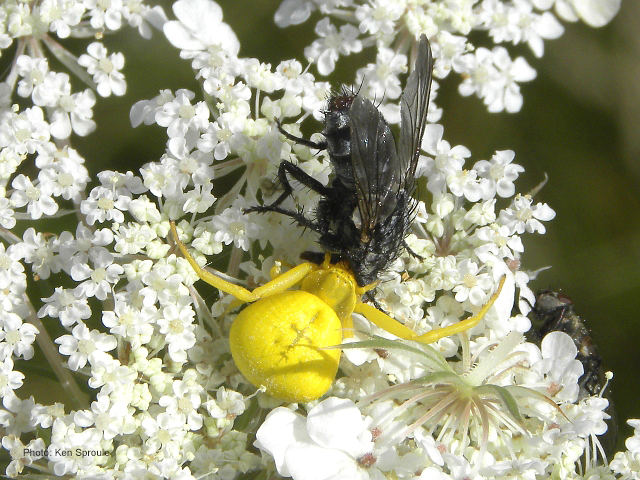
Some spiders prefer to capture their insect meals by ambush methods rather than expending any silk. Crab spiders (Thomisidae), use their larger front legs to easily grab their prey. Some species can change over time to match the colour of their plant surroundings.


A more active hunter is the jumping spider (Salticidae).These creatures pounce on their insect prey using their sharp vision and nimble movements.


Most spiders only live for one season. They lay eggs, usually inside silken cocoon-like structures. In some species the eggs hatch before winter but the young spiderlings remain protected in the silk until they can disperse in the spring.

Spiders feed by injecting venom into their prey to immobilize it. Digestive fluids liquefy the prey and the spider sucks up the remains. Gruesome as this sounds, most spiders are rarely dangerous to humans. They are more likely to escape your presence than to bite you.

Even an arachnophobic gardener can't deny the benefits of welcoming spiders into the garden. Tall grasses and long stemmed plants provide stable support for orb-weaving spiders to construct their webs. Other spiders prefer the dark damp conditions of thick mulch. If a garden provides these habitats, it can be sure of non-stop, natural pest control from spiders.


About Jean GodawaJean is a science teacher and writer. She has been writing science-related articles for print and online publications for more than ten years. Jean holds a degree in biology and environmental science with a focus on entomology from the University of Toronto. She had conducted field research in the tropical rainforests of Asia and South America.

Bookmark this post with a Pin.