Wednesday, February 19, 2014

My Love Affair with Bell-Shaped Clematis

 
 A bell-shaped Clematis at the entrance to Chen's garden in Milton, ON. I believe this one 
is called Betty Corning (Viticella Group Clematis).

The large number of photographs I have taken are a testament to my love affair with every type and color of bell-shaped clematis. I seem to find them in all the best gardens.


Marion Jarvie's Garden, Thornhill, ON


Marion's Garden

Marion's Garden

Marion's Garden

Marion Jarvie's Garden, Thornhill, ON

This picture shows you something I like about these types of small flowering clematis: they don't take a ton of ground space and shoot up like arrows from amongst other perennials and shrubs. 

Planting them in amongst other perennials suits them as they love to have their roots shaded while the top growth gets full sun.

Depending on the variety, they can also provide a nice, long-lasting floral display.

A closer look at the clematis in the previous image.


Here is something I learned by making the mistake myself: Don't plant this type of clematis to the side of your plant support. 

Plant it directly under it so it grows up through the centre of the support. This way it is held in place and won't flop in strong winds or heavy rains.

Merlin's Hollow, Aurora, ON 

In his garden, David Tomlinson has a bell-shaped clematis growing up through a large tomato cage.

Merlin's Hollow, Aurora, ON 

Merlin's Hollow, Aurora, ON

I think this variety may well be Princess Diana (Texensis Group Clematis).

David also has used a variety of bell-shaped clematis to cover the arbor 
that leads to his "Fragrant Garden". 


At the moment I have only one variety of bell-shaped clematis (one plant in the front garden and another is in the back garden). Every time I show them I am embarrassed to have to admit that I lost the identification tags for them. 

Recently a friend suggested it might be Clematis, integrifolia.


I hoped to add more varieties of bell-shaped clematis last spring, but found they were a lot harder to find at local nurseries than I would wish. So this year I am going to do a mail order a few.

Here are a three varieties I am considering purchasing from Gardenimports. (They ship in Canada and with a special permit to the USA):


Left: Princess Kate from Gardenimports. Texenis Group Clematis that blooms mid-season with upward facing flowers. Blooms June to September. Grows 10-13 ft.

Clematis Texenis Group are a series of trumpet-shaped, late flowering group of clematis. 

Right: Queen Mother:  Viticella Group Clematis. Flowers mid-season. The Gardenimport's catalogue promises downward facing flowers that appear in June and continue non-stop until June. Height 4' 6''

Clematis Viticella usually have pinnate leaves (resembling a feather) and nodding single or double  bell-shaped flowers that are produced on the current year's growth. Interesting to note that Viticella Group Clematis are less prone to clematis wilt.


Beth Corning,Viticella Group Clematis: Starts to flower mid-season and continues to bloom for a couple of months. Lightly fragrant. Height: 8' Pruning Group C.

More Information and Links:


The page of clematis available at Gardenimports.

More information on the Viticella Group of Clematis.

Brief Notes on Planting Clematis: Clematis don't like to be moved, so choose your site carefully. Soak the plant in a pail of water for 10-15 minutes before planting. Place a generous layer of well-rotted manure or compost at the bottom of your planting hole. The root ball of your clematis should be about 5 cm below ground level. Back fill the hole with soil that has a generous amount of peat moss and/or compost and a few handfuls of bone meal. Water thoroughly and frequently.

I always have trouble keeping the pruning groups straight, but paying proper attention will give you the best floral display. Here are a few quick notes on pruning:

Group A: These clematis flower in early spring on growth produced in the previous season. It is best to prune them shortly after they flower.

Group B: These clematis bloom in early summer on the previous season's growth and then again later in the gardening season on the current season's growth. Remove all dead or weak stems in March and prune the rest to a leaf bud at about 25 cm above ground level.

Group C: This final group produce blooms on new growth each year. Cut back all vines to the ground in March.

Thursday, February 13, 2014

Using Lines to Advantage in a Garden Setting


Line defined: a long narrow mark or band, a straight or curved continuous extent of length without breadth, a contour or outline considered as a feature of design or composition, a notional limit or boundary, a length of cord, wire or other material serving a particular purpose...

"Sight line" defined: a line extending from an observer's eye to viewed object or area.

Jackson Pollock painting, Summer 1950, photo: Hans Namuth 

A simple line can be powerfully expressive thing.

It can speak volumes of the action that created it: the rapid downward slap of a brush loaded with paint or the fluid gestures of an arm as it loops the dripping paint brush over the surface of a blank canvas.

The gardening equivalent of a Jackson Pollock painting!


The vertical line of a tree in Marion Jarvie's garden in Thornhill, ON

In a garden, there are certain lines which the eye gravitates to and follows: the vertical line of a tree trunk, the curve of a pathway, a length of fence or the horizontal line of the horizon.

Brian Folmer's Botanical Garden near Walkerton, ON

The eye shoots along the simple straight line at high velocity. Speed lends a certain sense of drama to 
the distance the eye is able to cover so quickly.

Private Garden in Rosedale, ON

To pull off this kind high drama, you need to keep the eye focused and moving. 

I think this works best when the line of sight is created using a single material, in this case fine gravel. 

In this and the previous example, the plantings have been deliberately kept simple and repetitive to reinforce the linear perspective.

Private Garden, Forest Hill, Ontario

You might think that you need a big garden to effectively use the power of converging straight lines, but here we have a much more humble sized walkway as it intersects with a little courtyard just outside a suburban front door. 

The journey is not nearly as long, but the effect of projecting the eye in the direction of the urn is still quite effective.


This is the garden that actually got me thinking about the subject of this post. 


In this backyard garden nothing stops the eye from shooting rapidly down one side of the garden, across the back and up the opposite side. 

Unlike my earlier examples, here the rush with which the eye travels down the parallel straight lines of the flowerbed and fence does not work in the garden's favour. There are no design elements present that invite you to relax or linger. I think that the unintended result is that you are much more likely to be dismissive of what is actually quite a nice planting.

A simple quick fix for the problem would be to break up the fence line with vines, evergreens or small trees. She could also soften the line of rocks with plants that spill forward over the edges of the raised beds.


Curves are more relaxed than straight lines.

Private Garden on Ward Island near Toronto, Ontario 

When used well, a simple curve can feel like a bit of a grand gesture.

Marion Jarvie's garden in Thornhill, ON

As evidenced by the next three photographs of Marion Jarvie's garden in Thornhill, Ontario, 
the bold sweep of a curve also has a certain elegance to it.

Marion Jarvie's garden in Thornhill, ON

Marion Jarvie's garden in Thornhill, ON

Private Garden, Brampton, ON

The eye can still makes pretty swift work of a simple curve, but trek does not end as abruptly 
as it tends to with a straight line.


The curvaceous lines of the flowerbeds in this garden in Rosedale, Ontario are more complex and it only stands to reason that it takes the eye much longer to make the trip around the garden. 

Private Garden in Rosedale, Ontario

Again be aware that the objects you place in the garden can greatly impact your experience of it. Here a bench has been added to the previous image. The straight line of sight to the bench now trumps the sweeping curves of the flowerbeds. 

The effect on our perception is not better or worse; just different.

Brian Folmer's Botanical Garden near Walkerton, ON

When a line, in this case a path, vanishes into the distance it creates a sense of mystery. 

In terms of an overall strategy with your garden's design, it is not a bad idea to keep at least 
some of  your cards close to be vest.

Private Garden, Forest Hill, ON

This looks like a woodland park, but is actually a suburban garden in downtown Toronto.

Who knows what's just around the bend! And that uncertainty is intriguing.

Private garden in Milton, ON- More of this amazing garden in the coming weeks

There is no right or wrong in using lines in your garden's design.

 It's more about using lines to show off your plantings to their best advantage.

Friday, February 7, 2014

A Plant wants What a Plant wants!


As a parent, the natural tendency is to provide the very best you can for your children. Nobody's perfect, but as parents, we have the very best of intentions.

It seems I have transferred a little of this parenting style outside into the garden. 

How I wish this were my own Lavender!

I have always strived to provide my plants with the very best I possibly can. 

I began by amending and improving the soil on our property. 

And then, every spring I add compost, bone meal and manure. To complete the process, I top dress the flowerbeds with mulch to keep the soil moist and weed free.


When summer heats up and rain is scarce, I take pity on my plants and out comes the garden hose. 

I battle red aphids every summer.

When pests line up I strike back (organically of course). I can't tell you how many green worms I have handpicked off my roses or red lily beetles I have swished under foot.

Russian Sage, Perovskia atriplicifolia at Edward Gardens in Toronto

I am well aware that plants like different soil types, but for some unknown reason, I haven't paid that as much heed to that as I should. 

Following those parental instincts I reasoned that if I gave my plants the very best soil, they should perform perfectly. Right? 

Wrong! 

A plant wants what a plant wants. If that means poor, sandy soil, it wants poor, sandy soil.  If it needs gravelly soil with really good drainage, then that is just what it wants.

My long line of failures is testament to the truth in this.

Russian Sage, Perovskia atriplicifolia at Edward Gardens in Toronto

Russian Sage. You think with the word "Russian" in the common name, it would have no problems overwintering here in Canada, but I kept losing my plants every winter for years. 

Most recently, I put my latest Russian Sage in the sheltered herb bed. It made it through winter all right, but it failed to prosper. 

I gave it protection, but what it really needed was the right soil. Russian Sage is a huge, flamboyant perennial that can grow to 150 cm (3 to 5 feet), yet my sorry specimen is pathetically scrawny. 

This is what I aspire to: Russian Sage, Perovskia atriplicifolia at Edward Gardens in Toronto

I think it's finally sinking in: get that soil right or it is never going to perform well. 

Other than heat and sun what it needs most is loamy, loose and airy,well-drained soil.


Ditto on the lavender. 

Right now it is in the same herb bed and it is sulking just as much as the Russian Sage.  The best soil for growing lavender is gritty or sandy loam, so no wonder it is not doing well in the black top soil of the herb garden.

I have done some research and I need to either move it or amend the soil. There is already plenty of organic matter for good soil aeration, but I need to make the soil much more free-draining with fine crushed stone. I think I may also have to add some lime (apparently lavender likes soil with a pH factor between 6.0 and 8.0).

Merlin's Hollow, Aurora Ontario

A closer look at the thyme lawn at Merlin's Hollow

One of my projects for this spring is inspired by the thyme lawn at Merlin's Hollow, David Tomlinson's garden in Aurora, Ontario. 

In my case, it is going to be a thyme walk that runs along the path to the back garden (pictured below)

Out with the boring grass and in with the fragrant thyme!


Like Russian Sage and Lavender, thyme likes really well-drained soil. I have learned my lesson the hard way and this time I am starting with the soil. 

Thyme likes sandy, dry gritty soil and that is just what I am going to give it!

Have a wonderful weekend!

Monday, February 3, 2014

A Hauntingly Beautiful Spot and a Murderous Tale


I was honestly worried that the man lying motionless on the wet grass was dead. Eyes shut, arms held stiffly at his side, the old man was lying flat on his back with his legs extended straight out like a body in a morgue.

All around the little courtyard park where he lay, there were rows of townhouses, but no one was about. It was well before dinner hour and I had happened by only on chance, while looking to meet up with my husband.

It was freezing cold and a light rain was falling. Could he be sleeping? No. Surely, no one in his right mind would choose to sleep on the wet grass in the rain.

I stopped walking, stood still for a second and watched to see if the old man's chest might rise and fall with the measured breath of slumber. I could see none, but then, perhaps I was just too far away. Too much of a coward to approach him myself, I rushed off to the spot where I knew I could find my husband.


A few minutes later, my husband was standing over him, "Are you okay, sir?" I heard him ask. The man opened his eyes (I sighed with relief!) and mumbled a slurred response.

"Can I call someone to come help you?", my husband asked. I heard the old man muttered something nonsensical. Then he mumbled something about a daughter. He tired to sit up, wobbled wildly and fell back hard on the wet grass. My husband noticed there was a beer can at his side. Mystery solved. The man was simply fall down drunk.

Though his problems were self-inflicted, we could not in all good consciousness leave him there lying in the cold. Alcohol thins the blood and can make a person, especially a man in his early sixties, more susceptible to hypothermia. It seemed clear enough to us that this was a man who needed some sort of help.

This brings me the point of my story: when faced with a complete stranger, it is not always easy to tell when to step up and offer assistance. It can feel akward and even uncomfortable to step into another person's private problems.


Let me tell you another story. This time I will put you in the driver's seat.

There is a dog, a white, mop-head of a dog. He is a harmless, goodnatured, goofy dog who you have noticed sitting out at all hours of the day and night, in every kind of weather, in an outdoor pen. In the summers, the grass is uncut and a water dish seems absent even on the hottest days. In winters, his ramshackle dog house is stuffed with straw. Mostly you notice that he prefers to sit outside shivering in deep snow. What is most distressing, is the fact that a rash has begun to spread across his rump.

Then one day you find him loose running wildly through the neighbourhood, giddy in his excitement to be free of the pen. You might feel glad for him except you see that he is covered in his own green excrement.

Are you ready to call in the authorities?

Get ready of the complication.

You don't know his owner, but you have heard tell of her drinking problem from a close friend. There is a lot of sadness in her life, because it has been recently discovered that her husband is dying of cancer. The most recent operation has left him barely able to stand. As this man's health has deteriorated, their small business has begun to falter.

How do you help the poor dog? It is gut wrenchingly hard isn't it? Knowing when and how to step in is not easy.


I know this post is getting really long. Just one last story! This one is both sad and true.

But first, let me set the scene for this story. Along the banks of the Credit River there is a chain of valleys, I live in one of them.

The valley to the south of us is in my estimation the most beautiful. Unlike the more northern valleys, it is a broad plain that sits low on the water table.


In summer it is lush and green. 


In fall, the valley is filled with ochres, reds and orange. 

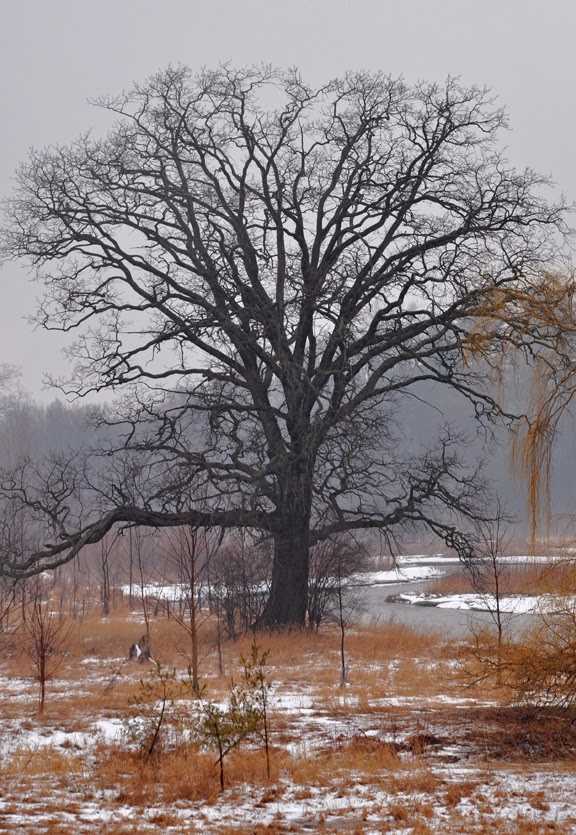
In winter, its beauty is more haunting.


This valley was also the sight of a local murder. 

If you are a mother, I am sure you will be able to identify with this terrible story. Again, I am going to put you into the story:

You are in the middle of a weekend shopping trip to the mall when your daughter asks to use the washroom. The problem is that you have your 9 year old son in tow and he is refusing to be seen in the women's washroom at his age (this story occurred 10 or more years ago before family washrooms became common). 

You understand of course. He's growing up so fast. Maybe you even experience a brief moment of pride at the thought. 


You don't want to send your daughter into the washroom alone, so you opt to leave your son who is older on his own in the hallway. You'll only be a few minutes and he is right outside the door.

Moments later your son is abducted from the hallway by a man recently released from prison. People witness the abduction: it's popular mall. But here is the part of the story that especially breaks my heart: no one steps forward and no one intercedes. It is not that they are heartless or don't want to get involved. Most witnesses see a boy struggling with a man, but fail to recognize the situation for what it is. Instead they see a misbehaving child and decide the man is most likely his father.

The abductor brought the young boy to the picturesque river valley assaulted and murdered him. Then the deeply disturbed man turned himself into police.

This true story haunts me a little. I have a son who is about the same age as the boy who was murdered and we often shopped at that very same mall. I pass by the valley where the terrible deed was done at least a few times a week.

How I feel for that poor woman who left her son on his own for just a brief moment! As a mother, I find myself wishing someone had stepped forward, even though I know that confronting and questioning the actions of a seriously disturbed man was a potentially dangerous thing to do.

But then, aren't most mothers willing to through themselves in harms way for the sake of their children?


So what happened to the man we left lying in the grass a few paragraphs back? We stayed with him until police arrived to handle the situation.

And the neglected dog? That was another true story, and as you may have guessed, it could not possibly have end well. One of my neighbours tried to help out with the care of the dog, but she could only do so much. I took action the day I found him roaming loose covered in excrement and soars. With a heavy heart, I called the SPCA. I begged them to use compassion with the woman whose husband was so seriously ill. I told them that I hoped a new or temporary home could be found for the dog during the ongoing health crisis.

I am not sure anything like that happened. I was walking our dogs when the angry dog owner confronted me in a drunken rage a couple of weeks later. The only good thing to come out of this story is that the poor, neglected dog did go to a new home.

I worry I could have handled the situation better, but I am still glad that I interceded.