Showing posts with label Veronica gentianoides. Show all posts

Sunday, April 19, 2015

The Garden of Donna & Duff Evers, Part 1: The Lakefront Terrace Garden


Donna and Duff Evers have the enviable view of a lake which sparkles through evergreen trees at the back of their home near Halifax, Nova Scotia. There is a short plateau of land with a deck and then the property rolls down in a gentle incline to the lake. 

Is it harder to garden on a slope than a flat piece of land? 

"There are days my aching bones make me wish I was gardening on a flat plot of land, but on the whole, the positives outweigh the negatives. And we don't have to go to the gym to work out," Donna laughs.

To ease the incline the Ever's have terraced the slope with a low stone wall that runs most of the width of the property. As you can imagine, this was no small undertaking.

Donna: "The stonework came first and we learned the hard way. Several walls did not come through the first winter and had to be rebuilt. We did things right the second time around. It helps to have a husband who likes working with stone. We handpicked the stone from a local quarry and trucked it home. The walls began with a three to four inch tamped base of crushed gravel. Fitting the stones together was a bit like working a jigsaw puzzle."


Marking the outer perimeter of the terraced garden is a square lattice fence.

Donna: "The fence in this garden serves several purposes. It defines the garden and separates it from the expanse of grass that is the septic field. It breaks up the wind from the lake and provides support for all the climbing vines."

"When making this garden we had to work around a massive stump that was impossible to move. We planted a climbing hydrangea and a clematis at the base of the stump. It took a while, but the hydrangea completely covers up the stump and the clematis now weaves its way through the hydrangea."


Donna: "Gardening on a sloping property definitely has it challenges. The biggest one is erosion. The terraces and stonework, combined with my obsession for over-planting has taken care of that problem. The stone walls with their excellent drainage have provided unique planting sites for Lewisia, Saxifraga and Hens and chicks."

Donna: "The walls are a great place to sit with a coffee in the spring sunshine."

Lewisia cotyledon 

Donna: "I'd like to think that this plant was evidence of my gardening skill, but the truth is, it's dumb luck. Lewisia needs excellent drainage around the crowns to prevent rot in winter."

"I am never certain it will make it through the winter. Fingers crossed! It never seems to be happy on our rock walls. I must give it a little fertilizer this spring."


Bellflower, Campanula chamissonis: has compact green leaves which grow not more than two to six inches high. Light purple, bell-shaped flowers with a white throat appear in mid-spring. Again, good drainage is essential. This campanula is not invasive. Full sun. Height: 5-15 cm ( 2-6 inches), Spread: 15-20 cm (6-8 inches). USDA Zones 4-7.


Donna: "The geum is the one everyone grows. It does really well in our dampish soil and it often has a few blooms again in fall. I love it planted with anything blue."

Geum borisii: Forms a low growing clump with sprays of bright orange flowers from early spring into summer. As Donna notes, it may even re-bloom in fall. Part shade and moist soil are best. Height: 30-45cm (12- 18 inches), Spread: 30-45 cm (12-18 inches) USDA Zones: 5-7. Note: Geum borisii struggles with heat and humidity south of zone 7. 

Jacob's Ladder, Polemonium ( left) and Veronica gentianoides (right)

Two blue options from Donna's garden that might be planted with Geum:

Donna: "Jacob's Ladder, Polemonium (seen above on the right) likes dampish spots in our garden and it has become well enough established that I have been able to divide it and spread it about. It blooms earlier than other varieties of Polemonium and the foliage seems to be a little more delicate."

"Veronica gentianoides (seen above on the left) is another spring favourite. I love it planted with orange and yellow geum in the front border.  The leaves form a ground-hugging rosette and the spikes of flowers are the loveliest blue."


Donna: "The terrace wall needed to be backfilled with crushed stone to provide drainage. The crushed stone also helps with freeze/thaw winter conditions here in Nova Scotia. Most years the wall requires a bit of spring maintenance in the way of repositioning a stone or two."

"When completed we backfilled the walls with quality garden soil and compost. Then the fun began. The area gets full sun all day long and we filled it with sun-loving plants." 


Donna: "Duff chose a relatively flat spot and made a level pad of crusher dust. Over the winter it formed into a relatively solid base. The shed is a board and batten construction with a cedar shingled roof. The windows were recycled. I only wish it were bigger because it is filled to the rafters."

Rosa 'Father Hugo'

Donna: "Rosa 'Father Hugo' is an early bloomer and it does not repeat bloom. It is disease-free and low maintenance. I just have to cut it back from time to time so we can get to the shed. It has attractive reddish stems and great fall color. I have never seen it for sale in local garden centres. Ours came from a cutting taken from a friend's garden. Roses do not do well in our garden and so I am happy to have the lovely Father Hugo."

Father Hugo Rose or Golden Rose of China, Rosa hugonis Species rose (1899) is a vase-shaped rose that can reach up to 9 feet tall. It is a very hardy (to Zone 5) and drought tolerant rose. It has attractive ferny foliage and single yellow roses in spring. ARS Rating: 8.7

Here's a link to Part 2 and Part 3.

Friday, April 10, 2015

Jacquie's Spring Garden, Part 2


Traditional thinking links creativity with some lightning strike of genius or some crystal clear "aha" moment. 

But people like Jacquie don't wait for a flash of inspiration; they simply get down to it. Making a garden is about hard work and perseverance. When you talk with a gardener who has as much experience as Jacquie, you realize that creativity involves planting a perennial in the wrong spot, digging it up and moving it to a more appropriate one. You make mistakes, but hopefully, you learn from them. 


When I asked Jacquie about her methods for creating such pleasing plant combinations, she told me:

 "I used to be that I'd plunk a plant in where I had room. Now I'm much more careful. Often a shrub or tree will remain in a pot for a month until I decide for sure where its permanent home will be. Smaller plants don't take as long, but even so, it takes me a while to decide."

"I look at the foliage and plant colour, texture and size, walk around the around the garden with it or sometimes I just sit the plant where I think it should go, and leave it for a few days just to be sure. "

"I might do that two or three times before it's a done deal. If a plant doesn't do what I think it should do the first season, I'll try it somewhere else next year. I'm much braver now and more ruthless. Eventually, it all works."


I was curious to know the story behind this tall, totem-like wood carving.

Jacquie says, "I had friends for dinner including Steve, an ex-priest and Maureen, his wife and an ex-nun. Steve passed away last year, just before Christmas, but he was a character and as big as life, so his memory lives on. "

"During dinner, he told us he had taken a course at Lee Valley on how to carve outdoor trees but didn't have a tree to work on. 

"During Hurricane Juan, two 100' poplars fell down into our neighbour's property. When the people we hired had trimmed one of the poplars to about 25', it popped back up and landed in the 8' hole it had left. When I saw it standing, I realized I could probably do something with it and so stopped them from cutting it down further. Then I forgot about it." 

"When Steve complained about not having a tree, I said, "I have just the tree for you." He was excited and started that summer. It took about a week in total to complete it."

"Steve had a very dry humour. I was watching him up on his ladder one day and asked why he was using a mirror. He replied, "I want to get the wrinkles just right." And they were! We were very pleased with the carving, and now, we treasure it even more."

The lower section of the hillside garden

Unknown variety of Euphorbia 

Jacquie kindly spent over an hour trying to find the name for this Euphorbia for me but to no avail. 

"It must have been given to me because I keep a record of everything. It seeds around a lot, but in spring I gather the seedlings up and clump them together. It also has to be cut back in mid-summer, so it leaves a bit of a hole. Despite all that, I really like it for its colour."

I did some poking around myself on the internet and I wonder if it is no Euphorbia 'Mini Martini'. Any suggestions?


Flowers or foliage? I asked Jacquie which she valued most. 

Her answer: "I think I value flowers and foliage equally, but am much more interested in foliage than I used to be. For instance, hostas didn't use to interest me much, except as a filler, and now I'm crazy about them."

Golden Comfrey, Symphytum x uplandicum 'Axminister Gold'

Jacquie: "I love Golden Comfrey for its beautiful foliage and have moved it several times because it burns in the sun. I think it's finally found its home."

Golden Comfrey, Symphytum x uplandicum 'Axminister Gold' has long oval leaves edged with a creamy butter colour. Note: the foliage can cause skin irritation, so use gloves. It has pale blue bell-shaped flowers in early summer.  This plant likes moist soil in full sun or light shade (afternoon shade is best in hot regions). It has a spreading growth habit. If you cut back the foliage after the plant flowers it will produce a new flush of fresh growth. Powdery mildew can be a problem. Propagate from root cuttings or grow plants from seed. Height: 75-90 cm (29-35 inches) Spread: 75-90 cm (29-35 inches) USDA Zones: 4-9

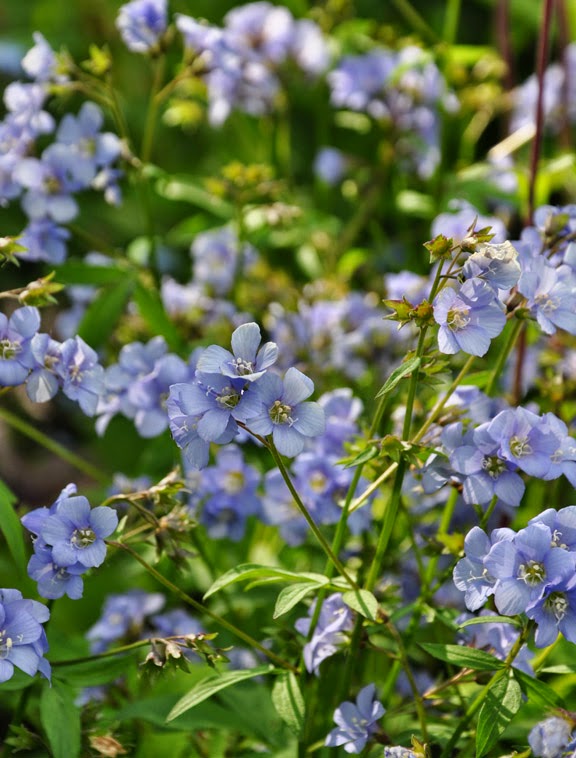
Gentian Speedwell, Veronica gentianoides

Jacquie has two different cultivars of Veronica gentianoides"I have one that is pale, pale blue - almost white and another that is a deeper blue. Love them both."

Gentian Speedwell,Veronica gentianoides: forms a low rosette of wide leaves with upright powder blue flower spikes in late spring/early summer. Veronica gentianoides tolerates a variety of soil types but likes the soil to be moist. Full sun or light shade. Height: 30-40 cm (12-16 inches), Spread: 30-45 cm (12-18 inches) USDA Zones: 2-9.


Jacquie's "flower fairy" who presides over the lower part of the garden from the top of a 
stump of an old crabapple tree.


Lysimacahia cliata 'Firecracker': is an upright plant with burgundy-purple foliage and insignificant yellow flowers. It prefers clay soil and moist conditions. For best colour, plant it in full sun or light shade. Be warned this is a pretty aggressive plant that spreads. Height: 75-90 cm ( 29-35 inches), Spread: 75 cm and more ( 29 inches...) USDA Zones: 2-9

Jacquie's review of this foliage plant: "It's a horrible spreader, but worth keeping contained in a pot for its beautiful colour. I have one area where it has gotten fairly wild and I'll never get rid of it."


Unnamed variety of Verbascum. Jacquie says,"I've had trouble with these in the past because my garden is so wet, but this one is doing well.


Jacquie told me, "I found the Buddhist hand in one of those small boutiques you stumble upon in a mall and just have to enter because everything looks so interesting. It was very inexpensive and I thought it might dispel evil or bring good luck or something good. I've looked it up and it appears to have many possible meanings. It's lost a finger, but now it has more character."


I asked Jacquie if she had a favourite perennial. 

Not surprisingly she replied, "Favourite perennial? That's impossible to answer. They're nearly all favourites!"


Geum borisii: Forms a low growing clump with sprays of bright orange flowers from early spring into summer. It may occasionally re-bloom in fall. Part shade and moist soil are best. Height: 30-45cm (12- 18 inches), Spread: 30-45 cm (12-18 inches) USDA Zones: 5-7. Note: Geum borisii struggles with heat and humidity south of zone 7. 


An interesting mix of colours and textures with a large, glass bottle as a centrepiece.


Geum rivale: has nodding reddish-brown and butter-yellow bells in May/June. This plant will grow in average garden soil, but it likes moist conditions and some light shade. Bees love its flowers. Height: 25-50 cm (10-20 inches), Spread: 45-60 cm ( 18-23 inches) USDA Zones: 5-9.

Creeping Speedwell, Veronica whitleyi


Jacob's Ladder, Polemonium caeruleum

Jacob's Ladder, Polemonium caeruleum: forms a low mound of ferny foliage with star-shaped blue flowers on tall, upright stems. It can self-seed prolifically given the right growing conditions, so deadhead it after flowering if you want to limit seedlings. Average garden soil is fine, but Jacob's Ladder likes the soil to be moist. Height: 45-80 cm (18-31 inches), Spread 30-45 cm ( 12-18 inches). USDA Zones: 2-9.


Even though the sun shines well into the evening in June, the light in Jacquie's garden was starting to fade. Happy, but weary after taking pictures for well over an hour, I sat with Jacquie for a few minutes while she continued to pot up her plants. You can learn a lot from someone like her. We compared notes on plants and chatted about gardening. 

As Jacquie's beautiful garden shows, creativity is mostly conscious hard work. With a little passion and determination, we all have it in us to be creative.

I have one more post showing how Jacquie's garden transitions into late summer 
This third post will appear in the coming weeks. 

Have a wonderful weekend!