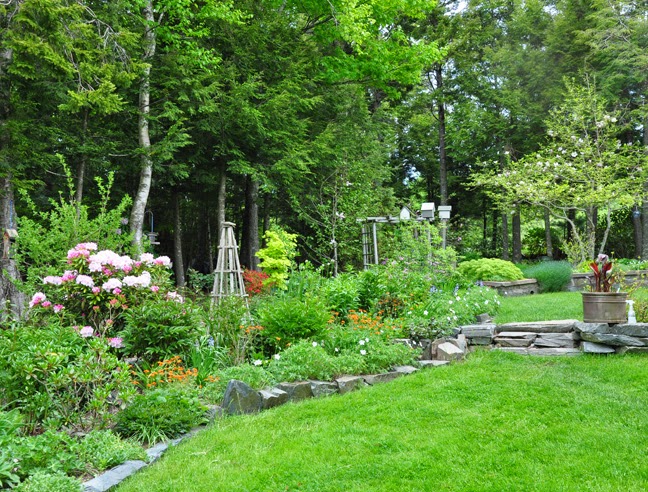
When Elsie Reford set out to create a garden at her summer home north of Montreal, she began in a wooded area. A meandering stream gave her a picturesque starting point and the conifer forest that surrounded it gave her the perfect backdrop.
Though this area was not to become the most flamboyant of the gardens she would undertake (see Our Visit to Les Jardin de Métis, Part 1), it is perhaps the garden that blends most comfortably in the natural landscape that surrounds it.

Elsie Reford
What is a garden but plants beautifully assembled and displayed? It's the setting that makes Les Jardin des Métis unique.
Elsie had a profound love for the outdoors and the Quebec landscape. To her home province, she brought a treasure trove of botanical curiosities; lilies, primulas, gentians and blue poppies from the Himalaya mountains. Most of them were a challenge to grow in a northern setting, but that did not discourage her. As most gardeners do, she learned by trial and error.


Over the years, I have visited many shade gardens. The most remarkable amongst them are the gardens that artfully allow texture, contrast and subtle shifts in color to work their magic.
There is less visual noise in a good shade garden. Flowers never really assume a lead role. Instead, they are simply members of the supporting cast. The principal color is usually green and it is amazing how restful the predominance of that one single hue can be.

Two hostas–both are "green" but the shade of green couldn't be more different. The blue-green hosta has large deeply veined foliage, while the chartreuse hosta has smaller, brighter leaves. Alone they're just two rather ordinary hosta plants. It's when you contrast one with the other that you create something interesting.
If I can use a musical analogy, in the photograph above we see two distinct notes played together in harmony. Now, let's step back and see the full orchestral score.

As we look out beyond that initial pair, we see there is a myriad of different greens each adding its unique voice to the overall "sound". The interplay of leaf shapes and sizes is also lovely.
And I would be remiss if I did not point out the role that the craggy, moss-covered stones play. The plantings seem lush and verdant in comparison with the rocks.

When you have a plant like this Maidenhair Fern, you can make the fine lime-green foliage seem even more delicate when you place it beside the big, bold leaves of a blue-green hosta.
Most of the hostas at Les Jardin des Métis were not identified, but I have one that is similar in my own garden that I can recommend:
Hosta 'Snake Eyes' has medium green leaves with a light green centre framed with a creamy-white edge. The flowers are lavender. Part-shade to full shade. Height: 55-60 cm (21-23 inches), Spread: 110-120 cm (43-47 inches). USDA zones: 2-9.


Northern Maidenhair Fern, Adiantum pedatum is a deciduous fern with curved reddish-brown to black stems and arching compound fan-shaped blades. It prefers moist, rich soil, but it adapts to average garden conditions. Best in bright shade. Height: 30-75 cm (12-30 inches), Spread: 30-45 cm (12- 30 inches). USDA Zone: 3-8.
Interesting tidbit: Early Quebec settlers harvested Maidenhair ferns to make a syrup that was exported back to Europe where it was used as a coagulant to arrest hemorrhaging.


This big swath of a single hosta is a great reminder that a garden bed doesn't always need a mix of different perennials to look great. Allowing a single plant to spread out and fill a large area can be very striking.

When plants are given the freedom to seed themselves, the gardener's hand is less evident.
If you read my last blog post on Jardin de Métis/Reford Gardens, you may remember "The Long Walk" has a traditional stepped planting where perennials are arranged from shortest along the front of the flowerbed to tallest at the back of the border.
The plantings in this woodland alcove are much less formal. As you can see in the photo above, two tall ferns jut up from the outer edge of the centre garden bed. In behind them are much shorter plants (unacceptable in a traditional stepped scheme). This random placement feels less contrived and more in keeping with the way plants self-seed naturally. Perhaps that is why this part of Jardin des Métis seemed so much more at home in its forest setting.


I absolutely love the delicate wisps of the white Goat's Beard and the soft green texture of the ferns. If fairies were real, this would certainly a setting in which to find them!
Goat's Beard in three different sizes:
Goat's Beard, Aruncus dioicus is the largest of the three and has feathery white plumes mid-summer. The plant has green ferny foliage which is quite attractive in its own right. Part-shade or shade and average to moist soil. Height: 120-180 cm ( 47-70 inches), Spread: 90-150 cm (35-59 inches.) USDA Zones: 2-9.
Goat's Beard, Aruncus 'Misty Lace' is more suited to a smaller garden and is the medium-sized plant. Height: 60-75 cm (23-29 inches), Spread: 45-60 cm (18-23 inches). USDA Zones: 3-9.
Dwarf Goat's Beard, Aruncus aethusifolius forms a neat mound of ferny foliage with reddish stems. It has short spikes of white flowers in early mid-summer. Part-shade or shade and average to moist soil. Height: 20-30 cm (8-12 inches), Spread: 20-30 cm (8-12 inches). USDA Zones: 2-9.


At the time Elsie created her woodland gardens, ferns were not commonly used in a home setting. Ferns had experienced a bit of a craze in Victorian England, where displays of exotic specimens collected from around the world were kept in glass conservatories. This fashion for ferns never translated to widespread use in outdoor spaces.
Ferns remained a botanical curiosity, but no one seems to have taken interest in their cultivation. To her credit, Elsie saw a potential use for the ferns growing in forests and along the stream banks of Estevan Lodge. She collected specimens that grew in and around the property and incorporated them into her plantings.


Lady Fern, Athyrium filix-femina 'Erika Silver'* is a delicate fern with pale silvery-green foliage and a non-spreading, mounding habit. Part-shade to full shade. Height: 90 cm (35 inches), Spread: 80 cm (30 inches). USDA Zones: 4-9.
*I had difficulty finding sources for this fern anywhere other than one Quebec nursery. You might have more luck finding a similar-looking plant Athyrium 'Ghost'.
Most of the ferns in Les Jardin de Métis are native to the woods along the Lower St. Lawrence Valley. This part Of Quebec has around thirty species, the most common being Maidenhair ferns (Adiantum), Ostrich ferns (Matteuccia) and Wood ferns (Dryopteris).
Most ferns like moist soil that is rich in organic matter. If your garden is dry (like mine) you may struggle to grow those lovely Maidenhair ferns (Adiantum). I find Ostrich Ferns (Matteuccia) fair a bit better in drought conditions, as do Japanese Ferns and Lady Ferns (Athyrium).
Ferns do have one drawback–they tend to be at their best in the spring and early summer. By August, they can look a bit bedraggled. In a place like Jardin de Métis, that is open to the public throughout the summer season, browning ferns can pose a bit of a challenge for the staff. Visitors expect the gardens to always look their best. As a result, fading ferns are trimmed back. You can do this in your own garden, but do remember your ferns will not benefit from the decaying foliage. Some organic matter should be added to keep the soil dark and rich.

As I said, most of the hostas were not identified, but I did try to capture some of the plants for which I could find tags.

Hosta 'Golden Tiara' is a popular hosta that has medium green leaves with irregular creamy-yellow margins. 'Golden Tiara' is a smaller sized hosta that has better tolerance for dry conditions. It prefers rich, well-drained soil. Lavender flowers. Part-shade to full shade. Height: 30-60 cm (12-24 inches), Spread: 60-90 cm (24-36 inches). USDA Zones: 3-9.


Hosta 'Blue Umbrellas' has blue-green leaves that are cupped downward (hence the name umbrellas). The pale lavender flowers are carried on tall stems that can reach 40 or more inches. This is a large hosta that has thick, corrugated foliage (helping with slug resistance). Part-shade to full shade. Height: 30-60 cm (12-24 inches), Spread: 60-90 cm (24-36 inches). USDA Zones: 3-9.

Another perennial that caught my eye was this silver-green Pulmonaria.
Pulmonaria longifolia 'Diana Clare' has narrow silver-green leaves that are lightly speckled with green on the edges of its foliage early in the season. A silvery patina develops as the season progresses. Deep violet-blue flowers appear early in the spring and soften to a purplish-pink. This plant likes moist, rich, well-drained soil. Part-shade to full shade. Height: 30-60 cm (8-12 inches), Spread: 38-45 cm (12-18 inches). USDA Zones: 3-8.
While flowers did not play a dominant role in these shade plantings, there were some beautiful blooms in among the ferns and hostas.

Gardeners have long had a fascination with wild orchids. Of the 15,000 species recognised by botanists, relatively few are found in North America and even fewer are native to the forests of Quebec. Lady Slippers are the most prevalent of these wild orchids. The Latin name, Calceolus mariae, translates roughly as "Virgin Mary Our Lady's Slipper."
Elsie incorporated a wild, yellow Lady Slipper she found growing on the property along the streambanks into her plantings. She was also gifted some white and pink Lady Slipper's that were collected from the wild by gardening friends.
A few Tips for Growing Lady Slipper Orchids
Lady slipper orchids have experienced a bit of decline in recent years due to habitat loss and a reduction in the number of tiny bees the flowers depend on for pollination. Today, collecting orchids is prohibited but you can find plants at specialist nurseries (Fraser's Thimble Farms in British Columbia would be one example).
The Lady Slippers at Les Jardin des Métis bloom from late Apri into June. Fall is the best time to plant them. For bare-rooted plants, dig a hole and create a central mound. Position the eyes about an inch deep and spread bare roots over the mound. Cover with soil and water well. Apply a water-soluble fertilizer once a week when new growth appears in the spring. Nutrients and consistent moisture are necessary right into the summer for the plant to produce next year's shoots. If well-sighted and cared for properly, the number of blooming stems can double each year.
Lady Slipper orchids prefer morning sun and afternoon shade. They like evenly moist conditions, but not soggy soil. Loose, free-draining soil with lots of organic matter is key to having success with them.
Divide every 3-5 years in the fall.
Note: Lady Slipper Orchids vary widely so this is a general guide.

I particularly liked this pairing of two annuals with the backdrop of green ferns. Planted on the outer edge of a flowerbed, the two types of Nicotiana were growing in a bright pocket of sunlight (part-shade). I could not find a plant tag for the white Flowering Tobacco, Nicotiana but could well be Nicotiana alata grandiflora.
Flowering Tobacco, Nicotiana alata grandiflora is a long-blooming heirloom that has fragrant white flowers that are attractive to butterflies. It likes moist, rich soil and grows 3-5 ft tall. Full sun or bright shade. USDA zones 9-10 (or is a self-seeding annual in more northern garden zones.)

Identified on a plant tag as Flowering Tobacco, Nicotiana x sanderae 'Perfume Lime' I had difficulty finding references on this plant, but I did locate a similar-looking annual flower.
Nicotiana langsdorfii has delicate lime-green flowers. It likes moist, rich soil. It can be grown in sun but has the best green color in bright shade.

Woodland Lily, Lilium martagon var. albuim may carry as many as 30-50
pure white flowers on a single stem.

Scattered in amongst all the other shade perennials were tiny pink and white Martagon lilies.
To find lilies for her garden Elsie had to order bulbs from specialized growers in England. She planted white Lilium martagon var. albuim and pink Lilium martagon var. cattaniae beside her blue poppies, under crabapples and in among her ferns.
Growing Martagon Lilies
Martagon lilies are one of the oldest lilies in cultivation and can live for decades in the same place. They are native to Asia and Europe where they thrive in the dappled light on the edges of meadows.
Martagon lilies can be grown from seed but they can take up to seven years to mature and flower, so it's best to purchase bulbs. Martagon lilies require patience. In the first growing season, the bulbs reestablish a root system. It can even take a couple of years for them to get established enough to even put in an appearance. The advice I have found suggests that planting them in the fall gives these lilies the best start.
Good drainage is key to get Martagon lilies through the winter. They hate soggy soil and will rot, so dig in some humus-rich, organic matter. Dappled shade is best. The blooms on a single stem are numerous, but each flower is small, so plant them twelve inches apart in groups of three bulbs. Planting depth depends on the bulb size. Bulbs can vary in size, so the best guidance is to plant them two and a half times the diameter of the bulb. Water deeply rather than often.
A granular fertilizer (10-10-10) should be applied in early spring and after they flower. Removing the part of the stem that carries the flowers will halt seed production and concentrate the plant's energy on producing a bigger bulb. The bigger the bulb, the better the display of flowers.
Cut the plant to the ground once the leaves have aged to yellow.

Lilium martagon var. cattaniae

Foxglove
Elsie was a self-taught gardener who oversaw the maintenance of her summer retreat well into her eighties. When she passed away in 1958, the property passed to her son Bruce who did not share his mother's passion for gardening. Nature quickly began to reclaim the space. Thankfully for us, the government of Quebec bought the property in 1961 and opened the garden to the public the following year.
Elsie genius was to recognise that her property overlooking the Gulf of St. Lawrence was the perfect setting for a northern garden. Each summer, thousands of visitors to Les Jardin des Métis are grateful for that foresight.