Showing posts with label Invasive plants. Show all posts

Wednesday, August 21, 2019

My Weed Management Strategies


Like laundry and dirty dishes, weeds are a routine task that needs to get done. In July and August, I find that weeding is my principal garden chore.

My approach tends to be proactive–I do my best to prevent problem weeds from gaining a foothold, but I have a very big garden to manage and weeds are happy to take full advantage of any opportunity.

Here is a look at my overall approach to weed management.


Take stock of any Issues


I always begin my time in the garden with a little stroll. I like to pause and admire what's in bloom, but there is also a very practical purpose to this exercise– I make mental notes on what needs attention and the chores that are the most urgent. If I notice weeds have begun to flower or set seed, I'll target that problem area before I do anything else. If the list of chores is long or I'm otherwise pressed for time, I might only have a chance to cut the flower heads off any weeds. When I have more time, I'll circle back and take care of the roots.

Most importantly, this walk around the yard reminds me of the reason I garden in the first place. It's when I take pleasure in the beauty born of all my hard work.


Assorted Phlox, Rudbeckia triloba 'Prairie Glow' and white Liatris


An Overall Gameplan


As I said, I tend to tackle any urgent weed problem immediately. For me, it doesn't make sense to concentrate on clearing one flowerbed at a time if I know Goldenrod seeds are going airborne at the very back of the yard.

But once everything pressing is addressed, I tend to work through the flowerbeds one at a time, clearing one bed completely before I move to the next. Once an area is done, I will mulch any disturbed ground as a final step.

The Best Time to Weed


After it rains is absolutely the best time to weed. Dry soil, especially if you have clay, can be as hard as a rock! Wet soil is soft and loose making it so much easier to pull weeds.

There seems to be only one drawback to a damp garden– the rain also seems to bring out the mosquitoes. If the bugs are bad, I tend to work in one of the more open areas of the garden (in my experience, mosquitoes love the cover of shade and dense growth).

If the mosquitoes are a worry for you to, try to time your weeding chores on a day when there is a good, stiff breeze. Mosquitoes are not great flyers, so they tend to lie low when there is a wind.

 Not my garden thank goodness! These are weeds in an open field.

 Seeds with Wings

Begin by Gathering all your Tools


My weeding tools couldn't be any more basic. I use a trowel with a sharp point and a heavy-duty plastic bucket (a former plant pot for a tree) to collect anything I pull. I also keep a shovel on hand for anything with stubborn roots and a pair of pruners (if a weed has gone to seed, I will cut the seedhead off first and then remove the rest of the plant. This lessens the chances any seed will drop to the ground or get airborne).

One last thing I should mention. Weeds can be armed and dangerous! While I don't always wear garden gloves, I always put them on when I'm weeding. Etched into my memory is the first time I had a run-in with Stinging Nettles. My fingers were on fire!

Follow the Shade


Some gardeners love the sun, but I find the heat and humidity drains my energy. And I have fair skin that never tans. The sun only plays connect the dots with my fine freckles.

I prefer to wait for an area to move into the shade before I begin my work. After a while, you get used to the way the sun moves across the sky and how that impacts any one portion of the yard.

For instance, I know that the flowerbed next to the pond enjoys a period of shade for a little over an hour in mid-afternoon. The circular garden at the back of the yard is full sun in the morning and shaded in the late afternoon. If I want to weed in the shade, those times are the perfect opportunities.

Garlic Mustard

Know your Weeds


Like so many people, I have had an issue with Garlic Mustard. I've learned its habits and now use that knowledge against its further spread. I watch for Garlic Mustard in early spring. It flowers in May and is a prolific self-seeder. Before the tulips are finished and the perennials have flushed out, I comb the garden for Garlic Mustard and pull any flowering plants. In the fall, I make a second sweep and yank any seedlings that I may have missed. In just a couple of years, I have reduced the initial problem very significantly.


Make sure you Get all the Roots


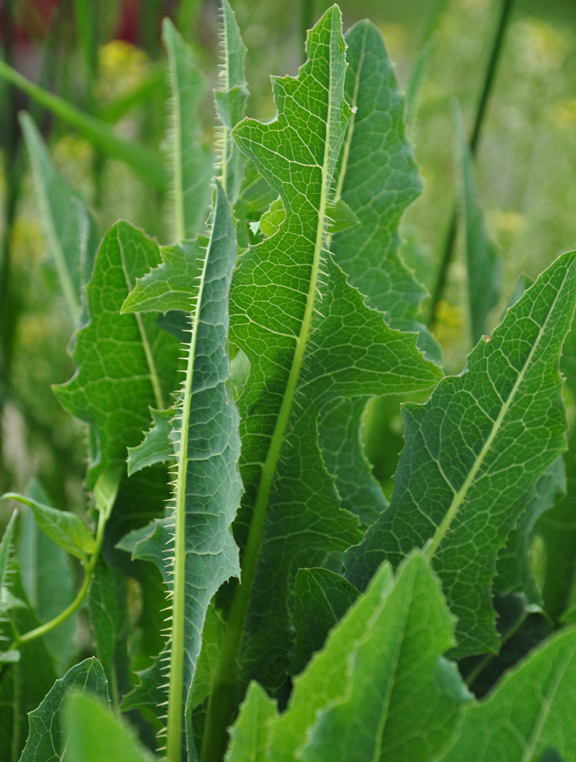
Canada Goldenrod, Solidago canadensis blows into the garden from the surrounding fields. I appreciate that it is an attractive, late-summer magnet for bees, wasps and other insects, but it is also a terrible thug. It both seeds prolifically and spreads by underground roots.

Once you've dug out a weed that spreads underground, I find it pays to go back over the area a second time and look for any root segments that you may have missed.

 Lilium 'Black Beauty'


 Phlox (the bubblegum pink is self-seeded, the darker shade is 'Niki') and Agastache 'Blue Fortune'

Lilium 'Black Beauty'

The hose snaking its way through the flowerbeds.

Open Ground is an Invitation for Weeds


To my mind, I can fill any open ground with the plants of my choice or nature will make the selection for me.

The perennials in my garden are all snuggly planted. Whenever possible, I layer my plants. For example, I will plant hostas and Lamium at the feet of shrubs. I also let Lamium wander around the feet of taller plants. The Lily you see in the image above grows up through Geranium macrorrhizum 'W. Ingwersen's Variety'.


Watch that you or your furry friend isn't spreading the problem


Just a quick caution to alert you to the possibility that you or your pets may inadvertently become part of the problem.

I looked down the other day when I was weeding only to discover that my skirt was covered in seeds. It took me ten minutes to pick the fuzzy seeds out of my clothes! Piper got covered in seeds as well and had to be brushed clean.


Invasive Weeds


For me, a problem weed or plant is not just aggressive, it's also a plant that is hard to remove where unwanted. Weeds can send out roots that spread underground in many directions. Eradicating them can be very difficult. Even if you dig out the main plant, any roots segments you miss are capable of producing a new plant.

I have written about invasive plants quite extensively, so if that is an issue you are facing, I am going to refer you back to these earlier posts Part 1: Invasive Plants, Part 2: Plants to Avoid and Part 3: How I Eliminated Goutweed from my Garden (a method that might easily be used for weeds as well). 

Balloon Flower, Platycodon grandiflorus

 An older variety of Phlox that sometimes self-seeds.

Phlox paniculata 'Jeana' has clusters of tiny flowers.

Mulch


My number one strategy for suppressing weeds is to use mulch. Honestly, I could not manage my sizeable garden without it.

Mulch works by depriving seeds of sunlight. A mulch is simply a layer of material (usually organic) that is spread over the surface of the soil. Mulch not only helps suppress weeds, but it also helps with moisture retention and depending on what you use, soil health and fertility. A few organic options might include compost, manure, straw or hay, pine needles, leaf mold, shredded bark, sawdust and wood chips.

A Few Factors to Consider

The drier and woodier the mulch, the slower it will decompose and the fewer nutrients it will add to the soil. Manure, compost and straw may all contain weed seeds, so it is important to know the source of these materials.

Perhaps the best mulch is compost or leaf mold you make yourself. You know what's gone into it, and when its properly made, aged compost shouldn't contain any weed seeds.

Hydrangea paniculata 'Little Lime', Eupatorium rugosum 'Chocolate' and a pink Phlox.


I don't mulch every square inch of my garden, but I do mulch most of my flowerbeds. The exception would be a number of mature areas of the garden where the plants are so tightly packed weeds have trouble finding any open ground to colonize.

While I started to make compost and leaf mold, my composter's present output does not meet my full requirements. This is something I hope to rectify in the near future with an overhaul of my present setup. In the meantime, I use natural cedar mulch. It is not super nutritious, but it is effective and very affordable.

Mulch is such an important topic I think I will come back in another post (perhaps after we redo our compost bins) and address it in more detail.

Single Balloon Flower, Platycodon grandiflorus and Phlox 'Eva Cullum'


Do we really want to think of the Garden as a Battleground?


As I wrote in the opening of this article, like housework, gardening is a chore. Our approach to these two tasks is however quite different. We always talk about doing battle with weeds, but it never occurs to us that we are waging war when we pull out the vacuum cleaner. Why is yanking weeds any different than killing germs and getting rid of dust and dirt?

My husband and I had a long discussion about this. "I want to end my post on a positive note," I said to him. "I struggle with the notion of my garden as a battleground." After all, the garden is where I go for peace and comfort. The joy it brings me seems so out-of-step with any notion of winning a war against weeds.

Certainly, there is a long history of gardening as a means of taming or controlling nature to suit our purposes. Modern science has only sharpened the battle cry. Make things fast and easy. Bring on the chemical concoctions!

For me, it's time for a new mindset. I don't want to engage in a struggle with Mother Nature, because I know it is a battle she'd win anyway. If I were to step away from my garden for just a few months, Mother Nature would quickly reclaim her rightful place.

There is no such thing as a spotless house or a weed-free garden and perhaps that is as it should be.

Monday, April 3, 2017

Gardener Beware: Invasive Plants, Part 2: Plants that should come with a Warning Label


Missed Part 1? Read it here.

One of the more popular things I have ever written (for another website as it were) was an article on invasive garden plants. It has been viewed almost 200,000 times. At the end of the article, I asked readers to share their experiences with aggressive plants. Readers left almost 500 comments! It seems that many people have had a plant that has run wild through their yard. Gardeners welcomed a chance to share their frustrations and struggles in the comment section of the article.

But as well as sharing their problems, a few readers took exception with one of the plants that I had deemed problematic: Lily-of-the-Valley.

"I would LOVE to have Lily-of-the-Valley take over my space. They have a sweet, delicate smell." wrote Lois Gibbs of Buzzards Bay, MA

Ah, Lily-of-the-Valley! Yes, the white bell-shaped flowers are cute and their fragrance is divine, but boy can it spread.  Here's Lily-of-the-Valley's secret underground weapon:


Just look at those roots! They run deep and shoot out in different directions (I actually missed some of the deepest part of the root when I dug this plant out). Unless you dig down deep and wide with your shovel, you are very likely to miss a segment of the plant's prolific root system. 

Just when you sit back and relax thinking the issue is dealt with, new Lily-of-the-Valley pops up to mock your efforts. 


Not only does Lily-of-the-Valley spread unseen under the ground, it developes little orange-colored berries that are filled with seed.


And while I am grumbling about issues with this plant, I'll also mention that Lily-of-the-Valley is very susceptible to fungal leaf spot in the late summer.

Some of my readers did not appreciate it when I expressed a need for caution when it came to planting aggressive plants:

"OK ladies...this article and all your comments were all very helpful...however...any "bloomin' idiot flowers" you'd like to get rid of just send them "crazy" growers to me!" Jan B. Crossville, TN

"I am glad you posted this, I need some aggressive plants up here..." Debby Boyle, Necedah, WI

"Funny. Everyone is trying to get rid of invasive plants and I am trying to find them. I am in Dallas, TX and it's so hot and dry...I need something for my pitiful yard..." SkyN, Texas

I will reply here as I did in the original article. Be careful what you wish for! With all due respect, what these people are really looking for is not an invasive plant, but one that will be successful in a challenging outdoor area. Yes, they may face some difficult growing conditions, but that isn't a good reason for resorting to a plant that is as problematic as it is pretty. It's so much better to take a step back and look for a plant that is appropriate to the site. 


I am not going so far as to say never plant Lily-of-the-Valley. Just do it cautiously knowing you are planting something that can really spread. Choose your spot carefully, so hopefully it can be contained. 

I found Lily-of-the-Valley growing in my garden when we moved in. Under a big maple at the back of the yard, it's limited to an island bed and hasn't been a problem... so far. In the shadow of the maple, it fights periwinkle and English Ivy for turf. In the front garden however, Lily-of-the-Valley is a real nuisance. I've tried to get rid of it, but man is it difficult!

 A shade gardener who is not afraid of Creeping Jenny.

Groundcovers

The majority of readers wanted to weigh-in on plants that were giving them grief. Groundcovers were high on the list of problem plants. Here's a list of the ones mentioned most frequently:

Creeping Jenny, Lysimachia nummularia
• Goutweed, Aegopodium podagraria 'variegatum'
Periwinkle, Vinca minor
False Lamium, Lamium galeobdolon 'Florentinum'
Bugleweed, Ajuga
Lily-of-the-Valley, Convallaria majalis
Winter Creeper, Euonymus fortunei
Chameleon Plant, Houttunynia cordata

"Chameleon Plant– beautiful, but it spreads like crazy and I can't get rid of it. It's those underground runners. NEVER, NEVER PLANT THIS." Diane D. Lawrenceville, GA

"Creeping Charlie is much worse than Creeping Jenny and I am not just saying that because I am a woman.", E. Simmons, Florence AZ

Suggestions and Alternatives

As I wrote in the previous post, gardeners can on occasion be too impatient when it comes to filling up their flowerbeds. Patience is a virtue, especially when it comes to gardening. It is better to look for plants that are"clump-forming" and fill a space with a larger number of plants clustered together.

Chinese Lanterns, Physalis alkekengi

Gooseneck Loosestrife, Lysimachia clethroides on the lower right.

Rose of Sharon (left) and Obedient Plant (right)

There were lots of other plants that were called out for not being well-behaved. Here are just a few that readers complained about:

Japanese Knotweed, Fallopia japonica
Anemone Canadensis
Chinese LanternsPhysalis alkekengi
Spiderwort, Tradescantia
Obedient Plant, Physostegia virginiana
Gooseneck Loosestrife, Lysimachia clethroides 
Bamboo, Bambusoideae (spreads underground)
St. John's Wort, Hypericum perforatum
Purple Heart, Wandering Jew Purpurea
Ribbon Grass, Phalaris arundinacea
Sundrops, Evening Primrose, Oenothera 
Mexican Evening Primrose, Oenothera speciosa
Snow-on-the-Mountain, Aegopodium podagraria
Rose of Sharon, Althea (a terrible self-seeder, but it has to be said that it is a good, late-summer shrub. Look for one of the varieties that are sterile, if you are concerned.)
Orange Daylilies, hermerocallis fulva (not the hybrid daylilies, but the kind you see growing in ditches and at the side of the road)

"I have Yarrow that has taken over my front lawn..." Kris Lee, Jackson, WY

Another problem is Purple Heart, Wandering Jew Purpurea. It came with the house when we bought it. It is everywhere. I have removed bags of it and every year it comes back. I have grown to detest it...", Burrgmb, Southlake Texas

"Tree of Heaven is the worst name for a pest that I can think of!", Kristen McCann, Fresno CA

"Snow-on-the-Mountain and Yucca are both my garden nemesis. Here in Michigan they grow like CRAZY! Catnip is another that I will always avoid." J Merillant, Michigan, MI

"Another aggressive plant is Mexican Morning Primrose. It is a really pretty pink groundcover. However it developes a very intricate, dense underground network of roots that are a real problem to eradicate..." Gerald K, Mather, CA

Suggestions and Alternatives

There are so many great perennials! There is no need to feel that you have to resort to an unstoppable plant just to find something that works. If you are stuck on what will grow in a difficult area, do some homework. Look for books on shade, clay soil, dry or otherwise inhospitable conditions. See if there is a garden tour or open gardens in your area and find inspiration there. 
There is a great plant for almost any situation– even the difficult ones!

I have Anemone Canadensis in an isolated bed, so for me it hasn't been a problem. Others really dislike its spreading ways. On the right is Snow-on-the-Mountain.

Wisteria (top), Trumpet Vine (lower left) and Virginia Creeper (lower right)

Vines and Climbers:

So many different types of vines have given gardeners concern. Trumpet Vine and Asian Wisteria were amongst the most-hated vines, but the others mentioned most frequently were:

Honeysuckle, Lonicera (native to Korea, China and Japan)
English Ivy, Hedera helix
Virginia Creeper, Parthenocissus quinquefolia

"Morning Glories* are a nightmare. One plant had taken over and I find myself constantly trying to pull them out as they reappear. Ugh...." Mary Kay@Studio23 Thirty

*Morning Glories are great self-seeders and can become a problem given the right conditions. If you have white flowers on Morning Glory-like foliage, you actually have Bindweed.

Suggestions and Alternatives

Most Clematis are a great choice for full sun (Sweet Autumn Clematis might be one of the exceptions). Climbing roses on a support are another choice for sun (or in some cases for part-shade. Rambling roses will often scramble up a tree for instance). 

If you want to grow Wisteria, I have heard that the North American native, Wisteria frutescens is a much better choice than Asian Wisteria. 

For shade you can always try a Climbing Hydrangea, Hydrangea petiolaris. It is a vine that is a little slow to get established, but isn't invasive to my knowledge. 

A large patch of Oregano in the left foreground and Chives on the right.

Herbs:

"Mint!!! I made the mistake of planting it in my flowerbeds, as they told me it was a natural ant repellent at the garden centre. Yeah right! Not only has it helped, it has taken over my bed..." Ldavis49, Knoxville, TN

• Mint, Mentha
• Oregano, Origanum vulgare
• Lemon Balm, Melissa officinalis
• Sweet Woodruff, Galium odoratum
• Chamomile, Matricaria maritima (great self-seeder)
• Feverfew, Tanacetum parthenium (great self-seeder)
• Chives, Allium schoenoprasum (great self-seeder)
• Thyme, Thymus (given ideal conditions)
• Tansy, Tanacetum vulgare
• Comfrey, Symphytum officinale
• Bee Balm, Monarda (makes some lists. I have it in my garden and find it is fairly easy to remove)
• Pennyroyal, Mentha pulegium (member of the mint family)

Suggestions and Alternatives

The solution for herbs that spread a little too vigorously is simple: plant them in a container. 

Cut chives back hard after they flower. You'll have fresh growth in a couple of weeks and will eliminate the possibility of unwanted seedlings.

Some gardeners, myself included, like herbs like Feverfew despite the fact that it reseeds itself a bit too readily. If you dislike prolific self-seeders, cut off the spent flowers before they set seed. Another way to limit the number of new seedlings is to remove most of the plants after they've finished flowering and leave only a few to reseed.

If you have any problems with plants, please share your experiences in the comment section of this post. Suggestions or alternatives to invasive plants are also most welcome!

Read Invasive Plants Part 1 and Part 3.