Showing posts with label Container planting ideas. Show all posts

Monday, March 19, 2018

Collectable Houseplant: Ferns


Fluffy Ruffle Fern or Sword Fern, Nephrolepis exalata likes bright, diffused light 
and soil that is evenly moist.

I have a soft spot for ferns. I like seeing their bright, kelly-green foliage on my window ledge in the winter months when the garden is blanketed by snow. 

Ferns do well for me. They seem to like the morning sunshine that my biggest windowsill affords.


I often move my ferns outdoors in the summer and back inside in the fall. 

All of the ferns in this hanging basket (above) performed well in a shady outdoor spot. The only thing they demanded was regular watering. In the fall, I divided the container planting and potted up the ferns individually for the winter months.  

Birdbath container planting in a private garden in Toronto.

As well as ferns, this post touches briefly on plants that look like ferns, and are commonly referred to as ferns, but aren't actually ferns at all. 

These fern-like plants make nice outdoor container plants too. This birdbath is my favourite example of using one of these non-hardy fern look-a-likes in a outdoor container planting.

Plumosa Fern, Asparagus densiflorus 'Sprengeri' also know as Asparagus Fern is often used by 
florists as a filler in arrangements. It's not a true fern but is actually a member of the lily family.


There are quite an array of indoor ferns you can collect and most of them like similar growing conditions. 

Here are a few basic tips for growing ferns:

Light: Avoid direct sunlight. Ferns like bright, diffused light. They prefer a north-facing windowsill that has indirect light. An east facing window is also good throughout most of the year, but may become too bright in the spring and summer months. With a east-facing situation, it a good idea to move your ferns back a few feet from the window in the summer or install a sheer curtain to help block the hot afternoon rays. 

Water: Ferns like evenly moist soil and regular waterings. Water deeply! I always take my ferns to the sink and give them a really good soak. Most indoor ferns are tropical, so lukewarm water is best.

Soil: Ferns like a good quality, well-drained potting soil.

Temperature: A fern's native habitat will tell you all you need to know about the temperatures it prefers. Ferns from the tropics like temperatures in the 60-70 degree F range (15-21 degrees C) Those from more temperate areas of the world are much more adaptable to a cool spot next to a window.

Humidity: Providing a fern with the humidity it likes can be a challenge. If your house is really dry, you can mist them with lukewarm distilled water. You can also place the fern in a closed terrarium, put it under a cloche or stand it in a water-filled tray of pebbles.
A few ferns that don't mind low humidity include: Boston Fern, Nephrolepis, Button Fern, Pellaea, Rabbit's Foot Fern, Davallia and Staghorn Fern, Platycerium

Ongoing Care: Keep your ferns looking their best by trimming away any brown or damaged fronds. Repot a potbound fern in the spring.

Fertilizer: In the wild, most ferns live on the forest floor where there is shade and plenty of decaying organic matter.  In the spring and summer use a liquid fertilizer (following the label's directions) every couple of weeks. 
Using a fertilizer in the winter months, when the plant is not actively growing, is unnecessary. Excessive fertilization in the winter can actually cause brown, wilted fronds.

Propagation: A large fern can be repotted or you can use the opportunity to divide it. Remove the pot and carefully break the plant into smaller pieces. Replant the divisions and water well.

Pests and Diseases: Possible insect pests include mealy bugs (soft, downy looking insects), spider mites (look for delicate webbing) and scale insects that can form lumpy colonies. 

A few of the Many Types of Indoor Ferns:


Jester's Crown Fern, Nephrolepis obliterata 

Sword Fern or Jester's Crown Fern, Nephrolepis obliterata makes quite a bushy plant and has sword-shaped fronds. In the wild, it can be found growing in the rainforests of Australia and New Guinea.

Tricolor Fern

Tricolor Fern, Pteris aspericaulis 'Tricolor' is another tropical fern that has pretty red stems and new growth that is bronze in color.

Silver Lace Fern, Pteris ensiformis

Silver Lace Fern, Pteris ensiformis (sometimes called Sword or Slender Brake Fern) has delicate, dark green leaves with silvery accents.

Glowstar Fern, Pellaea 'Glowstar'

Glowstar Fern, Pellaea 'Glowstar' has shiny, dark green fronds. It originates in eastern Australia.

Korean Rock Fern, Polystichum tsus-simense

Korean Rock Fern, Polystichum tsus-simense (family dryopteridaceae) has lance-shaped fronds. It is a South Asian fern that grows in shade near water or on rocky faces.  This fern can take a fair bit of shade. 

Maidenhair Fern, Adiantum raddianum likes bright diffused light and evenly moist soil.

Maidenhair Ferns, Adiantum Raddianum have to be one of the prettiest indoor ferns, but they have a reputation for being difficult, so I thought I would add a few extra pointers.

Like most ferns, they like bright, but indirect light. Too much sun and their foliage will scorch. Too little light and they turn yellow. The soil in their pots needs to be kept evenly moist, but not soggy. Neglect to water them and they shrivel in a heart beat. If this happens, cut the fronds off at ground level, water well, and fingers crossed, your Maidenhair Fern will recover.

This is a plant from the Brazilian tropics, so it prefers a consistently warm spot. It's also a fern that craves humidity (see care tips above).

Asparagus densiflorus in a private Toronto garden.

A Few Fern Look-a-Likes:


 The Asparagus "Fern", Asparagus retrofractus with its fine, feathery foliage that makes it look like a fern, but it is actually a member of the Liliaceae family. This houseplant has some definite drawbacks. The fine, needle-like foliage is feathery soft, but the base of the plant's woody stems have fine thorns. Ouch! Asparagus retrofractus also has a way of dropping their fine leaves the moment they get a bit dry. The good news is this plant is very easy to grow provided you water it regularly and give it a spot in a north-facing window.

The Foxtail "Fern", Asparagus densiflorus is very similar to Asparagus retrofractus, but it has foxtail-shaped plumes. The care for both plants is basically the same. 

It you want to take either plant outside for the summer, place them in a lightly shaded place with protection from the afternoon sun. Water them thoroughly and regularly.

Moss Fern, Selaginella

Moss Fern, Selaginella kraussiana 'Aurea' looks like a cross between a moss and a fern, but it is neither. It makes a great understory for taller houseplants or can be potted up all on its own. It likes humidity and moist conditions, so don't let the soil dry out completely. Like ferns, Selaginella is easily scorched by the sun, so give it indirect light. 

A Container Planting using Ferns


I thought that it might be fun to gather a few ferns along with some other houseplants into a container planting. 


Any ceramic container can be turned into a plant pot with a drainage hole. All you need is a drill and a set of tile and glass drill bits (these drill bits can be found at just about any hardware store).

Drilling a drainage hole is fairly easy. There is just one tip: use a small puddle of water on the surface your ceramic dish to keep the container and the drill bit cool.


I used three small ferns along with a Moss Fern, Selaginella and a variegated ivy. The mushrooms are from the Dollar Store (I think the large mushrooms were $2.50 and the little one was just $1).


If you're an indoor gardener who sometimes forgets to water, ferns may not be for you. But if your willing to keep a watchful eye of your plants and have a room with indirect light, ferns might make a nice addition to your collection of houseplants.

Bookmark this post with a Pin.

Thursday, August 3, 2017

The Little Stonehouse Garden, Part 2


Fate does not always smile upon old houses. With modern urban development, a quiet, country setting can sometimes completely change its character. A place where two country roads meet can evolve into a busy city intersection. And not everyone is willing to take on the demands of an older home. They need patience, vision and tons of hard work.

The home of Carrie and David Brandow is older than Canada itself. What began as a rural stone house is now a home on the outskirts of the city of Guelph. Despite the city's expansion, the house retains much of its original charm. The door and trim on the front entrance is Kelly green– a fitting choice for the home of an avid gardener.

"The house was built in 1854 (according to the date on the side of the house). I have heard differing stories about this house," says Carrie, "I've heard it was a farmhouse, or more often, it was a rooming house for people traveling between Guelph and Cambridge. It is not very big inside, so they would not have had many people staying at one time."

"We love the old charm, the deep windowsills and the location– it is half way between Dave's and my work. It's also close to the city, but still in the country."

Over the years, Carrie and David have done a number of renovations.

"The only thing that is the same about the property, from when we got it 21 years ago, is the original part of the house (we built the addition) and the greenhouse/shed– we have not got around to taking them down. We had to change everything else; upgrade the septic, build the garage etc. Which actually meant I would put in the gardens only to have them destroyed by one major construction project or another. The garden in place are now 3-5 years old."

It is amazing to think that the garden I am about to show you is only three to five years old! It looks like the it has always been there.


 Giant Fleeceflower, Persicaria polymorpha (tall, white flowering perennial), Salvia guarantica 'Black & Bloom' (blue flowering annual) and Wax Begonia, Semperflorens (red flowering annual).


For those of you that might have missed the first post, Carrie Brandow has a career in the wholesale nursery trade. Some of the plants she grows for the family business come home with her to fill her summer planters and enhance her garden's flowerbeds. 

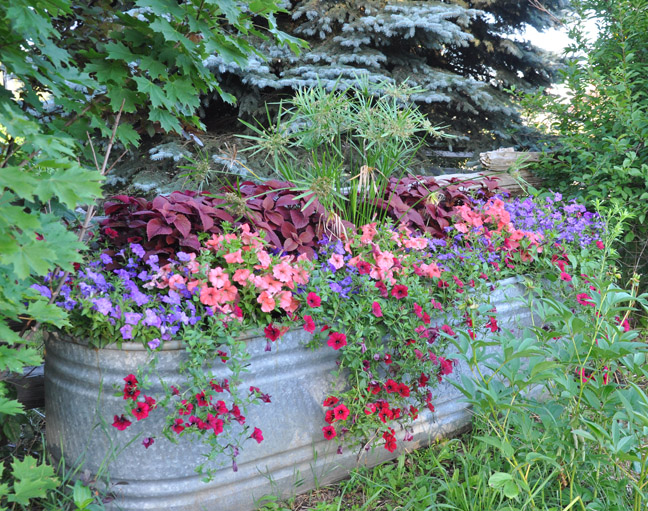
The huge container planting (above) began with an old water trough that Carrie and David discovered on the property when they bought the house. The bottom was rusted through, so as a container for annuals, it certainly offered lots of good drainage! 

1. Dwarf Egyptian Papyrus, 'Graceful Grasses King Tut' 2. Coleus 'Redhead' 3. Petunia 'African Sunset' (seed spreading variety) 4. Petunia 'Tidal Wave Velour Red' 5. Petunia 'Littletunia Purple Blue'

A closeup of the big container planting.


Another one of other Carrie's containers that I missed showing in the last post.

1. Coleus 'Redhead' 2. Fuchsia 3. Mimulus 'Magic Mix' 4. Nemesia Nesia 'Sunshine' 


This is the garden's main flowerbed. Annuals edge the bed and are dotted in among the perennials. Carrie sees a number of advantages in this planting style:

"The perennials create a base and change the colour interest throughout the season. Annuals add continuous colour."

"Annuals can also be changed year to year, so the garden is not the same every year. One year the main color is orange, the next year the main colour might be pink. The perennials get a different look simply by changing the colour of the annuals."

1. Delphinium 2. Maidenhair Grass, Miscanthus 3. Butterfly weed, Asclepias tuberosa 'Hello Yellow' 4. Perilla Tricolor 5. False Indigo, Baptisia 6. Echinacea 'Strawberry Shortcake' 7. Bergenia 8. Bearded Iris 9. Giant Lamb's Ears, Stachys byzantina 'Helen von Stein' 10. Annual Marigold 'Durango Mix'.

Perilla Magilla Tricolor (left) and Giant Lamb's Ears, Stachys byzantina 'Helen von Stein' (right)

Two foliage plants from the big flowerbed seen above:

Perilla Magilla Tricolor (annual) has burgundy foliage with bright pink centres. It is performs well in both sun and shade. Deer resistant. Height: 60 cm (24 inches), Spread: 45-60 cm (18-24 inches). Hardiness:10,11.

Giant Lamb's Ears, Stachys byzantina 'Helen von Stein' (perennial) has large, fuzzy grey-green leaves. This is a non-blooming type of Lamb's Ears. Full sun. Height:30-45 cm (12-18 inches), Spread: 45-60 (18-24 inches). Hardiness: 4-9.


Butterfly weed, Asclepias tuberosa 'Hello Yellow' forms an upright clump of narrow green leaves with clusters of yellow flowers. Green seedpods follow that can be dried for arrangements. Attractive to butterflies. This plant requires well-drained, somewhat sandy soil. Full sun. Height: 40-50 cm(16-20 inches), Spread: 50-60 cm (20-23 inches). USDA zones 4-9.

The tall spikes of Delphinium, an orange-red Echinacea 'Hot Papaya' and the pink spires of Mountain Fleeceflower, Persicaria.


Echinacea 'Strawberry Shortcake' is double flowered Echinacea with white petals and a pompom that starts off white and darkens into rose-pink. Full sun. Height: 65-75 cm(26-28 inches), Spread: 45-60 cm (18-24 inches). USDA zones 4-9.

A group of annuals: Salvia (blue flowers), Gomphera (magenta flowers) and Melampodium divaricatum (yellow daisy).

Butter daisy, Melampodium divaricatum is an annual that likes hot, humid locations. Full sun. Height: 1-2 ft (there are both tall and shorter varieties).

The same flowerbed from a different vantage point.


Alpine Betony, Stachys monieri is a perennial that forms a low mound of green leaves with mauve or pink flower spikes mid-summer. This plant is happy in average garden soil and likes average to moist growing conditions. Full sun, but will tolerate part-shade. Height: 30-60 cm (12-23 inches), Spread: 45-60 cm (18-23 inches). USDA zones 4-8.


This flowerbed sits toward the back of the property adjacent to the garage. Under the small tree, there is a nice grouping of hosta (see below). There is also has a little pond and more container plantings.

Hostas with a nice mix of color and texture.

A container planting next to the garage.

1. Salvia 'Patio Blue' (annual) 2. Geranium 'Mrs Pollack' 3. Nemisa 'Nesia Burgundy'  4. Mercardonia ( yellow annual) 5. Coleus 'Stained Glassworks Burgundy Wedding Train' 

Coleus 'Stained Glassworks Burgundy Wedding Train' trails nicely over the edge of a container. It has burgundy foliage edged in lime green. Height: 30-46 cm (12-18 inches), Spread: 46-60 cm (18-24 inches. 

The other side of the flowerbed that runs along the length of the garage.

1. Evening Primrose or Sundrops, Oenothera fruticosa 2. Crimson Scabious, Knautia  macedonica 3. Lysimachia punctata 'Golden Alexander' 4. Salvia 'Patio Blue' (annual) 5. Coleus 'Defiance'

Two of the perennials in detail:

Crimson Scabious, Knautia macedonica is a short-lived perennial that forms a low, rounded clump of grey-green leaves. Wiry upright stems carry maroon flowers throughout the summer and into the fall. This plant likes somewhat dry conditions and is happy in average garden soil. Full sun.  Height: 60-90 cm (23-35 inches), Spread: 45-60 cm (18-23 inches). USDA zones 4-9.

Lysimachia punctata 'Golden Alexander' has variegated green leaves with a cream margin. Spikes of starry yellow flowers appear in summer. Unlike some loosestrife, this cultivar will supposedly spread moderately to form a small patch. Height: 45-60 cm(18-23 inches), Spread: 45-60 cm (18-23 inches). USDA zones 4-9.


There is a row of trees at the back of the property that provide privacy and shade. Here Carrie and David have a small fire pit and a couple of comfortable chairs.


The garden that runs along the side of the yard continues with a mix of annuals and perennials. Among the perennials are lilies, phlox and dahlias.


In the hot, dry area at the centre of the yard, Carrie has a metal basket and a couple of blue ceramic pots filled with succulents.


Silver Spurflower, Plectranthus argentatus 'Silver Shield' (perennial– can be used as an annual-depending on your zone) is a spreading, sub-shrub native to Australia. It is primarily grown for its attractive, fuzzy, grey-green foliage. It has upright flower spikes with bluish-white flowers. Grow it in part shade in rich, well-drained soil. Height (as an annual foliage plant): 60 cm (24 inches), Spread: 60cm (24 inches). USDA zones: 10-11.


1. Paddle Plant, Kalanchoe thyrsiflora 'Desert Rose' 2. Echeveria 'Ruffles' 3. Sedum spurium 'Voodoo' 4. Mother of Thousands, Kalanchoe daigremontiana 


One final corner of the garden to explore. A soft pathway of wood mulch leads from the house down to the garage.

The garden in the early morning light.

And later in the day.

In the back row: Coleus 'Wasabi' and Coleus 'Saturn' In the front row: Begonia boliviensis 'Bossa Nova Red', Pansy 'Cool Blue Wave', Fuchsia 'Autumnale' and Fuchsia 'Marinka' at the sides of the box (not shown).

Unless you have a greenhouse where you can give seedlings an early start each spring, planting large areas with annuals, as Carrie has done, may not be an affordable option for everyone. But what you can take away from this planting style are design tips that can be adapted to suit any garden on whatever budget:

• Pick a key, high traffic area and use annuals to give you continuous color from summer into fall.

• Consider using annuals to edge a perennial bed. At the front of a large flower border, they won't get lost in a crowd.

• Mass annuals together for a display that has a big impact. 

• Choose large or oversized containers that have a wow-factor rather than lots of little pots.

• As Carrie suggested in the first post, remember that even with annuals, foliage color is a constant. Flowers come and go. If you want to keep your container plantings looking their best all season, keep the different foliage colours in mind. 

I love Carrie's idea to vary the look of your garden each year by changing the type and color of the annuals you choose. It's refreshing to have a new look every once in a while. And it's an easy update with a minimum of fuss! Who doesn't love that?