Saturday, May 1, 2021

New Perennials and Shrubs for 2021 from Proven Winners + Some Old Favourites

Sadly, we are in the midst of yet another lockdown here in Ontario. I was surprised and a little relieved to discover that, despite the lockdown measures, nurseries and garden centers are open for a reduced number of shoppers. Plant shopping can finally begin so it's time to start drawing up a wishlist of some new plants along with a few old favourites. 


If you're a fan of Gardener's World, you may remember Carol Klein wandering through a winter garden that showcased red and yellow dogwoods to perfection. I already have red and lime-green varieties, but I have yet to add a Dogwood with yellow stems. Dogwoods are one of the more shade-tolerant shrubs. They also adapt to a wide range of soil conditions. What also interests me about Artic Fire® 'Yellow' is spring flowers and the white berries that follow.

New for 2021 Red-Osier Dogwood, Cornus stolonifera Artic Fire® 'Yellow' is a deciduous shrub that has bright yellow stems that add winter interest to the garden. Arctic Fire® 'Yellow' has tiny, star-like, white flowers followed by white berries. Not available in Florida. Part shade to full sun.  Height: 48-60 inches, Spread: 60-72 inches. USDA zones: 2-7

I saw this next Dogwood when I was scrolling through a wholesale nursery website. I couldn't decide if I liked the shape of the shrub, but I thought the foliage was really interesting. Pucker Up!® might be something I have to see in person before I decide if I like it enough to purchase a plant.

Red Twig Dogwood, Cornus stolonifera Pucker Up!® has heavily textured foliage. Though the stems have a reddish cast this shrub's defining characteristic is its foliage. Adaptable to a wide range of conditions. No flowers. Slow growing so it rarely requires pruning. Not available in Florida. Part sun to full sun. Height: 36-48 inches, Spread: 36-48 inches. USDA zones: 3-8.


To the best of my knowledge, a dastardly vole has destroyed one of my favourite hydrangeas. I am just waiting for some warmer weather to see if any of the rootball of my 'Invincibelle Ruby' survived (I discovered most of the shrub sitting uprooted on the surface of the soil earlier this spring). So heartbreaking! I will probably get another 'Invincibelle Ruby', but if I can't find one, this new introduction might do nicely.

Smooth Hydrangea, Hydrangea arborescens, Invincibelle Garnetta® is a compact, reblooming hydrangea that has big, mophead, pink blooms on strong stems (no flopping like older cultivars such as 'Annabelle'). Full sun is recommended for northern zones. In hot climates some afternoon sun is beneficial. This hydrangea blooms on new wood making it a great choice for northern gardens. Prune in early spring to one-third its size. Fertilize in the spring after pruning. Height: 30 inches, Spread: 30 inches. USDA zones: 3-8.

What can I tell you? I am a sucker for a daylily with a pretty ruffled edge!

New for 2021 Hemerocallis, Rainbow Rhythm® 'Lake of Fire' has a large 7" orange-apricot flower with an orange-red eye. The flower's ruffled edges are orange-red with a razor-thin yellow-gold margin. Average soil and moisture conditions. Part to full sun. Height: 24 inches, Spread: 18-24 inches. USDA zones: 3-9

New for 2021 Ornamental Oregano, 'Drops of Jupiter' has chartreuse foliage and mauve flowers. Though the fragrant leaves are edible, they don't have the flavor of traditional oregano. Average to poor soil with good drainage is ideal.  Heat and drought tolerant. Attracts bees and butterflies. Full sun. Height: 24 inches, Spread: 36 inches. USDA zones: 4-9.


If you've grown traditional varieties of Russian Sage, you'll know they are large perennials that often tend to flop. This new variety is more compact and upright. Russian Sage blooms from summer into the fall, so that's another reason to consider this plant. If you can't find the new 'Sage Advice', 'Denim and Lace' is a second offering from Proven Winners for smaller gardens.

  Russian Sage, Perovskia atriplicifolia 'Sage Advice' has lavender flowers on a strong, upright plant. Grows best in dry to average, well-drained soil. This long-blooming cultivar is drought tolerant. Full sun. Height: 32-36 inches, Spread: 28-32 inches. USDA zones: 4-9.


That I might get excited about something that doesn't flower is a sign that I am evolving as a gardener. I definitely would like to include some new conifers among this year's purchases. I like the texture and the compact size of this native juniper. 

New for 2021 Juniperus communis 'Tortuga' is a low-mounding groundcover with emerald-green foliage. It is a tough evergreen that is perfect for a dry sunny spot. It resists drought, salt, heat, deer, and rabbits. Average to poor soil. No pruning required. Full sun. Height: 24 inches, Spread: 24 inches. USDA zones: 2-7.

I am not convinced this next item is for me, but anyone who grows azaleas might be interested in a repeat bloomer. (Note: This is not a shrub that is ideal for colder zones. If you wish to plant this azalea at its limit of 6b, select a protected location and mulch well)

Reblooming Azalea, Rhododendron, Perfecto Mundo® 'Double Purple' has ruffled flowers. 'Double Purple' first blooms in the spring on old wood, then it experiences a period of growth before it0 puts on new flowers from mid-summer into the fall on new wood. If you need to prune it do so right after the initial flowering in spring (this will also encourage more reblooms). Fertilize in spring. Acidic soil is best. Resistant to lace bug. Sun to part shade. Height: 30-36 inches, Spread: 36 inches. USDA zones: 6b-9.

In my experience, yews are indispensable additions to a shade garden (Note: they can also handle full sun). What interests me about this particular yew is its dwarf rounded habit. You could even use it to replace boxwood as a low hedge.

New for 2021 Yew, Stonehedge Dark Druid® has soft, fern-like evergreen foliage and a compact, rounded habit. Sun to shade. Height: 36-48 inches, Spread: 36 inches. USDA zones: 4-7.

'Paint the Town Fancy' on the left and 'Cherry Vanilla' on the right.

 I have one clump of Dianthus that I've had for years, but generally speaking, I have not been terribly successful with this plant. I put this down to a need for better drainage to see the plants through a Canadian winter. I am not ready to give up just yet. These plants like full sun, and loose, well-drained, slightly alkaline soil. The spicy fragrance of the flowers spurs me into trying again until I am more successful.

New for 2021 Dianthus hybrid, 'Paint the Town Fancy' has fuchsia-pink flowers with a red eye on a low mound of grey foliage.  Continuous bloomer that is heat and drought tolerant. Full sun. Height: 6-8 inches, Spread: 16-18 inches. USDA zones: 4-9.

Old Favourites from Proven Winners

Dianthus hybrid, Fruit Punch®'Cherry Vanilla' has double deep red flowers on a low mound of blue-green foliage.  Continuous bloomer that has a spicy fragrance. Full sun. Height: 8-10 inches, Spread: 8-12 inches. USDA zones: 4-9.

I am redoing a bed at the back of the garden. Weeds moved in when I got wrapped up in other projects and I have decided it is time for a full rethinking of the plantings. Based on increased levels of drought, I want to move away from thirsty plants like phlox. Though the P.W. site suggests that baptisia is "moderately drought-tolerant" in my experience I find they handle drought well, so I am looking back to consider a few older P.W. cultivars. The first is 'Sparkling Sapphires' for the rich color. A white Baptisia might also be nice.

False Indigo, Baptisia Decadence® 'Sparkling Sapphires' has deep violet-colored flowers on a compact plant with deep blue-green foliage. Height: 30-36 inches, Spread: 30-36 inches. USDA zones: 4-9.

False Indigo, Baptisia Decadence® Deluxe 'Vanilla Cream' has pastel yellow buds that open into vanilla flowers. The compact foliage emerges bronze in spring and becomes grey-greenThis cultivar was selected for its petite size and unique flowers. Full sun to light shade. Height: 30-36 inches, Spread: 36 - 42 inches. USDA zones: 4-9.


I ended up buying this next shrub late last summer. The maroon foliage color is what sucked me in– it was wonderfully dark and I thought it might look stunning next to a blue-toned evergreen I also purchased. 

My Monet® 'Sunset' needs winter protection from rabbits.

One issue I have with weigela is rabbits. For instance, I have a 'My Monet Sunset' that gets eaten to the ground every year. This weigela got nibbled a little but not nearly so badly. Was this luck or better rabbit resistance? It's too early to say.

Weigela florida, Spilled Wine® has deep maroon foliage and bright pink flowers. This shrub grows wider than it grows tall. It prefers well-drained soil but is adaptable to a range of soil conditions. Medium moisture conditions. Deer resistant. Height: 76-90 cm (30-36 inches), Spread: 90-106 cm (36 - 42 inches). USDA zones: 4-9.


I fell in love with this shrub when I saw it in Jacquie's garden in Nova Scotia. Pearl Bush is quite an old-fashioned favorite, so I have found it a bit hard to find. Hopefully, I can finally track one down this summer. 'Blizzard' is the tallest of the two options Proven Winners offers. 'Snow Day' is more compact.

Pearl Bush, Exochordax Snow Day® 'Blizzard' has white flowers in the spring. It's an easy-to-grow shrub that flowers on the previous year's growth. This shrub has much larger flowers than the older variety 'The Bride'. Prune to keep it small. Full sun. Height: 60-72 inches, Spread: 60-72 inches. USDA zones: 4-8.

I hope you've enjoyed reading through my list of possibilities. 

By the way, I have gotten a notice from Google saying they are fiddling around again with the workings that send my blog posts to subscribers. I know a number of people have complained already that they no longer receive my posts. Sorry about the confusion! For now, I'd recommend you follow me on Facebook. I don't post on a regular schedule, but I always share a link to each post on my Three Dogs in a Garden Facebook page

I also have an Instagram account if you like to see a selection of my photographs.

Wednesday, April 21, 2021

A Little Cheat with Spring Bulbs

Though warm weather seems to have arrived early here in Southern Ontario, I remind myself that we are only entering the second half of April. Not two years ago we had a snowstorm in the third week of the month. 

This spring we had really pleasant weather up until the end of March when strong gusts and a sudden dip in temperatures made working outside rather unpleasant. At night, the thermometer dipped below zero degrees Celsius. Though it's warmed up once again there is no predicting that the fine spring weather will last.

Over the last couple of years, I've been experimenting with options that can handle the blustery weather we sometimes have in April. I've discovered that there are a few tricks that winter-weary Canadian gardeners can put to good use. 


The daffodils with flower buds in the second week of April.

For guidance as to what to plant, I look to my garden for clues. If the hyacinths and daffodils have flower buds in amongst a good few inches of green growth, it tells me it's safe to think about using pots of forced daffodil and hyacinth bulbs to fill my empty flower pots. 

Tulips in the second week of April.

Generally speaking in the month of April, it's usually a bit early to think about using forced pots of tulips in my container plantings. Again, if I look to my garden, the growth of the tulips is always well behind that of the daffodils. If the vast majority of tulips aren't showing more than a couple of inches of green growth, that tells me it's better to hold off for a week or maybe two before I think about putting pots of blooming tulips outdoors. This year spring is exceptionally mild and I think gardeners in my zone might easily get away with using pots of forced tulips outdoors.

When hyacinths are tightly closed it can sometimes be a challenge to guess their flower color. White flowers have lime green buds. Purple flowers have flower buds that are inky-green.  Green buds that have a dusty rose cast will be pink.

When the month of April proves to be a really cold one, I like to shop for pots of forced bulbs that have tight flower buds that are just beginning to peek up over short green foliage. If the weather remains cold, the bulbs slow down and hold back their flowers. Even though the arrival of fully open blooms may slow, the forced bulbs will still be a little ahead of the regular bulbs planted in the garden.

And as well as being the safest choice, less developed flowers will last a little bit longer than flowers that are already at their peak.


Here's a step by step:

•When I get my pots of forced bulbs home, I check to make sure they are well-watered (so often I find plants at the grocery store are as dry as can be).  Next, I ease my bulbs into the cold by putting the pots outside during the day. 

• For the first few nights, I bring the flowerpots onto our enclosed porch each evening (as an alternative, you could also place them in an unheated garage or even in the trunk of a car. Just be sure to remember they're in the back of your car before you head out!) 

• If it's super cold (below zero Celsius), I might even bring the bulbs inside for the night or cover them (horticultural fleece or even an old sheet will do).

I often plant the bulbs as they are right in their pot. 

• Once my pots of bulbs have acclimatized to outdoor temperatures, I plant them up. This can be done in a couple of ways. You can sink the bulbs, pot and all, right into your container planting. This makes it easier to lift them out once they've finished flowering. 

Alternatively, you can remove the plastic pot and plant the bulbs directly into your container planting Don't worry about teasing out the roots. Leave them as they are unless you want to break up the bulbs and plant them individually.


Companions for Forced Bulbs

Cheerful pansies are one of the first annuals to arrive at garden centres. They're pretty affordable and can handle cold temperatures like troopers. If I can find them, I prefer flats of smaller plants because they are the most economical. 

Ranunculus

Pussy Willow branches and pink primula on the right.

Other annual options you might consider could be primula, alyssum and ranunculus. Ranunculus may object if the temperature gets really cold, so you might want to cover them if the weather changes for the worse.

Placing three or five Pussy Willow branches in the centre of my arrangements is my favourite way to add some height to my spring containers. Other options might be Red or Yellow-twig Dogwood or Curly Willow branches.

Other Ways to Use Forced Bulbs

Last fall we were so busy with interior renovations and garden projects, there was little time to plant spring bulbs. If like me, you didn't get around to planting bulbs in the fall, there is still something you can do. 


If, for instance, your garden is looking a little green, you can always inject a little instant color by planting a few pots of forced tulips in amongst your perennials. The tulips will look good for a couple of weeks while the perennials around them continue to develop and move into their bloom phase.

Forced tulips are not reliably perennial, so this is just a quick fix. Once the tulips have finished flowering, add the spent to your compost pile.


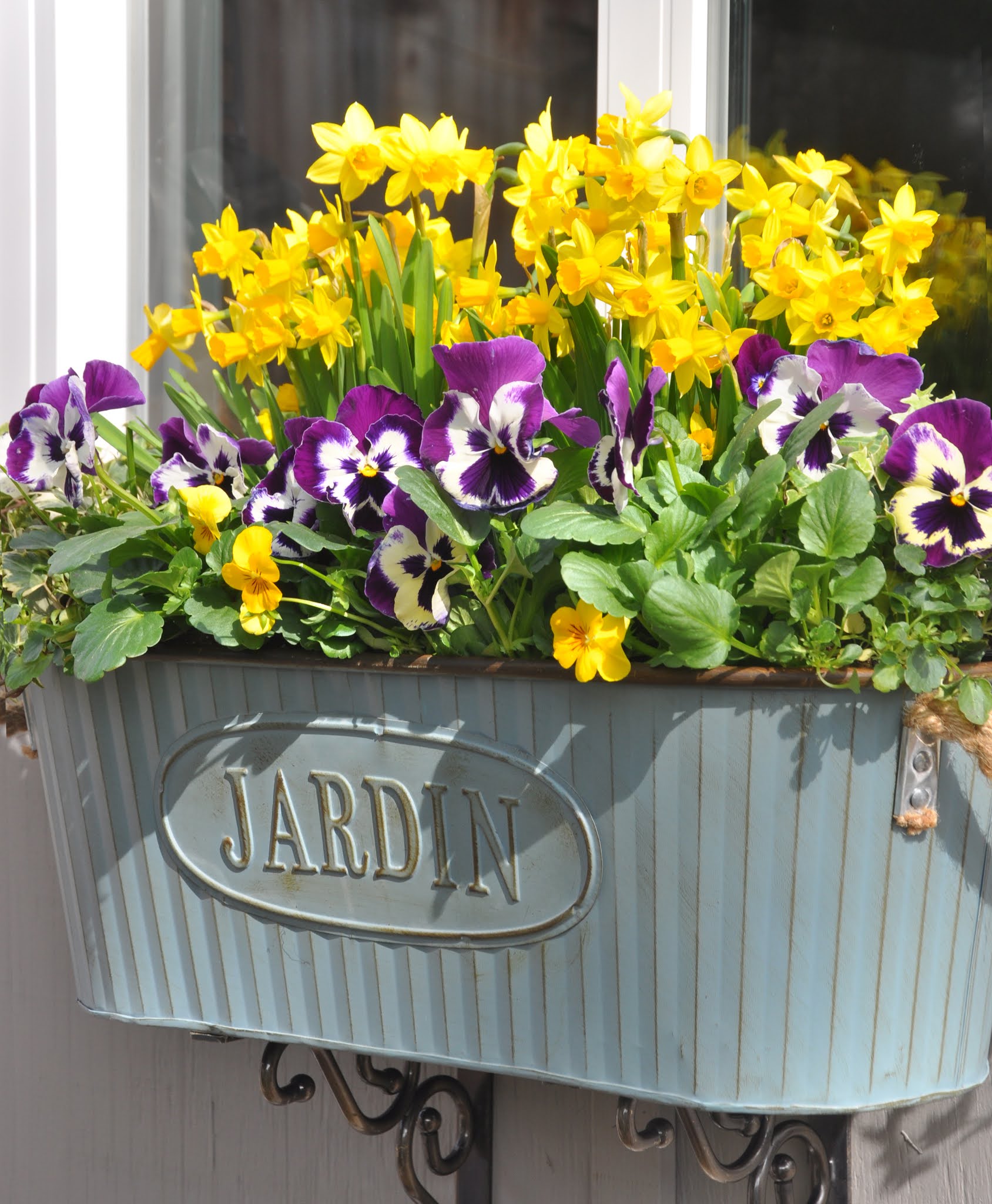
As well as filling flowerpots, you can also use forced bulbs in window boxes.

Every spring I tell myself to take pictures and make notes so when fall arrives there is no guesswork as to where to add new bulbs. Despite my best intentions, the spring season is always so busy I never seem to get around to that important note-taking. As a result, I find myself struggling to remember where there were holes in my bulb planting schemes every fall. 

Last spring I tried a new idea that was fairly successful. I filled some of those bare spots that needed bulbs with the spent daffodils and hyacinths from my container plantings. 

A pot of forced daffodils was transplanted into the garden last year and has come 
back again this spring quite nicely.  


Despite the wisdom that says forced bulbs won't return, I have had decent luck getting forced hyacinths and miniature daffodils to return the following spring. Forcing bulbs to bloom indoors is hard on them. Placing them into an outdoor setting where they are allowed to follow a normal cycle improves the odds they will return the following spring.

 Once the flowers have started to fade, I remove the bulbs from my containers, cut off the blooms and plant them in the ground at a depth suitable for the type of bulb. It's very important to allow the foliage to remain exactly as it is. The foliage will feed the bulb that produces next year's flower. 

Not every forced bulb returns, but I count it as a bonus when bulbs that gave life to my containers return for a second show.

P.S. The thermometer dropped last night and we awoke to a blanket of snow. On the plus side, it has already started to melt.


Our white magnolia was gorgeous this year. One woman even stopped to take a picture.

Pink Star Magnolia, Magnolia x loebneri 'Leonard Messel'

Thursday, March 25, 2021

A Work in Progress


A few years ago, we experienced a winter ice storm that sent huge tree limbs crashing to the ground. Two mature trees were so badly damaged they had to be removed. 


While the loss of the huge tree in the back corner of our property was dramatic, the loss I felt the most keenly was the small tree just inside the back gate. 

Before the tree came down, the little courtyard at the side of the house was always one of my favourite parts of the garden. This had nothing to do with the way it looked and everything to do with how the courtyard made me feel. The leafy tree canopy always made this spot wonderfully cool on a hot summer's day. The moment you entered the back gate, the contrast in temperatures between the full sun front yard and the comfort of the shaded backyard always elicited a sigh of relief and appreciation. When it's really hot, the sun can be oppressive. The shade, especially when combined with a light breeze, is so welcome.

The Pathway

Once the tree was gone the courtyard changed completely. My hostas fried and turned brown. Goldenrod, Creeping Thistle and other weeds quickly transformed the gravelled pathways into a weedy mess. A replacement tree died during its first winter. My once peaceful courtyard became a source of stress and frustration.

There are gravel pathways in a number of places in the back garden. This is the view from the back door late in the summer. I hand-pull the weeds in the gravel and it's a ton of work!!

One of the reasons the weeds got out of hand was my hesitation about a suitable replacement for the gravel pathway around the base of the tree. My overall experience with gravel pathways has been a troubled one. If you lay down a foundation of landscape fabric and cover it with gravel it looks good for the first few years. Eventually, tiny pinholes develop in the cloth and weeds take advantage of any opening. Even if you rake the gravel routinely, leaf litter and other debris falls onto the surface and breaks down into a fertile medium ideal for more weeds. Your choice becomes hand pulling the weeds or spraying them.

I recently watched an interview with head gardener Asa Gregers-Warg about Beth Chatto's renowned gravel garden in Essex, England (Note: though the gravel in my garden is only in the pathways, the general principals at work are pretty similar). While this section of Beth's garden is famously drought-tolerant, Asa says it's also the most labour intensive parts of Chatto's garden as a whole. I can believe it! The free-draining gravel makes it an ideal place for weeds to thrive. 

The video interview by Alexandra of the Middle-sized Garden Youtube channel and blog.

Here's what I have learned through trial and error. The best way to keep weeds at bay is to deprive seedlings of light. And the best way to deprive them of light and make it hard for them to sprout is by making the surface they must penetrate hard and compact. It's impossible to compact pea gravel. 

The pathways at the Halifax Public Garden. Limestone screening is crushed limestone chips (1/4") mixed with limestone dust.

The pathways at the Halifax Public Garden

Eventually, I want to try working with something finer than gravel. Lime screenings, which are often used for pathways in public gardens, are something I want to experiment with in the future. For now, I have switched to natural cedar mulch to make my circular pathway around the central tree. 


Piper taking a break on the mulched path that encircles the Magnolia tree and the garden at its feet.

To create the path, I simply laid down a thick layer of natural cedar mulch. Next, I compacted the mulch with the flat side of an old-fashion garden rake. If the mulch breaks down or gets disturbed by the dogs, I can always add a fresh layer and repeat the compaction. So far, I am fairly pleased with the results. The compacted cedar mulch has kept the weeds at bay nicely (I pulled no more than a couple of weeds last summer). 

The one drawback is the aesthetic. There is also something about the neutral look of gravel that is so pleasing. Mulch may be soft to walk on, but it looks rustic and woodsy. Gravel makes a pleasant crunch underfoot. 

For now, I am sticking with the mulch for the pathway around the central tree. I plan to experiment with limestone screening in a small area. If it works out, I may remove the mulch and replace it with the crushed limestone.


Additional Privacy

I know there is a commandment that we should love our neighbours, but depending on the people next door, that can sometimes be a bit of a challenge. Adding a degree of separation between properties, a fence or a privacy screen can ease the strain of maintaining a good relationship with the folks next door.

The fence that skirts the perimeter of our backyard is a standard height of 6 feet. Unfortunately, there is still a clear view of the house next to ours. To add an additional degree of privacy, we decided to add a tall screen topped with an arbour. The overall layout of the structure was intentionally designed to fall entirely on our side of the shared fence.


Two verticle posts, set in concrete at the base, form the upright support for famed panels of wooden lattice. At the top, there is an arbour with a wooden ladder that runs along the top (2 x 2" boards cut on the front-facing end at a 45-degree angle). 

A square lattice is also an option.

The lattice comes in 4'x8' sheets that can be cut down to suit.  Depending on the retailer, the weave of the lattice may vary from a more open crosshatch or a more dense "privacy" crosshatch. As well as a diagonal lattice, there is a square option as well. 

We chose to use a diagonal privacy weave because it reflected the top section of the backyard fence. Hopefully, the arbour will be covered with a climbing vine one day soon. 


The Plantings–A Restricted Color Palette

We ended up replacing the tree that had been lost with a star magnolia. I always wanted a pink magnolia and this seemed like the perfect opportunity to finally plant one. 

Sadly, the new tree will take years to reach the size of its predecessor. So I started to wonder if there was a way to recreate the old feeling of privacy and comfort without relying on a tree.  It struck me that a quiet color palette can also feel soothing. So rather than planting my usual mix of colors, I decided to limit the palette. Much like the shade that had characterized the courtyard previously, the color white always feels fresh.


The big decisions made, I thought long and hard about what I wanted to do in terms of perennials and shrubs. Most of the old shade-loving hostas found new homes elsewhere in the garden. Only two were left right at the base of the new tree (small as the tree was, it still provided a little shade).  The vast majority of new plants would have to be sun-lovers (at least until the new tree matured). 


Salvia nemorosa 'Lyrical White' forms a compact clump of bright green leaves and has white flower spikes in early summer. Removing faded flowers encourages good reblooming. Fairly drought tolerant once established. Adaptable to a range of soil and moisture conditions. Divide every 3 to 4 years in spring. Full sun. Height: 50-60 cm (21-23 inches), Spread: 50-60 cm (21-23 inches). USDA Zones: 4-9.

Two old-fashioned annuals: Dusty Miller and Alyssum.

Tiny White Scilla

Plantings by Season (Full sun unless indicated otherwise)


Spring Flowering Bulbs:

Thalia daffodils
Scilla (white)
Species Tulips (white with a yellow throat)
White Crocus

Left to Right: Solomon Seal, Polygonatum, Dublin Patio Peony and Dicentra spectabilis 'Alba'.

Spring Flowering Perennials and Shrubs:

Double White Lilac (unknown variety)
Frilly White Peony, Paeonia 'Duchesse de Nemours' 
Dublin Patio Peony (dwarf single white peony)
Solomon Seal, Polygonatum (in part to full shade)
Dicentra spectabilis 'Alba', White Bleeding Heart (part-shade)
Service Berry tree, Amelanchier Arborea
Catmint, Nepeta 
Climbing Rose (only the rootstock took so this needs to be replaced)
Moss or Creeping Phlox


Summer Flowering

White Drift® Rose 'Meizorland'
White Cranesbill Geranium, Geranium x cantabrigiense 'Biokovo'
Salvia nemorosa 'Lyrical White'
Veronica 'Magic Show White Wands'
Meadow Rue, Thalictrum aquilegifolium 'Nimbus White' (part-sun)
Chinese Meadow Rue, Thalictrum delavayi (part-sun)

Hydrangea paniculata 'Bobo'

Late Summer/Fall Flowering

Hydrangea 'Bobo' (in part-sun)
Hydrangea paniculata 'Bombshell' (in part-sun)
White Echinacea purpurea 'PowWow White' 
Alyssum 
Rose of Sharon, Hibiscus syriacus 'Diana'

Flowering Lamb's Ears, Stachys byzantine and Alyssum

Foliage Plants:

Assorted Hosta (part-sun to shade)
Boxwood
Euonymus
Lamium 'White Nancy'
Non-flowering Lamb's Ears, Stachys byzantina 'Silver Carpet' 
Flowering Lamb's Ears, Stachys byzantina
Ostrich Ferns (shade)
Japanese Fern (part-sun)

The face pot is concrete but never seems to crack even though I leave it in place during the winter. I got it at the now-defunct Humber Nursery.


Container Plantings


There isn't a whole lot of space available for plants in this tiny area, but it is the first thing you see when you open the back gate, so it's nice to have flowers throughout the season. Container plantings seemed like the perfect way to add a little color.

The beige urns (with the white geraniums) are fibreglass pots I got years ago at Canadian Tire. They are wonderfully lightweight. I leave them out all winter and they have never cracked. 

Ornamental Kale, Round-leaved Oregano or Kirigami (Origanum rotundifolium), a decorative pepper and trailing Swedish Ivy (Plectranthus verticillatus).


The metal plant stand I've owned for years.  To give it a new lease on life, I applied a fresh coat of white spray paint.


I got the brown ceramic pots in a 30% off sale. I chose a neutral color because it fits with my goal to keep the area quiet. 


The Fountain

The focal point of our new privacy screen is an old cast-iron fountain. It developed a crack that couldn't be repaired, so I've turned it into a planter. Perhaps at some point, it would be nice to have the splash of a working fountain, but for now, this old lion will do. 


Rust-oleum Multicolor Textured spray paint in the color "Desert Bisque" 

After hanging on the fence for years, the paint on the cast iron lion was peeling. I cleaned, sanded and primed it. Then I sprayed it with textured paint. This took a bit of work but I was really happy with the result.


What I'd Still Like to Change


As with anything that is worthwhile, a garden takes time. At some future point, I'd like to replace the mulched path around the tree with something a little more formal. The rocks that edge the flowerbeds were free. While you can't argue with that, I feel it's a bit too cottagey for the look I was trying to achieve.

At the moment, the Magnolia tree blocks the view of the new privacy screen but at least that doesn't require a change– just time and patience for the tree to grow. Eventually, it will dominate the space casting what is now full sun back into the shade. Eventually, the plantings will have to change to suit the lower light levels. Like housework, a garden is never done!