Wednesday, April 10, 2013

J is for Jacob's Ladder


Jacob's Ladder, polemonium caeruleum is a perennial that the dogs have repeatedly pummelled into non-existence in my garden. I haven't given up on it just yet, in fact last summer I found a new spot for it in the front garden, where the dogs rarely tread.

To my mind, you want to think about adding Jacob's Ladder to your garden for the foliage. 


On their own, the flowers are small and a bit unspectacular. (This is Polemonium caeruleum 'Stairway to Heaven' in flower above). 


The single flower wispers. A grouping of plants covered with flowerbuds and softly colored blooms speaks up for itself and commands some attention.

To make any sort of impactful display, I think you need to plan on a cluster of at least three plants. 

When not in flower, Jacob's Ladder, polemonium caeruleum forms a low, bushy mound of ferny leaves. Flowers appear on upright stems in early summer and the blooms continue for many weeks. To rejuvenate this perennial and keep the flowers coming, clip it back by half in mid-summer.

The good news about this perennial family is that they are considered easy to grow and are perfect for a woodland setting. 

The bad news for gardeners like me is that Jacob's Ladder prefers somewhat moist soil. Particularly, if you live in one of the warmer climate zones, you will need to find a spot for these plants that isn't too dry, gets morning sun and afternoon shade.


It is the foliage that doggedly determines me to keep trying with this perennial. The delicate ferny leaves make it worth all the repeated attempts. 

This is Jacob's Ladder,  Polemonium caeruleum 'Blue Pearl' above. Height: 50-60 cm Spread: 45-50 cm. There is also a similar all-green, white flowering cultivar Polemonium caeruleum 'White Pearl'. Height: 50-60 cm Spread: 45-50 cm


Isn't this pretty? 

This is Jacob's Ladder,  Polemonium caeruleum 'Stairway to Heaven'.  It has pale blue flowers. Height: 40-50 cm, Spread: 30-45 cm.


I think I may have to go back to the nursery and pick up a few pots of this cultivar. I love the blackish-purple leaves and maroon stems (Note: the foliage becomes greener as the plant grows).

This is Polemonium caeruleum 'Purple Rain'. The flowers are a pale mauve. Height: 40-50 cm, Spread: 30-45 cm. 


This variegated form is nice too: Polemonium caeruleum 'Snow & Sapphires'. Sky blue flowers. Height 60-75 cm Spread: 40-50 cm


There are also other cultivars available besides the ones I have shown you here today. 

Many off them readily self-seed, although the dogs have seen to it that I have yet to experience this family trait! To control its spread, simply trim back the flower stems after the plants have finished blooming.

My garden alphabet so far: 'A' is for Astilbe, 'B' is for Butterfly, Three 'C's, 'D' is for Delphinium, The Letters 'E' and 'F' , 'G' is for Geranium , 'H' is for Hollyhocks, 'I' is for Iris and now 'J' is for Jacob's Ladder.

Monday, April 8, 2013

Third Time's the Charm (Part 2)


Musk Mallow, Malva moschata

Today, I will pick up where we left off in my previous blog post, and we will tour the two remaining garden rooms at Merlin's Hollow, while taking a look at how the garden transitions from spring into summer.


On the upper left, you can see the plan for The Fragrant Garden, which is the first room 
we will walk through.


Heading through the arbor, here is The Fragrant Garden as it looks in June.


Columbine were blooming throughout this part of the garden in the early part of the summer.


As you stroll around, a carpet of creeping thyme fills the air with fragrance.


On my last visit in July, the carpet of thyme was covered in small white flowers.


To the delight of bees and butterflies, lavender flowers also filled the air with their fresh perfume.


Now we will take a quick look at The Rock and Water Garden as it transitions from spring to summer. 

Here is the entrance to this area of the garden as it appears in May.


Spring Pea, 'Lathyrus vernus' in May


In June, there are more delicate Columbine flowers in this part of the garden.


Now here is the same arbor at the entrance to the garden in July. As you can see, a maroon-colored Clematis now covers much of the rustic, wooden arbor.


In July, the garden has filled in so much you can barely see the back door to the house!


Creamy-yellow foxglove, digitalis grandiflora


Musk Mallow, Malva moschata reaches to the top of the bungalow's low roof.


As in the other sections of the garden, there are more delightful, bell-shaped Clematis.


Here is a perennial that I am dying to add to my own garden: Queen of the Prairie or Meadowsweet (as it is sometimes called), Filipendula rubra. 

This variety has pink, cotton candy flowers in summer. Full sun/part shade. Height: 120-180 cm Spread: 90-120 cm. Queen of the Prairie likes moist or wet soil.


Here is the white blooming variety of Queen of the Prairie.


These are a summer blooming allium known as Nodding Onion or allium cernuum. 

I have never had this type of allium in my own garden, but apparently they are very adaptable, and will grow in sun or part shade in dry to medium-well drained soil.

David Tomlinson

So what is the secret to having a beautiful garden just like this one?


Merlin Hollow's big secret is now revealed.

It's not a pretty picture, but make no mistake, this stuff is gold. Rich, black gold!


All along the garden's back fence there are numerous piles of composted leaves and vegetation.

A white Hollyhock

Though it is a private garden, Merlin's Hollow is open to the public on a number of occasions each year. 

You can tour the garden located in Aurora, Ontario free of charge on the 2nd Saturday in May, the 2nd Saturday in June, the 1st Saturday in July and 2nd Sunday in July.

Wednesday, April 3, 2013

Third Time's the Charm


I had been to David and Deirdre Tomlinson's garden called Merlin's Hollow in May and June, but I had never visited the garden in summer. 

What would the garden be like at its peak I wondered? 

If nothing else, my first two visits to Merlin's Hollow had taught me that there was still had lots to learn from these two very experienced gardeners.

June Columbine

On each of my previous two visits to the garden it rained. No, scratch that. On my second visit, it not only poured, there was the accompanying dramatics of thunder and lightening. 

Could the third time possibly be the charm?


Well, as you will see from my picture of this Clematis, I only narrowly escaped the morning's rain.

The sun even obliged and put in an appearance for a couple of the shots!


For those of you who may have missed the previous blog posts on Merlin's Hollow, the garden was designed by David, a landscape architect, to be a series of 4 themed gardens or "rooms" surrounded by a tall cedar hedge. 


At the entrance to each of the 4 gardens is an arched garden gate. 


There is a Perennial Flower Garden on the lower left, a Fragrant Garden (with a thyme lawn) on the top left, a Rock and Water Garden (with a stream and pond) on the top right, and a Winter Garden (that is a formal knot garden) in the lower right corner. 

To the front of their house, David created a Winter Garden. This formal knot garden has clipped boxwood hedges, and because it is evergreen, the knot garden looks great all through the year. 


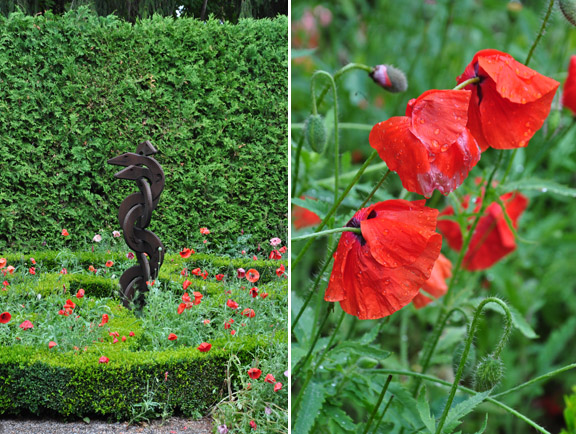
In spring, the centre sections of the boxwood knots were filled with spring bulbs. In July, bright red annual poppies were blooming.


In the narrow flower border that surround the knot garden, were these magnificent Bear's Breeches, Acanthus mollis. (Bear's Breeches are happy in a variety of soils and moisture conditions. Full sun/part shade Height: 90-150 cm Spread: 75-90 cm)

Note: Nothing in the garden is labeled, and so if I make a mistake in my identifications, please feel free to correct my mistake. 


Also in the Knot Garden was this plant: Spotted Bellflower, Campanula punctata (Carefully consider before planting Campanula punctata. From everything I have read, this plant can be a bit invasive.)


To the left of the Knot Garden is the Perennial Garden. Here it was in May.


 Now, here it is in June.


A second view in June.

Finally, here it is in July.


Let's take a look around at some of the July standouts in this part of the garden. We will begin with a quick look at a couple of the taller perennials. 

At the back of this grouping is Giant Fleece Flower, Persicaria polymorpha, with its creamy white flower plumes. Full sun/part shade. Average to moist growing conditions in a variety of soil types. Height: 90-120 cm Spread: 80-90 cm.

The mauve flowers in the foreground are Prairie Mallow, Sidalcea Full sun. Height: 60-90 cm Spread: 30-45 cm


Dark Mullein, Verbascum nigrum which is a tall, deciduous biennial or short lived perennial that tolerates drought and prefers loamy, well-draned soil. Full sun. Height: 90 cm Spread 60 cm


Culver's Root, Veronicastrum virginicum 'Album' will grow in a variety of soils, likes full sun and average to moist growing conditions. Height 120-180 cm Spread 75-90 cm


Now, we'll move on to plants for the front or middle of a border. Here we have Balloon Flower, Platycodon grandiflorus which likes full sun and will grow in normal, sandy and clay soils. It  prefers average or moist soil. Height: 45-60 cm Spread: 35-45 cm


White Masterwort, Astrantia blooms for a good part of the summer. Full sun or part shade. Astrantia is happy in a variety of soil types. Average to moist growing conditions. Height: 55-65 cm Spread: 45-60 cm


Whirling Butterflies, Gaura lindheimeri is a North American wildflower. Full sun to part shade 
Height: 90-120 cm Spread: 60-90 cm


By far, my favourite July blooms were found on the different varieties of clematis that were scattered throughout the garden. Seeing this clematis was a nice reminder that not all varieties of clematis reach for the skies. Some varieties grow to a much more modest height, like this pretty one above. 

I thought it was interesting that David and Deirdre were using a standard tomato cage for support and had placed the clematis in the middle of their flowerbed.


Here is another one of these bell-shaped clematis, this time on an arbor.

I am sorry that I don't have identifications for any of these clematis. If you like them as much as I do, you can always look for different bell-shaped varieties at your local nursery this spring. 

(In Canada, you can get a number of different bell-shaped varieties through Gardenimports. Locally, Lost Horizons Nursery also has a nice selection. If you know of any other great sources for clematis, please let us all know.)


There are still 2 more garden rooms to see, but I'll save them for a second post.