Wednesday, January 3, 2018

Looking Back and Moving Forward


Christmas always seems like the final stop at the end of a long trip through the fall. On the other hand, New Year's Day feels more like a precipice. The end of the year is a long way off and the journey is full of unknowns. Anything could happen in 2018...

Time marches on so efficiently on the internet! Bloggers, who focus on decorating and had their trees up in early November, already had their decorations down and packed away by the end of Boxing Day. Food and recipe sites seemed to have switched overnight from appetizers, party drinks and decadent desserts to detox salads and healthy, low-carb meals. For lifestyle websites and blogs, the new year is all about getting organized, setting goals and making resolutions.

To me, this all feels a bit too fast. It's a little a bit like sitting down to an amazing meal and then rushing to the bathroom to brush your teeth. I find that I want to savour the holidays just a wee bit longer. I prefer to linger at the dinner table and have a second cup of coffee after my meal.

Our Christmas tree is still up and won't come down until next weekend.


But I am slowly shifting my mindset to the new year. This week I will start to rough in an editorial calendar for the blog. 

Part of determining a direction to move this blog forward is taking a critical look back at the journey already taken. What worked? What didn't and fell flat with readers? 

Here's a quick look at some of the posts readers seemed to enjoy the most.


Candace's vibrant blue house and charming cottage garden was a huge reader favourite. The first of two posts featured the shady area toward the front of the property with a small waterfall and pond. 


Coming in second is this amazing garden in Mississauga. 

Years ago when Jamie first set out as a novice gardener to create the front garden of her dreams an old-growth forest, which were once part of a large estate, made the task seem daunting. Foot by foot she transformed the space. Now over a decade later, Jamie's front yard is a fabulous example of the many possibilities for gardening in shade.


Two gardens tie for third place. The Little Stonehouse Garden had plenty of container magic and flowerbeds that mixed perennials with an abundance of annuals. 


Equally popular was the garden of a regular reader. Teresa is a passionate gardener who has managed to fit a wide array of plants, trees and shrubs in a very modest sized urban garden. She invited me over to see her garden last July.  Filled with pretty vignettes, it was a pleasure to spend the morning with Teresa and photograph her garden.


In the "how-to" category, this post on eliminating goutweed attracted a big audience. So many gardeners, myself included, have unwittingly invited a plant home that spreads aggressively. 

Getting rid of a problem plant can be a Herculean task. In the third in the series of posts I wrote on invasive plants, I shared the method I used to eliminate goutweed from my front flower bed. Here are the three posts in order: Part 1, Part 2 and Part 3: How I Eliminated Goutweed from my Front Garden.


I am proud to report that the little fairy garden I did for a post on Creating an Ornamental Herb Garden held up really well all summer. Count on more herb-themed posts in the new year.


Posts on specific plants also did very well, so I plan to do more plant profiles in 2018. This post on Echinacea was a bit too long (even by my standards), but it certainly covered the subject well. 

A post on hardy hibiscus performed equally well.


To be honest, the popularity of this next blog post took me a bit by surprise. 

Swimming pools are a nice luxury, but it can be a challenge to incorporate them tastefully into a garden.  So I took a look at some of the many ways a pool can be integrated nicely into a backyard space. 

The positive response was much appreciated. It took me literally years to find enough good examples for a post.


In terms of public gardens, the blog post on the redesign of the Lucy Maud Montgomery garden in Norval, Ontario had lots of readers interested. 

It usually comes as a surprise to many fans of the classic Anne of Green Gables books that the author herself had a rather difficult, lonely life. Somehow out of hardship the beloved character of Anne Shirley was born.


I don't often get a chance to visit specialist nurseries, but this August my husband and I took a weekend and drove up to Willow Farm Grasses. I came away inspired by all the different ornamental grasses and I think readers did as well.


In the fall of 2017, my husband and I tackled a number of new projects. We laid out the foundation for a new stream and pond, added a big, new flowerbed and even did some preliminary work on a small thyme lawn. 

From here on in the garden won't get any bigger, but there are still lots of refinements I wish to make. I hope readers will continue to stick with me and follow along with my garden's evolution.


Sometimes I am a little slow in replying to comments, but I read and value everyone. Positive feedback keeps me going. 

I'd love to hear if there is a subject or plant you'd like to know more about. Perhaps there is a style of garden you want to see more of? Is there a challenge or a problem you're struggling with? I appreciate any help you can give me with making this blog better in 2018.

Thanks again for following along. I wish you all the best for the new year!

P. S. I am extending the deadline for a chance to win a copy of Pretty Tough Plants so people who were busy over the holidays have a chance to win. Draw closes this Sunday, Jan7th.

Friday, December 29, 2017

Solving the Mystery of Cyclamen Care


I will be honest– despite their reputation as easy-care houseplants, Cyclamen confound me. They seem to wilt the second they get too dry, and when I try to compensate for my neglect by overwatering them, their ungrateful leaves turn yellow.

I have to concede that cyclamen have lots of great pluses. The flowers float like butterflies over their deep green foliage. Even the heart-shaped leaves, with their silvery-green markings, are beautiful.

I'd like to do better by my cyclamen. It's not just a gardener's pride on the line. They're cheerful houseplants to have around in the dead of winter. They don't mind bright, indirect light and that makes them the perfect choice for my kitchen windowsill.

So I used this post as an excuse to learn a bit more about cyclamen care and will share some of the tips I've discovered along the way.


Cyclamen that are sold as houseplants at this time of year are often referred to as "florist's cyclamen".

In their Mediterranean homeland, Cyclamen persicum are a winter flowering plant. They come into growth in the autumn and bloom through the winter and early spring. Then they go dormant as the dry summer months approach.


Here are a few basics:

Light: Cyclamen like bright, indirect sunlight.

Temperature: Too much sunlight and heat will only serve to encourage your cyclamen into early dormancy. They prefer cool conditions, but they are not frost-hardy. An indoor daytime temperature of 65-70 degrees (18-22 Celsius) is perfect. Most homes are a little cooler at night and that's their preference too.

Water: Watering is where most people, myself included, go wrong. As I have discovered the hard way, cyclamen are very sensitive to soil moisture levels. When you do water, soak the soil thoroughly and let the excess water drain out of the pot. Then allow your cyclamen to dry out somewhat. More cyclamen die from overwatering than they do from drought. Water only when the soil just below the surface is dry to the touch.

One way to improve your success with cyclamen is to water from the bottom. That way you are assured that the moisture will reach right down to the bottom of the plant's roots. To water from the bottom, find a deep saucer or a container large enough to accommodate your cyclamen's pot and fill it halfway with water. Place your cyclamen into the container of water and wait until the soil in the cyclamen's pot is evenly moist (about 20 minutes).

If you opt to water from above, water the soil directly and avoid the foliage and central tuber. Water can rot the crown of the plant (particularly when the plant is in a dormant state).

However you choose to water, make sure you allow excess water to drain away completely. Like so many plants, cyclamen don't like soggy soil.

Dead leaves or flowers can be removed by simply giving them a sharp tug.

Humidity: Cyclamen like high humidity. If your house is as dry as mine, this can be a challenge. Setting the plant down on a shallow tray of water filled with pebbles can help keep the air around your plant moist.

Soil: A good quality all-purpose potting mix is best. If you peek through the leaves, you can see that cyclamen are planted with the tuber just slightly above the soil line.

Fertilizer: Fertilizing once a month with a water-soluble fertilizer is plenty. Too much fertilizer and your cyclamen will not rebloom.


Common problems:

Yellow leaves: Overwatering and too much heat will cause the leaves of your cyclamen to yellow. Yellow foliage in late winter/spring may also be a sign that your cyclamen is going into dormancy.

Wilted leaves and flowers: Wilted flowers and foliage are a sign of improper watering. The sudden onset of wilting may be an indication that the soil is too dry. Water your plant thoroughly and pinch off any leaves or flowers that do not respond.

Faded Foliage: Cyclamen are pretty resistant to indoor houseplant pests, but foliage that looks faded may be a sign of a spider mite problem. Look for fine webbing and check the undersides of the leaves for these tiny insects. If your cyclamen is infected, check your other houseplants as well. Spider mites often spread from one houseplant to another.

Depending on the severity of the infection, I'd consider disposing of the plant.

If you've caught things early, gently rinse or wipe the foliage clean. Isolate the cyclamen from other houseplants until you have the infestation under control.


Dormancy: After a cyclamen blooms, it will transition slowly into a dormant state. The leaves will begin to yellow and wither. At this point, you should stop watering your plant, and allow the leaves to die back. Then place your cyclamen in a cool, dry place for 8-10 weeks.

To bring a rested plant out of dormancy in the fall, move it back into the light and resume your normal watering regime.


I think what I need to do now is focus on getting my watering right.  How about you? What's your experience with cyclamen? If you have any great tips, please share!

Saturday, December 23, 2017

Simple and Inexpensive Upgrades for your Holiday Gifts

Over the holidays there seem to be so many occasions for a little "thank you" or a gift of appreciation. And when it comes to this type of holiday gift, as the saying goes, it's the thought that counts. You don't have to spend a ton of money. A little creativity shows the recipient you care enough to have invested some thought and time into your gift.

With that in mind, I have a few ideas to help you stretch your holiday shopping dollars.


A few simple upgrades can transform a humble plant into something special.

A grocery store Kalanchoe is rather unimpressive in its plastic sleeve. Throw out the sleeve, add in a bow and a rustic basket from the Dollar Store and you quickly have a nice looking gift.


 If you have a distance to travel, wrap it up in a sheet of cellophane and then add the bow last. Even with the upgrade, this gift is still under $15.


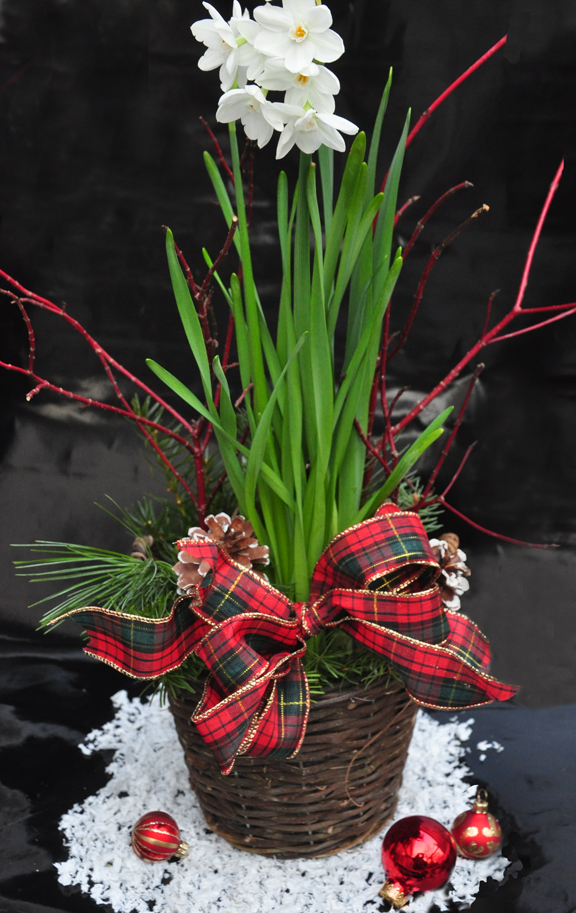
This is the same rustic basket with a pot of Paperwhites. These fragrant white flowers have a tendency to flop, so I like to add some dogwood branches to give them a bit of support (just be careful to avoid the bulbs when you push the dogwood into the pot).

I created some pinecone picks by hot glueing pinecones to some wooden shish kebab skewers from the Dollar Store. To fill out the arrangement I added a pine and spruce branches into the soil of the plant pot. The damp earth will keep the evergreen branches fresh for as long as the flowers last.

The final flourish was a bow. Cost of the various items for this project: Paperwhites $6.99, Dogwood $0, Evergreen branches $0, Skewers for the Pinecones $1, Bow $1. The total cost is just under $10.


I lucked out on the rustic basket and found one at the Dollar Store that had a builtin plastic liner. If all you can find is a plain basket, don't worry, it can easily be adapted to suit your purposes. 

Take the plastic sleeve off your plant and cut it down to size to fit into the basket. Tuck it into the basket and add the potted plant. I used some wooden snowflakes to decorate the basket and added a red bow for a final touch. Here's how it all added up: snowflakes $1, basket $3, bow $1, plant $8.99.


The plastic sleeves they put on plants are usually a little tacky. Switch it up for a metal bucket and this inexpensive Lemon Cypress looks so much more festive!


This white tin with a lace edge is from Ikea ($3.99). You may not have time to run to Ikea, but metal tins are often available wherever you purchase plants. You can also find metal tins at the Dollar Store.

Altogether this little Christmas tree with the improved packaging was still well under $15.


As well as getting creative with the pot, why not take a fresh approach to select a plant. Nothing adds to flavour to holiday cooking like fresh herbs. A pot of herbs would make a thoughtful hostess gift. 

Here I took two pots of rosemary that I found in the produce aisle at the grocery store and planted them together in a pretty blue pot with a crackle finish (from Walmart for under $10). A white bow added the final touch.


It would be a nice touch to include in your gift card a handwritten or printed recipe that makes use of the herb your giving as a gift (here's a link to Ina Garten's recipe for Rosemary Roast Potatoes). The total cost of this present is under $20.


A holiday gift need not be floral. Flowers are always fleeting. Sometimes it is nice to choose a gift that will hold up over time. A low light plant like a fern can look nice sitting on a desk, at a bedside or even at a nurse's station.

Here I took two small ferns and planted them into a pot for the Dollar Store. A metal dragonfly and a bow dress up the gift.


Here's a green plant with more of a classic holiday feel.

I switched out the plastic sleeve for a ceramic pot, added a few faux berries and a bow. It looks so much nicer, don't you think?


A heartfelt gift with a personal touch always means the most.

Bookmark this post with a PIN.

Saturday, December 16, 2017

Books for Holiday Gift Giving


Snow has finally arrived this week transforming the garden into a Christmas card. All the fallen leaves have been raked off the pathways and all my spring bulbs have been tucked snuggly into the ground. There is nothing to do now, but dream up fresh new plans for the coming spring. 

What new plants should I add? What improvements can I make? Gardening books are always a great way to find some answers. And with that in mind, I have a list of some book suggestions for last minute gift giving.


I would like to read this book for obvious reasons–it's a book about two things I love; gardening and dogs.

Nigel the golden retriever first appeared in the background of Monty Don's segments for the popular BBC television series "Gardener's World" and has risen to become a star in his own right. Nigel the dog has inspired huge fan interest, fan mail and even his own social media accounts. In this new book, Monty Don writes about Nigel and the other dogs that have been a part of his family's life and explores what it is that connects is with animals so deeply.

To confirm my interest in this book, I looked through the reviews on Amazon where it has received 4.8 out of 5 stars. One reader/reviewer writes,"It made me laugh and cry. A book written from the heart..." On Goodreads, the book has received 4.34 stars. The top review on Goodreads describes the book as "A lovely, light read..." 

All this makes me want to read the book even more. I'm hoping to find Nigel: My Family Life and other Dogs under the tree this Christmas!


The Art of Floral Forager features fanciful images all created with petals, leaves and other natural materials that artist Bridget Beth Collins gathers from her garden.

Included in the book are images of birds, fish, insects, mystical creatures and portraits of iconic women that have all been made using botanical materials. You can take a look inside The Art of Floral Forager here. You can also purchase prints of individual works of art on Bridget's website.


Of all the books I reviewed in 2017, Glorious Shade created the most reader excitement and no wonder. The book is a great resource for anyone interested in shade gardening. It's well written and packed with information. Read my full review here.

Another great gift for the shade gardener is The New Shade Garden (2015) by Ken Druse. This book covers basic topics such as designing your own shade garden and highlights a good array of perennials, shrubs and trees for shady conditions. Of the two books, I'd say this one has the most inspirational photos.


My pick for Best Coffee Table Book of 2017 would be Timber Press's Gardens of the High Line. 

The High Line was once an elevated rail line that had been neglected for nearly two decades. Today, it has been transformed into a public garden and serves as powerful example of urban revitalization. What I think gardeners will love about this book are the inspired plantings by world renowned Dutch landscape designer Piet Oudolf. 

With page after page of gorgeous photography, this book would do any coffee table proud. Read my full review here.


For those gardeners who love winter craft projects to keep them busy, I have two good books to recommend.

I follow San Francisco artist Tiffanie Turner on Instagram. Her very detailed paper flowers are simply amazing. Tiffanie's recently published book The Fine Art of Paper Flowers offers instructions for over 30 paper flowers including marigolds, roses, daffodils and more. Projects include flower crowns, daisy chains, boutonnieres and garlands. The photography in this book is wonderful.

The Exquisite Book of Paper Flowers by artist Livia Cetti features techniques for creating 27 blooms, including peonies, poppies, roses and hibiscus.  The author leads readers through the creation of each flower with clear instructions and step-by-step photographs. There are even pointers on how to create garlands, centrepieces, wreaths and corsages.


Erin Benzakein, the renowned owner of Floret Flower Farm, has written a terrific book full of professional tips for growing, harvesting and creating exquisite arrangements of year-round flowers. 

I have been following Erin's blog for a few years. I admire her openness, business smarts and her passion for flowers. Floret Farm's Cut Flower Garden is another book on my personal wish list. 


I enjoyed Marta McDowell's books on Beatrix Potter and Winnie-the-Pooh, so I am looking forward to reading The World of Laura Ingalls Wilder: Frontier Landscapes that Inspired the Little House Books. 

Plants, animals and landscape were an integral part of the Little House series of books. In her new book, she explores Wilder's life, inspirations and her deep connection to the landscape. 


Virginia Woolf's Garden is the story of the garden at Monk's House in Sussex, England where author Virginia Woolf spent summer weekends. Virginia was no gardener, but a little shed in the garden that her husband Leonard created was the place she came to write books like To the Lighthouse and Mrs. Dalloway. 

Author Catherine Zoob and her husband were tenants at Monk's House through the National Trust for over ten years. They helped to return the house and garden to its former glory. The book includes gorgeous photographs along with historical pictures and embroidered plans of the garden hand stitched by the author.


It wouldn't be one of my book reviews without a giveaway. 

Pretty Tough Plants highlights 135 plants that are designed to handle difficult conditions. Each of the water-smart choices has a color photograph and details about the plant's size, feature and bloom time in a handy box that can be read at a glance. The plant list includes perennials, annuals, groundcovers, grasses, trees and shrubs. A handy chart at the end of the book makes it easy to choose the right plant for your garden's specific conditions.

Thomas Allen & Sons has kindly given me a copy of Pretty Tough Plants to give away. Because this book will go to a winner through the mail, I will have to limit entry to readers in Canada and the USA. 

Please leave a comment below, if you would like to be included in the book draw. The draw will remain open until January 1st. If you are not a blogger, you can enter by leaving a comment on the Three Dogs in a Garden Facebook page (there is an additional link to the Facebook page at the bottom of the blog). As always, you are also welcome to enter by sending me an email (jenc_art@hotmail.com).