Sunday, March 19, 2017

The Tangled Garden


Gardener and entrepreneur are not two words you commonly see used together to describe someone, but both are perfect descriptives for Beverly McClare.

For a short while after finishing university, Beverly operated a café in Wolfville, Nova Scotia before she purchased a fixer-upper that sat on an unremarkable bit of land in nearby Grand-Pré. There Beverly began to grow and dry flowers and herbs that she used to make wreaths, which she sold at area craft shows.

When the recession hit in the 1990's, Beverly had to rethink her business plan and extend her offering beyond decorative crafts. It was a magazine photo of a herb vinegar that again fired her creative side. With that image as inspiration, she could envisage the potential of harvesting her own homegrown herbs and making a range of fine foods that she could sell. She began experimenting with unexpected flavour pairings and created a range of herb vinegars. From there, she went on to make the line of herb jellies, which remain the mainstay of her business to this day.


The new range of products proved to be very successful. That gave Beverly the funds to purchase additional acreage and expanded what she refers to as her "edible landscape." In more recent years the product range has grown to include oils, mustards, herb-infused honey, syrups, salsas, liqueurs and cordials.

Today there are stacks of herb-infused preserves that glow like jewels in the windows of the Tangled Garden Shop. From wooden ceiling beams, bundles of drying flowers and herbs have been hung to dry. In one corner of the shop, there is a cane chair studded with drying chive blossoms. A chalkboard sign reserves this special spot for gnomes, elves and fairies.

From the gardens that now sprawl over four acres, herbs, berries, fresh fruit and vegetables are harvested, prepared and bottled. Each day one hundred bottles of preserves are produced, six jars at a time. The finished preserves are sold not only in the little shop, but also at artisan shows and online.


The extensive garden continued to flourish and Beverly decided to open it to the public for a nominal admission charge. Now thousands of visitors flock to the Tangled Garden each year.


While some plants in the garden are ornamental, the vast majority are harvested for use.


Each area of the garden has its own character and special features. Here the herbs and flowers are planted in a series of raised wooden beds with gravel pathways.

The herb Borage with its pretty blue flowers.

Some of the Annual Herbs include:
Anise, Basil, Borage, Chamomile, Dill, Chervil, Calendula, Tarragon,Mint and Caravay

Perennial Herbs: 
Bee Balm, Chives, Geranium, Fennel, Rosemary, Sage, Thyme, Lavender, Angelica (biennial) 

Fruits & Berries:
Blackberry, Rhubarb, Currants, Grapes and Quince


Smoke Bush, Cotinus


On either side of a dry stream bed, there are tall ornamental grasses, the pink plumes of Queen of the Prairie, pink Coneflowers and blue Sea Holly, Eryngium with its grey-green foliage. 

Many of these flowers make it into Beverly's dried arrangements.

A dried arrangement in the shop.

Flowers that can be hung to dry include:

Artemisia 'Silver king' (Grey foliage you see here. Warning: this is an invasive plant.)
Sea Holly, Eryngium
Strawflowers, Helichrysum bracteatum
Roses 
Feverfew
Love-in-the-mist, Nigella (seedheads are wonderfully ornamental)
Statice, Limonium
Love Lies Bleeding, Amaranthus Cruentus
Hydrangea Paniculata
Poppy (seedheads)
Pearly Everlasting, Anaphalis margaritacea
Sea Lavender or Limonium latifolium
Gomphrena
Honesty, Lunaria annua
Yarrow, Achilla

For further information on hanging flowers to dry, read this post: Simple Techniques for Drying Flowers.


I can't remember ever seeing such tall pink Astilbe. They must love the abundant rain of a wet Nova Scotia spring.


Bee balm, Monarda. The  petals can be pulled from the flower 
and used as a substitute for mint. 


Looking for ways to experiment with flower petals in your cooking? Check out this cookbook.

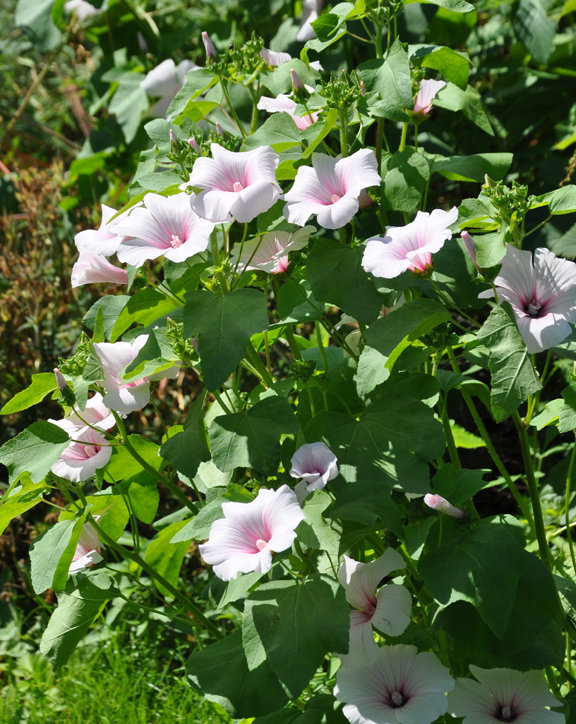
Lavatera, a very pretty annual flower.


A view of the garden with an Annabelle Hydrangea in the middle distance.


One of the garden's most remarkable features is a flower labyrinth that is 80 feet in diameter. Usually a labyrinth involves some sort of hedge, but here, in an open field with a view of the surrounding countryside, the spirals are floral.  


Drawing visitors toward the centre of the labyrinth is a large metal sculpture.


The "walls" of the labyrinth are a mix of plants including yellow daylilies, blue cornflowers, Lady's Mantle, and Betony (purple flowers).


One of the more recent additions is a unique waterfall where water tumbles down a series of steps.


Making the herb jellies that the Tangled Garden is especially known for, is a slow process. It takes a full day to chop the fresh-picked herbs, make the sweet or savoury juice and bottle the jelly. "The garden is soulful to me," says Beverly,"It gives me back so much more than I give it."

More information and Links:
The Tangled Garden Shop is located in Grand-Pré, Nova Scotia. The garden is open to the public with a $5 admission charge, daily from 10 am to 6pm from April to December. For more details visit the Tangled Garden website.

Watch a short video about Beverly McClare and the Tangled Garden

Wednesday, March 15, 2017

Gardener Beware: Invasive Garden Plants, Part 1

Though I loath to admit it, the Goutweed does look rather nice in this island bed.

Not every plant that your find in a nursery or garden centre is well-behaved. Retailers often sell plants that many consider problematic or invasive. 

Why sell them then?

Not everyone would agree on what constitutes a "problem" plant. Based on my own personal struggles, I happen to think that Goutweed, Aegopodium podagraria 'variegatum' is pure evil, but I know at least one friend who thinks that it has nice variegated foliage and likes to have this plant in his garden. 

Goutweed in behind some hostas.

 Sweet Woodruff


 Sweet Woodruff taking over a part-shade garden.

On the other hand, I happen to like the little white stars of Sweet Woodruff, but I know another garden writer who felt the need to write a public service announcement warning gardeners about the this groundcover herb. Certainly, if you bring Sweet Woodruff home and have no idea how it is likely to behave, you can find yourself in a bit of a mess.

For me a problem plant is not just aggressive, it is also a plant that is hard to remove where unwanted. Vigorous perennials like Goutweed can send out roots that spread underground in many directions. Eradicating it can be very difficult. Even if you dig out the main plant, any roots segments you miss are capable of producing a new plant.


Other plants like False Lamium, Lamium galeobdolon 'Florentinum' (read more about different types of Lamium here) send out runners above the ground (similar to those of a strawberry plant) that take root and create new offspring. 

In a somewhat similar fashion some vines, as well as climbing up, will send out runners along the surface of the ground. New plants will naturally layer along the length of the stem.


I personally don't mind some Feverfew, but have to remove many unwanted seedlings.

And then there are the prolific self-seeders! Feverfew, Tanacetum parthenium seeds itself everywhere and can easily crowd out other perennials. The seedlings are easy enough to remove, but if you resent yet another chore, you may find that this plant is a real nuisance.

The best thing a gardener can do is to avoid problems with invasive plants in the first place. Here are a few suggestions to help:

• When selecting an unfamiliar plant, ask nursery or garden centre staff for references: "Is this plant aggressive or invasive in any way?" Most well-trained staff will warn you about potential issues.

Bugleweed, Ajuga can easily get out of control in moist soil

• Pay heed to descriptives. A "groundcover" will spread out more or less aggressively to cover a wide area. The Sweet Woodruff, mentioned earlier, can blanket a large shady area. If that's not what you are looking for, try to find an alternative that is "clump-forming." 

• Take note of the manner a plant spreads and how quickly it does so. "Spreads by creeping rhizomes" means the plant will travel underground. "Prolific self-seeder" may be an issue, if you dislike removing unwanted seedlings.

• Proper botanical names are an invaluable way to identify plants, but common names do have their uses. If a common name includes the word "weed" (Goutweed is a good example) someone probably gave it that name for a reason.

Creeping Jenny threatening to choke out the herb Sweet Cicely.

• The internet is an amazing resource. Before you plant something that is unfamiliar, look it up online. Type something like: "Is Creeping Jenny invasive?" into the search engine of your choice. If you get a long list of results, I'd think twice about planting Creeping Jenny.

• Make sure a particular plant doesn't have an invasive plant alert for your region. Some plants are fine in one part of the country, but can be a problem in other regions where growing conditions are very favourable. Again the internet is a great research tool.

• I am a plant collector that loves unusual things, but I have learned the hard way not to take chances. If I've looked the plant up, but still have a few lingering suspicions, I put it in a spot where I can keep an eye on it and remove it if necessary (i.e. my raised nursery bed). It often takes a year or more for a plant to establish itself. If it is going to spread wildly, you may not see it until the third year. Only after a plant passes a probationary period do I put it out in the main garden.

Popular ways to Contain an Aggressive Plant


A few words on some of the common methods for restricting the spread of a plant.


Method 1: Use an aggressive plant in a container planting.

This works, but even so, I advise you to do this with a little caution. Trailing plants like Creeping Jenny look great in a container planting, but keep an eye on it. In a shallow pot, it can cascade right to the ground and take root. 

False Lamium 'Variegatum' trailing out of an urn. Notice it has almost reached the ground. Trim it back and it would be fine for the rest of the gardening season.

I almost had this happen with False Lamium 'Variegatum'. It trails nicely, so planted it in the window box under my kitchen window. A few weeks later, I noticed its yellow flowers had begun to set seed. The little black seeds were in danger of dropping into the garden below, so I trimmed the flowers off. Then a month later, I noticed that the runners, which made such a pleasing cascade over the edges of the window box, had reached down almost 4 ft to the ground and were about to take root. I was both dismayed and impressed with the plants determination to create offspring.

Artemisia 'Silver King'

Method 2: Put an invasive plant into a plant pot and submerge the pot in the ground.

Personally, I have found this doesn't work very well. Trailing plants will skip over the rim of the buried pot and take off into the rest of the garden (I had this happen with Oregano). 

Plants with deep roots can also sneak out the drainage hole in the bottom a buried pot. 

I tried planting Artemisia 'Silver King' in a buried pot only to watch it layer itself into the surrounding garden (layering occurs when an upright stem bends down to the ground and takes root).

Pachysandra covering a large area under a tree.

Method 3: Create a deep edge or trench around an island bed that contains an aggressive plant. This works to a degree, but you would really want to make sure the edge is deep and wide, so an invader can't jump across the divide. The only other worry might the possibility of the the plant self-seeding into other areas.

Method 4: Plant a spreader into a raised bed.

Where there is a botanical will, there is a way. In the picture below, you can see that Gooseneck Loosestrife (white flowers) has spread from the raised bed to the ground below.


I've also heard horror stories where the roots of really vigorous plants like Bamboo have cracked through concrete and escaped into the surrounding landscape.

Bottom line: know what you're planting and how it is likely to behave. 

Too often gardeners are impatient to fill up their flowerbeds and choose a plant that will spread quickly. Patience is a virtue, especially when it comes to gardening.

Read Invasive Plants Part 2 and Part 3.

Wednesday, March 8, 2017

A Shade Garden in the Toronto Beaches Neighbourhood


What Yvonne Butorac found when they moved into her home in the Beaches neighbourhood of Toronto was a bit of a mess. The "garden" consisted of some straggly evergreens, lilacs and a well-rooted, but terribly overgrown quince shrub.

"We moved to this house in August 2007," Yvonne recounts, "The house required a lot of work and nothing much was done on the garden until renovations were finished in 2008. In the process of those renovations we tore off the old deck and eight and a half feet off the back of the house. Even with the large deck we presently have, we gained a few more garden feet."

To make something of the yard was no small undertaking. At one time there had been a garage and remnants of the driveway remained along the west side of the house. The fence had fallen down on three sides, and at the back, there was ugly, green corrugated fencing. Where the current garden shed is now located, there was a rickety playhouse.

The fence was replaced in 2009; a new shed was constructed in 2010. During this time, Yvonne began to create a garden around the ongoing projects.


To creating a garden, Yvonne brought a wealth of experience. "I had a lovely garden at our last house in north Toronto that I has worked on over the 20+ years we lived there. Much of that previous garden was somewhat shaded, so I was familiar with shade plants. There I had the additional problem of clay soil. Here the soil is a treat to work with. Even so, I still supplement it with bags of black earth mixed with the city's compost."

The garden's layout evolved over time. "There was never a plan," Yvonne says,"Originally I thought that I would have no grass in the backyard, but then I tried digging up the sod so changed that plan."


Coleus in hanging baskets on the front porch.

The Beaches neighbourhood, just 20 minutes east of downtown Toronto, has the casual atmosphere of a lakeside resort town. If your very lucky there is a view of Lake Ontario, and even if your not, the lakefront is often within walking distance. Though there is lots of new development, many of the charming homes sit on shady, tree lined streets.

As is so often the case, older homes have their quirks and idiosyncrasies. "The backyard shares property lines with five other properties," says Yvonne,"Camouflaging two bleak garages 
was a challenge."


"I bought the rusty rabbits in a shop in the county near Bancroft maybe twenty 
years ago," Yvonne says.


1. Astilbe 2. Heuchera 3. Aralia cordata 'Sun King' 4. Bowman's Root, Gillenia trifoliata 5. Maidenhair Fern, Adiantum 6. Ligularia

Two plants with great foliage are Brunnera 'Jack Frost' and Heuchera.

Aralia cordata 'Sun King' is on the left of the plant stand.

Japanese Spikenard, Aralia cordata 'Sun King' is a fast growing, part-shade foliage plant. It has bright gold leaves provided that it gets a few hours of sun each day (in full shade the foliage will turn chartreuse). Young shoots of this plant are a delicacy in Japan and taste a bit like asparagus. The white fleshy roots are also edible and taste a bit like parsnips. Tall spikes of white flowers appear in the summer and are followed by purple berries (not edible for humans, but birds like them). The berries help 'Sun'King' self-sow and naturalize a shady area. This plant prefers average to moist conditions and well-drained soil with lots of organic matter. Choose a sheltered location for this plant away from harsh winds. Height: 75-90 cm (29-35 inches), Spread: 75-90 cm (29-35 inches). USDA zones:3-9.


Bowman's Root, Gillenia trifoliata (see also in the numbered photo above) is a tough, long-lived native plant with reddish stems, narrow leaves and white, star-shaped flowers. Full sun or light shade. Prefers rich, moist, well-drained soil. Good fall color. Height: 60-120 cm (24-47 inches), Spread: 60-75 cm (24-30 inches). Zones: USDA 4-9.


Yvonne says, "The pieces on the back fence have just happened. There is the old cold air return from this house, a couple of pieces neighbours had put out in their garbage, some refugees from friends' garage clean outs, etc."

Hostas are key plants in the shady areas of Yvonne's garden.


Yvonne has made the most of the yard's sunny pockets to stretch the possibilities beyond shade plants.

"I have an open approach to selecting plants. I try to avoid those that require a blazing hot sun all day because that does not exist here. Plants that are a little more tolerant of only a few hours of sun work better for me. I have over 70 varieties of day lilies and five tree peonies. One old rose bush I brought from the last house survives, but other than that, I don't do roses...

I often fall into the trap of not realizing how large a plant will get, so my plants are constantly on the move. I will try almost any interesting plant once. My car never passes a garden centre. I love garden club plant sales and garage sales where plants are offered. You never know what will turn up."


All Yvonne's hard work has paid off handsomely. The garden nicely reflects her personality and is as charming as the Beaches neighbourhood in which it resides.

Saturday, March 4, 2017

A Gardener's List of Seed and Plant Resources


Someone recently said to me,"You must have stacks and stacks of seed and plant catalogues." Well–this may come as a bit of a surprise– no I don't. There are a maybe couple of catalogues cluttering up my desk and that's it. I've always had access to a number of really good, local nurseries with more seeds and plants than I could ever possibly afford. In the last year or so however, things have shifted. I have now reached a point where I am willing to go further afield to find the more unusual seeds and bulbs I'd love to grow. The only problem now is determining where to shop.

What initially got me thinking about building a resource list was working on the post about Marnie Wright's shade garden. Marnie had so many interesting and unusual shade plants– many of which, I hadn't seen before. It was inspiring.

Where did Marnie find all these gems? The list of mail order sources she gave me got me wondering what else was out there. So I asked a few other exceptional gardeners, bloggers and garden book authors the same question.

The result is the resource list you'll find at the end of this post.

You can read the post on Marnie's shade garden here.

You can read the post on sunny main garden here and here.

But let's start with Marnie's plant and seed sources.

Marnie lists," William Dam Seeds for flower and vegetable seeds. Lindenberg Seeds for flowers, vegetables, plants and bulbs. Stokes for some varieties of seed (but not every year). Botanus for bulbs. Renee's Garden for seeds. Fraser's Thimble Farm for rare plants. Gardens North for unusual seed varieties."


Just to give you a few examples, I picked three random things from Garden's North. This first is Penstemon mensarum which is native to Colorado (I didn't even know that there were blue Penstemon!). In the centre is Arisaema amurense. Finally, on the right, is Iliamna remota, which is rare and native to Illinois. 

Next we'll move on to the mail order suggestions of a number of authors.


Nancy J. Ondra is the author of more than a dozen books on gardening including most recently Perennial Partners: Create Amazing Combinations with your Favourite Perennials and Container Theme Gardens. Nan can also be found blogging at Hayefield.com. Nan tells me:

"For out-of-the-ordinary seeds, I depend on Plant World Seeds . And for uncommon annuals–particularly heirloom and fragrant kinds– I can always count on Select Seeds to have something tempting."


Margaret Roach is the author of a number of books including The Backyard Parables.  She has a full list of seed and plant resources on her very popular blog A Way to Garden. I asked Margaret to tell me about a favourite seed source.

Group picture of Turtle Tree Seeds staff.

Margaret writes, "I love winter squash, but not just in winter. I've grown all the oddballs and rarities, and adore each crazy-looking one, but then there is my go-to standard...'Butternut'...but a version that comes from a very special seed strain.

One that really produces lots of big fruits, resists squash bugs, is sweet and dark-orange and (maybe best of all) it lasts even just stashed away in my pantry until the following spring(!!!) is the 'Butternut' from Turtle Tree Seed, the nation's largest biodynamic seed company and located right near me.

They have been selecting their seed strain of 'Butternut' for decades for the quality of lastingness–of being a good "keeper"– and large fruits (most of mine are 5 or 6 pounds a piece) can, as I say, last until May in good and delicious condition. Amazing.

And of course making it all extra sweet: Turtle Tree Seed is part of Camphill Village, a community that's home to special-needs adults, who are treated with respect. They live in family-like units with service volunteers; they each have a job (some work at the seed company); they live rich and productive lives. I love supporting that place."


Karen Chapman and Christina Salwitz have a new book out this spring: Gardening with Foliage First (more about this book in an upcoming post). Here are two of Karen's recommendations:

"I like to add a few deer-resistant, fast-growing annuals to my summer borders to fill those awkward gaps between maturing shrubs. Renee's Garden Seeds has a terrific selection– their heirloom Nicotiana was stunning last year and scented the evening air with its jasmine-like fragrance...


... I also love the super-sweet white Avalon corn and the Fortex runner beans that Territorial Seed Co. offers. They have become mainstays in my veggie garden– the quality and the yield are always reliable."


Author Lorraine Johnson began gardening with native plants and writing about it long before it became fashionable to do so. This spring an updated third edition of her classic book 100 Easy-to-Grow Native Plants was published. Not surprisingly then, Lorraine has two native plant nurseries to suggest:

"For easy-to-grow native seed mixes tailored for various conditions–e.g., pollinator gardens or semi-shade gardens– check out St Williams Nursery & Ecology Centre. And for drought tolerant, low-maintenance alternative to regular grass seed, you can't beat Wildflower Farm's Eco-Lawn."

Just what is an Eco-lawn? It's a blend of six carefully selected fescue grasses that produce a thick, green lawn that is drought tolerant once established. On average it only needs to be mown about once a month. Deep roots means that the lawn stays green once established– even in drought. An Eco-lawn can be grown in most soil conditions and thrives in sun, part-shade and even shade.

Two items that caught my eye from the Wildflower Farms website. Ironweed, Vernonia (left) and Wild Quinine (right). Wild Quinine is clump-forming perennial with a long bloom time. It likes full sun or part-shade and makes a great cut flower.


This is my friend Donna's garden out on the east coast of Canada. I aspire to have a garden half so lovely one day! What's Donna's favourite source for interesting and unusual plants? It just so happens that the nursery she favours is on the opposite side of the country in British Columbia.

Donna says,"Fraser's Thimble Farms is my favourite mail order nursery. Their catalogue can be overwhelming, but it makes great winter reading. So many treasures not available elsewhere; corydalis, hellebores, erythronium, trilliums, primula and arisaema just to name a few... 


...White Japanese Wood Poppy, Glaucidium palmatum leucanthum is on my wish list for this year. It has a hefty price tag, but our garden is chock-a-block full, so I am planning to order just this one treasure.
I co-ordinate both a spring and fall order with like-minded plantaholics and share the shipping costs. We have been ordering from them for ten years. Our order always arrives on the date requested. The plants are packed carefully and are always healthy. It's like Christmas when the box arrives."

In building this resource list, I felt I should include another garden bloggers besides myself. I decided to ask Tammy Schmitt. Tammy's always funny and entertaining blog is called Casa Mariposa.

Tammy tells me,"If you go to the "So Seedy" page on my blog, you can see all the companies I work with. I love them all or I wouldn't bother to shop with them. :o) I'd give Botanical Interests a big shout out because they're a yearly Fling sponsor, but I also love Outside Pride too. Swallowtail Seeds and Select Seeds are terrific for their diversity."


My turn! For bulbs, I pretty much rely on Botanus (they have lots of other temptations as well). For daylilies, I turn to Vivaces Nordiques in Quebec. They're selection is superb and the plants that arrive in the mail are a generous size. For herbs, Richters. They have a little over 25 different types of thyme for example. 

From Vivaces Nordiques: Baie-de-Gaspe (left) Ballerina-Beautiful (middle) and Barbie's Favourite (right).


I hope to order a white Hellebore from Frazer's Thimble Farms...and maybe a peony like the one I admired in Marnie Wright's garden.

So now it's your turn! What mail order companies would you recommend to fellow gardeners? Please share in the comment section.


Here's the full resource list that has been updated to include my reader's recommendations:

Botanical Interests is a family-owned company that sells high quality, organic, untreated vegetable, flower and herb seeds. 90% are open-pollinated and are non-GMO. You can review their catalogue online or request a copy. (USA orders only)

Botanus  have unusual bulbs, begonias, dahlias, gladiolus, gloxinias, lilies, fruit and veggies, roses, shrubs, vines and climbers, perennials, ferns and grasses. They have a print catalog, which you can request, and a weekly garden club video airing every Thursday during the gardening season. (shipping within Canada)

Chiltern Seeds is a U.K. seed company that specializes in unusual flower, vegetable and herb, wildflower, tree, shrubs and climbers seeds. 

Floret Flowers  is a family run flower farm in the Washington's Skagit Valley that has become well known for its unique and heirloom flowers. They sell a curated collection of seeds, bulbs, dahlias as well as gifts and paper goods (shipping worldwide).

Fraser's Thimble Farms is a rare and unusual plant nursery in British Columbia. They offer a wide range of hellebores, bulbs, Japanese hepaticas, ferns, hardy orchids an A-Z list of unusual perennials, peonies, deciduous vines, shrubs and conifers/evergreens. (shipping within Canada & the USA only)

Gardens North began as a small business run from a dining room table and now ships seeds to over 50 countries. Their catalogue is online only. They specialize in hardy native and exotic seeds, both herbaceous and woody.

Heritage Harvest Seed is a Canadian heirloom/heritage seed company that specializes in rare and endangered heirloom varieties of vegetables, flowers and herbs. (shipping within Canada only)

Lindenberg Seeds have both an online and a print catalogue that you can order. They offer flower and vegetable seeds, perennials, bulbs and roots as well as gardening supplies. (shipping within Canada only)

Northland Rosarium sell roses that are container grown on their own roots (shipping in the USA only).

Outside Pride offers over 1000 flower, herb and groundcover seeds. (USA only).

Plant World Seeds offers 3000 varieties of seeds in total. They include flower, vegetable, grass, vines and climbers, trees and shrubs seeds. (shipping worldwide).

Renee's Garden Seeds features Renee Shepard's personal selection certified organic, non-GMO vegetable, herb and flower seeds. The seed packets have wonderful illustrations making them a nice gift. Renne's also carry three cookbooks and a collection of "scatter gardens" seed canisters. (Canada and the USA only)

Richters have herb seeds and plants, gourmet vegetables, everlastings, oils, gardening books and tools. They offer a print catalog that you can request. (shipping worldwide) 

Select Seeds has a print catalog that they will ship within the USA and Canada.They also have an interactive online digital catalogue. Select Seeds specializes in old-fashioned fragrant flowers, pollinated annuals, bee-friendly flowers, vegetables and herbs, flowering vines, rare annuals and perennials.

St Williams Nursery & Ecology Centre  are focused on native plants, native seed mixes and specialty seedlings. (shipping within Canada only).

Swallowtail Seeds  has annual and perennial flower seeds, flowering vine seeds, vegetable and herb seeds. (shipping worldwide)

Territorial Seed Company  is a family-owned business that offers vegetable seeds and plants, flowers and herbs, fruit and vines, garlic and tomatoes, heirloom and open-pollinated vegetable plants and seeds as well as garden supplies. ( shipping within the USA only)

Turtle Tree Seeds  is a small non-profit seed company that sells 100% open-pollinated vegetable, flower and herb seeds. Their seeds are non-GMO, non-hybrid, never treated and grown without the use of chemicals. (shipping within the USA only)

Vivaces Nordiques is located in Quebec, Canada. Their specialty is daylilies or hemerocallis. Minimum $50 order. (shipping within Canada only).

West Coast Seeds is located in Vancouver, B.C.. They specialize in heirloom, organic, non-GMO vegetable, herb and flower seeds. (shipping internationally)

Wildflower Farm is a great source for organically grown, non-GMO, native North American wildflower seeds, native grasses and wildflower seed mixes. (ships within Canada and the USA)

William Dam Seeds carry vegetable, herb, flower, climbers and vines, ornamental grass seeds, root stock and bulbs, and garden supplies. (shipping within Canada only)