Wednesday, August 14, 2013

M is for Monarda


For me, Monarda or Bee Balm has always seemed like a flower that is having a bad hair day. 

At best it looks a bit disheveled, and at worst, it can look like a complete mess.

Flowers with the first flush of youth

This is wild Monarda at dusk in a nearby park...

Now looking a bit worse for wear!

Blooms now spent, the bald flower heads are ready to set seed.

So why do I have flowers that can sometimes downright unattractive in my garden? 


 It is simple: butterflies, bees and hummingbirds simply adore it and that is a good enough recommendation for me. 


I never cease to thrill when I see a hummingbird flitting among these bright red mopheads.

In my back garden, Monarda seems to have a mind of its own. It doesn't always show up where I place it. Instead sets off on road trips, spreading to wherever it finds is a favourable spot.


This spreading habit could be a problem, but I find it relatively easy to yank it out whenever it migrates to a spot I don't want it. 

(In my research for this post, I came across a reference that suggests that Monarda planted in part shade is more prone to a  spreading habit and is less likely to flower profusely. Thinking about it, I have noted that it tends to clump more densely in sun than shade.)

Monarda, Bee Balm in the Healing Garden of Bethesda 
United Church near Hamilton, ON

For most gardeners, Monarda's long history of medicinal use by Native North Americans is just an interesting footnote. The leaves when crushed exude a spicy, highly fragrant oil that has antiseptic properties. (Bee Balm is a natural source of Thymol which is the primary active ingredient in modern commercial mouthwashes)

All I know is that I love the scent of the leaves as I work amongst the plants!

Monarda 'Raspberrry Wine' Height: 90-120 cm Spread: 60-75 cm Resistant to Powdery Mildew, Sun/Part Shade Mauve flowers in July and August.

Monarda also has culinary uses and apparently tastes like a mix between mint and oregano. One  of these days when I am feeling a bit adventurous, I would like to brew a pot of tea using its leaves, but for now, my experiments have been limited to trying out different colored cultivars.

'Raspberry Wine' is one of my early favourites. It is a bit taller than the common red Monarda and has wonderful maroon flowers.


I also have a soft mauve flower (Monarda didyma 'Panorama Mix') which seems to be struggling a bit in the half-shade of the back garden and may need to be moved to a sunnier location. 

Recently, I discovered a patch of similarly colored wild Monarda (Monarda fistulosa) growing in a local park. Even though its foliage was covered in mildew, it was quite beautiful (pictured above).


Monarda 'Marshall's Delight' Height: 75-120 cm Spread: 60-75 cm Resistant to Powdery Mildew, Sun/Part Shade Mauve flowers in July and August.

My 'Marshall's Delight' has been crowded out by other plants and also needs a new home. The flowers on this cultivar are a great shade of hot pink. Here is a better picture in another garden:

Monarda 'Marshall's Delight' in a private garden in Hamilton, ON


Monarda 'Petite Delight' Height: 30 cm with a compact habit, Spread: 45 cm, Resistant to Powdery Mildew, Sun/Part Shade, Mauve-Pink flowers in July and August.

Monarda, 'Grand Parade'  Seen here in the half-shade of a private Hamilton area garden

Monarda, 'Grand Parade' is a mid-sized Canadian selection. Height: 40-45 cm Spread: 50-60 cm Resistant to Powdery Mildew, Sun/Part Shade, Mauve flowers in July and August.


This is Monarda 'Coral Reef' Height: 90-100 cm Spread: 60-90 cm Resistant to Powdery Mildew, Sun/Part Shade Coral pink flowers in July and August.

I find the lower leaves on my Monarda drop off leaving bare flower stems, so it is good to hide its rather ugly legs with shorter perennials. Companion plants blooming at the same time might include: 

Catmint, Nepeta ' Walker's Low'

Echinacea

Dwarf Calamint, Calamintha nepeta

Phlox- although be careful which variety you choose as a companion plant beacuse both phlox and Monarda are prone to mildew.

Russian Sage


Even though it has a flower that sometimes looks like it is in desperate need of a comb 
Monarda is one plant I can't imagine being without.

My garden alphabet so far: 'A' is for Astilbe, 'B' is for ButterflyThree 'C's, 'D' is for DelphiniumThe Letters 'E' and 'F' , 'G' is for Geranium , 'H' is for Hollyhocks, 'I' is for Iris , 'J' is for Jacob's Ladder, I am skipping K for now because I am stumped for a 'K', 'L' is for Lobelia and now 'M' is for Monarda.

More Information and Links:

Richters Herbs in Goodwood, Ontario has a great collection of Monarda varieties on offer.

Friday, August 9, 2013

A few ideas from the Griesser's Mid-Summer Garden


This is a garden that I happened upon when I got lost one Saturday morning. 

Baffled by the weird progression of house numbers on this particular street, I had pulled the car to the side of the road to get my bearings. 

I glanced across the street and this is what I saw:


Isn't that a nice garden, I thought to myself. I love the soft curves of those front flowerbeds. 

Could this be the "Open Garden" I was looking for? I dug out the scrap of paper on which I had hastily jotted down the address for the Open Garden. 

No! The house number was definitely wrong...but I reasoned, if there was anyone in the neighbourhood capable of giving me directions to the garden I was actually looking for, surely it would be another gardener. I boldly resolved to go to the front door, get directions... and maybe even work in a request to take a few pictures. Shameless I know!

As luck would have it, I didn't even make it all the way up the front path when Patricia Griesser happened out her front door. Gracious and kind, as most gardeners I come across are, Patricia gave me a tour of the lovely garden she and her husband Loren created a few minutes later.

As we chatted away, Patricia shared a number of really great ideas. Here are just a few of them.


1. Turn problem features into assets. What would you do if there was an open drainage ditch for rainwater at the front of your property? 

Most of the other homeowners on the same street had just ignored it and left if as a grassy incline. Instead Patricia has used it as an excuse to create a very nice rock garden. In doing so, she has turned a less than ideal feature into a very nice asset.


2. Plant herbs for great foliage without the bug and slug holes. Here Patricia has incorporated Purple Sage in amongst her flowers.


3. Place pots of brightly colored annuals right into your perennial borders. As we all know, perennial flowers come and go leaving sections of any garden without any color at least some of the time. To add a bit of interest, Patricia places container plantings of colorful annuals right into her flowerbeds.

4. To save money and to guarantee a nice mid-summer display, pot up your annuals as early you dare. That way they can fill in nicely by July. Because they were given lots of time to mature, it took only three of these pretty purple and white Scaevola plants to fill a good sized flower pot.


This tropical Caladium is one of Patricia's favourite plants in the garden at the moment. "I love the foliage. It will grow in complete shade and really adds a bright pop of color to a shady corner." 


5. Don't think of annuals as just "flowers" or as plants you only use in pots. Here Patricia has planted two different varieties of Licorice plants as a groundcover at the front of her perennial border. They look great and are untouched by slugs.

Yellow tiger lily

As we pass along the fence, there are a number of lilies adding to the show of
mid-summer blooms.


Unknown Daylily (possibly 'Frans Hals')


Oriental Lily


6. Don't let a lack of sun or space limit the kinds of plants you grow. The Griesser's backyard is fairly shady and less than ideal for growing vegetables. Instead Patricia grows tomatoes right in with the flowers along the front fence. She also has them growing in pots by the sunny side doorway.

On the right there is a picture of a blackberry which she has espaliered along the fence.


We will head into the back garden next.


Interesting to note that tomato cages were used to prevent these 'Annabelle' hydrangea from flopping.


A pretty patch of Japanese Grass opposite the 'Annabelle' hydrangea.


Did you notice the nice circular motif in the stonework under the gate? 
This motif continues along the pathway into the backyard.


Here we are just inside the back gate. To the right is a pondless waterfall. Patricia had someone help with the installation of this water feature, but did all of the planting herself.


This is Tigger, a 16 year old Tabby who knows just how to make a dramatic entrance.


Photograph ME! I am the true beauty, not that silly garden!


I would be remiss if I didn't also introduce you the other family pets. Harvey is the blonde and Patricia describes George on the right as "our little general".


Mature trees cast most of the back garden into dappled shade.


If you could be a kid again, wouldn't you just LOVE to have a castle like this in your backyard?

Patricia tells me, "The castle play house was built by my husband 20 years ago when the boys were 2 and 4. It was converted to a folly about 6 years ago..."


"The metal bunnies are made from recycled materials by Dog Bite Steel, an Uxbridge Ontario metal artist. I love his whimsical creations."


The generously proportioned deck off the back of the house is the perfect place to sit and enjoy the garden. 

Just at the top of the stairs is another one of Patricia's favourite plants this summer: Begonia, 'Million Kisses'.


Begonia, 'Million Kisses'


Many thanks to both Patricia and Loren for allowing me to share their delightful garden.

Have a great weekend everyone!

Update: Many people have remarked on the rock garden/rainwater drainage ditch. I asked Patricia a bit more about it and here is what she had to say:
"Typically with heavy rain, only 20% of the ditch floods. But it does drain quickly. The top part of the ditch is planted with several different sedums: Angelina, Dragon's Blood, Sedum Acre (this one is extremely hardy and spreads like wildfire). At the bottom of the ditch there is Vinca, Creeping mint, variegated Ajuga, self-seeding Violas, Perilla and Candy Tuft.
In total there are probably 10 different Sedums, 3 different Creeping Junipers, several Thymes, 5-6 different creeping Phlox, Creeping Jenny, Rock Rose, Lamium, Hens and Chicks, and Creeping Veronica. There are also crocus and miniature daffodils for lots of spring color."

The Winner is...


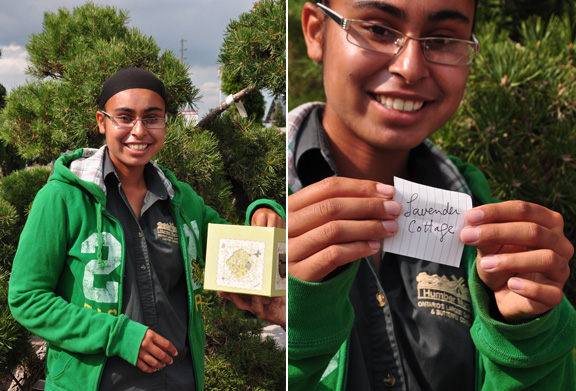
Humber Nursery is having its annual parking lot sale. There are lots of bargains to be had including Japanese Maples regularly priced at over three hundred dollar for just $99. I not only managed to take a peek at the trees and shrubs on sale, I also got a little assistance with my latest book giveaway from one of the very friendly staff overseeing the big sale.


I put all the names in my little floral draw box and Harleen drew Lavender Cottage as the winner of the book Cooking with Flowers. Congratulations Judith! I will be in touch shortly to get your address so I can get the book off to you in the mail.

Now if only I could figure out how to get a full sized Japanese Maple home in my little red Toyota....