Sunday, February 1, 2015

Location, Location, Location

In the coming months I have a few public gardens to show you, each of which has something unique makes them special. 

Templin Garden in Fergus, Ontario has one really great thing going for it: location, location location. It's hard to beat the spectacular view of a deep river gorge that the garden offers.

And if you get tired of simply admiring the flowers and the view, there is a stone staircase that takes you right down to the bottom of the gorge.


Melting snow and spring rains mean that the Grand River can sometimes be a loud, raging torrent. 

When we visited last August however, the waters had subsided and the vista from the footbridge that crosses the river was quiet and picturesque.


Templin Garden was a depression era work project under the direction of J. C. Templin, the then editor of the Fergus Evening Express.

Today the gardens are largely under the care of the "Digging in the Dirt Gang" who plant and maintain approximately 30 gardens in small town of Fergus. These twenty-odd members of the local Horticultural Society meet every Tuesday in Templin and go about doing the work needed in the garden. 

Let's take a look at some of their handy work, shall we?


White spires of Laitris spicata

An array of jewel coloured Zinnias.


Brown-eyed Susan, Rudbeckia 

I contacted the Horticultural Society to find out the identity of this really gorgeous Phlox. Speaking for the Society, Roberta tells me that she believes it to be Phlox paniculata 'Bright Eyes'.


This is the stone staircase that descends down to the Grand River:


Balloon Flower, Platycodon grandiflorus

Looking across to the far side of the Grand River.


It's quite the romantic spot don't you think?

Farewell to a Canadian Gardening Institution


Sometimes we take long standing institutions for granted until they are gone.

In need of a winter pick-me-up, I decided to pop into the Gardenimport's website to get a little spring preview. What a shock it was to find a brief letter from Dugald and Lynn Cameron saying that "it's been a good run, but after 32 years, we've reached the end of the road".

It seems that Gardenimport, a venerable Canadian garden mail-order company, is the latest casualty of these recessionary times.

As harbingers of spring and fall, Gardenimport's twice-a-year catalogues were always something to look forward to receiving in the mail. Yes, what they sold was pricy, but you could always count on finding a selection of rare and exotic perennials and bulbs that no one else offered.

In an interview on the CBC' radio's "Ontario Today", Dugald recounted that he started his company back in the 80's when gardening experienced a huge serge in popularity. At that time, it was hard to find a nursery that sold anything out of the ordinary. The arrival of big box stores with volume purchasing power and the growth of specialty nurseries however, made it increasing difficult for Gardenimport to compete on price. Despite heroic efforts and a new website, sales continued on a path of gradual decline.

Expressing her distress about the closing, Marjorie Harris praised Gardenimport for helping to create "the kind of taste we have in gardens today." She went on to lament consumers who were willing to put the bulk of their budgets into hardscaping and "ten cents on their plants."

But can we blame consumers caught in a recession for choosing price over quality?

Perhaps not, but putting price above other considerations has an unfortunate side effect of limiting our choices as consumers. The closing of Gardenimport is likely to be most keenly felt by Canadian gardeners who live outside urban centres with their arsenals of big box stores and garden centres at which to shop.  Even here in the Greater Toronto Area it will be challenging to find many of the more unusual plants and bulbs I purchased in the past from Gardenimport.

With the closing of Gardenimport, the selection of rare and unusual plants and bulbs available for sale in Canada just got that much smaller.

What feelings do you have on the closing of Gardenimport?

Tuesday, January 27, 2015

The Rock Garden, Part 3: Creative Ways to Use Texture

In this, the final post on the Rock Garden in Truro Nova Scotia, I want to look at one of the design features that make this type of garden so appealing: texture.

Generally, we turn to foliage, bark and other hard surfaces to add a textural element to a garden's design. In a rock garden, however, a low dense blanket of blooms can be used to create an exquisitely textured surface.

White Creeping Thyme, Thymus praecox 'Albiflorus'

Saxifraga paniculata 'Brevifolia'

Texture can be defined as the tactile quality of a surface. In contrast with the rugged, weather-beaten granite, there something jewel-like about the tiny green rosettes of this Saxifraga paniculata 'Brevifolia'.

Texture has a marvellous tactile quality. It is hard to resist touching soft, fuzzy foliage like this Pussy Toes, Antennaria dioica 'Rubra' (seen below).


Pink Pussy Toes, Antennaria dioica 'Rubra': is a native wildflower that has grey-green leaves and pink flowers in early summer. Pussy Toes are well suited to hot, sunny spots and poor, dry soil. Height: 10-12 cm (4-5 inches), Spread: 30-45 cm (12-18 inches) USDA Zones 3-9. 


So far most of my planting notes have featured alpines and perennials. In this post, I'd like to shift the focus briefly onto another key rock garden component: the conifers.

Darwin Carr, Operational Manager for the grounds at the Agricultural Campus of Dalhousie University notes:

"Dwarf conifers always look great when paired with alpines and rocks. They give the garden the look of high alpine terrain."

"Wind, ice and snow sculpt the native evergreen forest near the snow line of mountain tops into Krummholz, which is a German word meaning "crooked wood". Krummholz trees are usually short, attaining no more than six feet in height. These stunted, twisted trees are some of the inspiration for landscaping with dwarf conifers."
           

Picea abies 'Little Gem': is a Norway spruce cultivar that has a cushion-like habit.  This conifer is a slow grower (about 3" per year).  Full sun to light shade. Deer resistant. Needs regular watering especially during periods of summer heat. Height: 20-30 cm, Spread: 20-25 cm. USDA Zones 3-7.

Darwin Carr notes,"This is one of my favourite dwarf conifers. I have a nice one in a concrete trough at home that's been there for about 10 years. In that time, it has reached about the size of a dinner plate."

Carpeting the ground is Wooly thyme, Thymus pseudolanuginosus, in the left foreground is Cotoneaster adpressus 'Little Gem', directly behind the Cotoneaster is a Bristlecone Pine, Pinus artistata.

Too often people think a great garden is one that is filled with flowers but just look above to see how wonderful a scene that is primarily green can be. Contrast and texture make "green" interesting. The grey-green carpet of thyme is like soft velvet, whereas the Cotoneaster and Bristlecone Pine, by contrast, are stiff and spiky. 


Without the high drama of flowers, nothing demands your attention. There is a subtly at work here. I think that is why green feels so restful. It is like soft music.

The golden colored groundcover is Juniperus horizontalis. The weeping evergreen is Thuja canadensis 'Pendula'. The upright conifer is Juniperus chinensis 'Iowa'. 

When mixing together a scene that is generally green, you can add an extra level of sophistication by considering the directional flow of your foliage. 

In front of a group of upright conifers, this weeping evergreen Thuga canadensis 'Pendula' cascades in an incredible waterfall effect.

The plant with the silver foliage is Salix helvetica, the upright chartreuse shrub on the left is a dwarf Alberta spruce,  Picea glauca 'Rainbow's end' and the evergreen on the right is Picea abies 'Gregoryana Parsonii'.

Texture does not work its magic in isolation. Shape and color have a role to play in accentuating different textural surfaces.


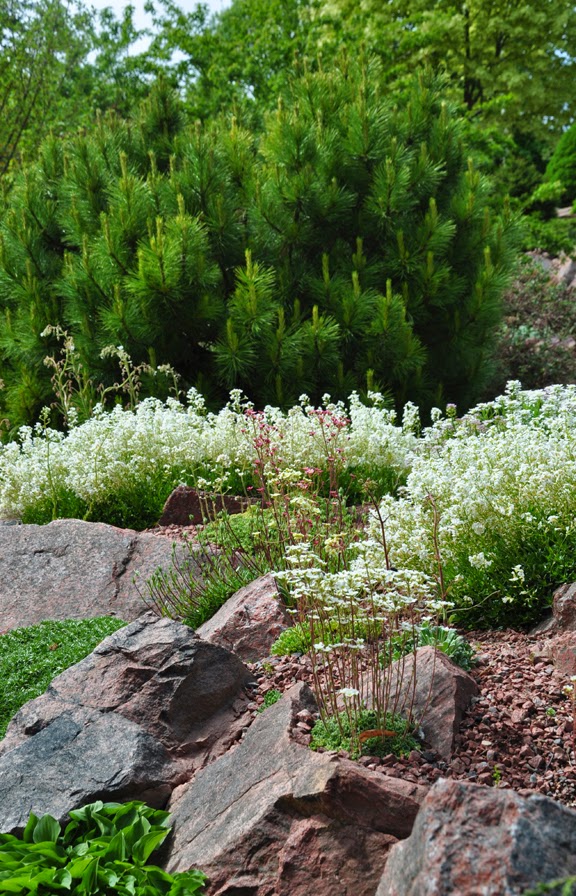
This mix of plants includes is Phlox borealis ( magenta-mauve in color) and white Arabis x sturii and some small patches of white Candytuft, Iberis saxatilis.

And of course, in any rock garden, there is the stone. It is amazing to think that plants manage to grow in this spare, rocky landscape.

Spurless Columbine, Semiaquilegia 'Sugar Plum Fairy'

And yet they flourish and often in the most delicate way.

A cascading white Candytuft, Iberis saxatilis

Pinks, Dianthus 'La bourboule'


Sheriff's Rock Jasmine, Androsace sarmentosa 'Sherriffii': has mauve flowers and evergreen rosettes that form a trailing carpet. Excellent drainage is key to having success with this plant. Full sun or light shade (they may need a little afternoon shade in warm regions). Height: 10-12 cm (4-5 inches), Spread: 30-45 cm (12-18 inches) USDA Zones 3-9. 

Saxifraga paniculata 'Brevifolia'


Saxifraga paniculata: has rosettes of evergreen leaves and sprays of white flowers carried on maroon stems. This plant likes light shade and somewhat moist soil with good drainage. Height: 15-25 cm (6-10 inches), Spread: 25-30 cm (10-12 inches) USDA Zones 3-9. 


Red Lady's Fingers or Red Kidney Vetch, Anthyllis vulneraria var. 'Coccinea': has a low mound of silvery-green leaves and orange-red flowers in late spring. This plant tolerates poor soil and dry conditions once established. Full sun. Height: 15-20 cm (6-8 inches), Spread: 30-45 cm (12-18 inches) USDA Zones 4-9. 


Pasque flowers, Pulsatilla are unique in the many ways they manage to add texture. Not only are the grey-green leaves and bell-shaped flowers are soft and downy, but the seed heads are also as fine as baby's hair. The flowers bloom before the foliage emerges each spring and open in the morning sunshine and close each evening.

Darwin Carr tells me:

"We have an enormous number of Pulsatilla in the garden... We started with two species, and they really like growing conditions here, so if we don't deadhead them after flowering, we will have literally thousands of seedlings the next spring."


In the foreground is Japanese Burnet, Sanguisorba obtusa. In the middle ground are Pasque Flowers, that have gone to seed and in the upper left is Kashmir Mountain Ash, Sorbus cashmiriana which has white fruit.


I want to close this series by recommending that, if you ever are lucky enough to tour Nova Scotia, a visit to the Rock Garden on the Agricultural Campus of Dalhousie University is well worth your while. Already I am looking for any excuse to go back and see the other campus gardens that I missed the last time around: the Butterfly Garden, the Chef's Garden, the Alumni Garden and the Herb Garden.

But then, it doesn't take much of an excuse for me to want to visit my old home province of Nova Scotia. ( Missed the two earlier posts? Here's a link to Part 1 and Part 2.)

Saturday, January 24, 2015

Little Dog Lost


When I realized in panic that Rusty wasn't in the house or fenced yard, I naturally turned up our street calling his name frantically as I went. After all this was the path we walked each evening. That he might have turned the other way, toward the corner and the six lane highway, seemed unthinkable.

A neighbour heard me calling. Taking pity on me, improperly dressed for the freezing weather, he offered to drive me around to look for Rusty. 

And what a kind man he was to drive me all over the neighbourhood, even waiting patiently while I left our details at the elementary school on the off chance that Rusty might turn up there. 

When our neighbour finally dropped me back home, I went out again on foot, but it was if Rusty had vanished off the face of the earth. Frozen, I finally retreated home. Later in the afternoon when my husband came home, we went out in the car and continued to look well into the evening, but to no avail. We went up to bed with one less dog and two very heavy hearts.

First thing this morning the phone ran. It was the animal shelter calling. I heard my husband saying Rusty's name into the receiver and my heart leapt for joy. Somebody had found our little lost boy! 

But no, seconds later I heard my husband repeat the words "was hit by a car and had passed before the Police or Animal Control arrived".  I burst into tears.

A spring and the latch on the backyard gate usually means that the gate locks shut whenever someone goes out. Unfortunately freezing temperatures and snow had effected mechanism and yesterday morning the latch did not lock. A gust of wind and the gate swung open for only a moment. Rusty seized the opportunity to go on a walk-about. What made him turn toward the busy highway we'll never know, but before I even realized he was missing, he probably already gone.

How we will miss our sweet little dog. My husband and I are devastated.

Sunday, January 18, 2015

Beekeeping Q & A with Duff and Donna Evers

Is it just me or is there an growing interest in hobby beekeeping? 

Just poking around for a few minutes on the internet lead to all manner of clubs, local associations and classes in beekeeping.  

I even found a local group, the Toronto Beekeeper Co-operative that has, among its many activities, a roof top apiary in the core of downtown Toronto. Beekeeping in the heart of Canada's biggest city? Hey, why not?

Last summer I visited Nova Scotia and stopped in for an afternoon to visit my friend Donna Evers. She and her husband Duff have been hobby beekeeping for years.

I asked Donna to tell me more about it:

"Duff first kept bees thirty years ago when we lived in New Brunswick and is delighted to be tending bees again. This will be the third year we have them in our garden in Nova Scotia. 

"The first year was quite uneventful. The bees went about their business, filled our garden with their presence and gave us about 70 lbs. of honey to share with friends. 

"Since then we have lost some swarms and caught swarms from neighbouring hives. A swarm of bees is a sight to behold!"


I confessed to Donna that while I find bees fascinating, like many people, I am a bit fearful.

Donna coached me to, "Read, read and then read some more before you decide to keep bees. The more you learn the less frightened you become. We have been stung, but it has always been our own fault."

"When there is a good supply of pollen and nectar, bees are happy to go about their business. Under these conditions it is a good time to check out what is happening in the hive. Weeks of cold, rainy weather tends to make them cranky, and then they are best left alone."


I asked Donna about the costs involved in beekeeping as a hobby.

Donna replied, "For backyard beekeepers like us the cost of a start up hive is around $350. This includes the nucleolus of bees and a wooden hive. A bee suit, gloves and a smoker are also necessary for investigating activity in the hive on a regular basis."

Picture by Donna Evers. Uncapping the honey before it goes into the centrifuge to be spun out.

"At the end of the season an electric knife and a centrifuge are needed for honey extraction. Often hobby beekeepers belong to a co-op and members share the equipment necessary for the extraction."

I also asked about the basic set up of the hives:

"Our hives are wooden boxes set on a base of cement blocks. These boxes are called supers and inside each super are ten frames. The bees build out honey comb on both sides of each frame. Then they proceed to lay eggs, store pollen and nectar in these honey comb cells. When a cell is filled it is capped by the bees. 

Picture by Donna Evers. Here Duff is looking for any queen bee cells. There is lots of evidence of stored and capped honey.

Picture by Donna Evers: "The hive's queen is in there somewhere!"

"When the frames in a super are filled, a new super of empty frames must be added.  We always leave two full supers for the bees when they are wrapped for the winter. These two supers are the winter home and food supply for the bees. "

Picture by Donna Evers.

"Bees do not hibernate. For the winter months we cover the bee hives with sheets of styrofoam and then wrap them in tar paper. An entrance is left for the bees to come and go and do a bit of house cleaning on fine days." 

Picture by Donna Evers.

Donna's honey is a pale, golden color. Generally the honey I find in the supermarket is a deeper gold. I asked Donna about the difference.

Donna: "Our honey is unprocessed. The color and the taste is largely determined by the plant material that the bees visit to gather the pollen and nectar."

"Pasteurized honey is honey that has been heated to 145F. Pasteurization improves the shelf life and helps slow the crystallization of the honey. Unpasteurized honey is run through a stainer and put straight into a container."

Picture by Donna Evers. A collected swarm following the queen into the hive.

Finally I asked Donna about swarms of bees.

Donna:"Swarming is the way bees increase, but a beekeeper discourages this from happening by inspecting the hive and destroying any queen cells. Two queens will not co-exist in a hive and a swarm results. After a swarm the beekeeper is left with a diminished hive. Honey production will drop and it will be a weaker hive going into winter."


" The little box on the top of the arbor is a swarm trap that is baited with lemon grass oil. The beekeeper crosses his/her fingers and prays that the swarm of bees which left his hive will be tempted to take up residence in the swarm box. Unfortunately our first swarm settled at the top of a 60' spruce instead. There was no way we could collect them. The weather at the time was rainy and cold. They remained in the tree for five days and never seemed to have considered the swarm trap. When the sun came out on the sixth day, they were gone."

"To capture a swarm is good fortune indeed, because the swarm is anxious to setup housekeeping and often becomes a very productive hive. In a swarm the bees cluster around the queen and scouts are sent out to determine where best to establish a new residence.  This is when a swarm must be captured." 

"Once a new residence is decided upon the swarm leaves and your golden opportunity is gone. "

"It is worth knowing that bees in a swarm are not likely to sting. They have engorged on honey before leaving the hive and finding a new home is top priority."

Picture by Donna Evers

Donna warned me,"Jennifer, I have just skimmed the surface. Don't ever get trapped in a room with a bunch of bee keepers ;-)"


I leave the final words of this post to Donna, "There is always something to learn. Bees are the most amazing creatures."

Just a Few of the Resources Available:

Donna had a few books to recommend for anyone interested in keeping bees:

The Beekeepers Handbook 4th Edition by Diana Sammataro and Alphonse Avitabile (which Donna describes as "Duff's bee Bible")
Bzzz: Beekeeper's Primer by Evelyn Fatigati (Donna says it's her favourite, but is no longer in print. It  is however, available second hand from Amazon. Donna tells me that it is a "wonderful book about a young boy whose grandfather gives him a hive of bees for his birthday.")

If you are interested in beekeeping, be sure to check out the regulations in your area.
Donna's brief note on beekeeping regulations: "In Canada each province has a system in place for registration and inspection of hives. This has become very strict, because of the diseases that are threatening the honey bees." 

Online Resources:

French Bee Transfer (seen above) great for craft projects available as a downloadable file from the Graphics Fairy.

Creating a Bee Friendly Garden: Bee friendly project ideas

American:

Links to area Beekeeping Associations by State: Apiary inspectors of America

Canadian:


Nova Scotia: 

Ontario: